
More than a quarter of rejected candidates did nothing wrong


What 16,308 recorded rejection decisions reveal about how offshore hiring really works.
This article was contributed by Alon Pearl, Founder and CEO of VA Masters. He founded the firm in 2021 after hiring a virtual assistant remotely to solve his own bandwidth problem, and now writes on hiring at volume, drawing on the 166,350 applications the firm has processed.
Key takeaways
- 27.7% of candidates were turned down because the role closed or was put on hold. Add the cases where a client simply chose someone else and roughly 36% of rejections are about circumstances rather than capability.
- A weak CV does not predict weak work. Candidates rejected for thin experience and candidates who failed the practical test have almost identical CV ratings, 1.76 against 1.71. On the test itself they diverge sharply, 3.51 against 2.40.
- The highest-scoring group in the whole dataset is the people who stopped replying. They hold the strongest CV ratings and the strongest test scores of any group.
- Age predicts nothing. Median age sits between 28 and 31 in every rejection category.
All figures cover 16,308 recorded rejection decisions, January 2025 to September 2026.
Rejection is not the same thing as a verdict
A rejection email reads the same whatever caused it. The candidate assumes they were judged and found wanting. Most hiring advice assumes the same thing.
This analysis draws on 16,308 recorded rejection decisions from January 2025 to September 2026 to see what the reasons actually say. A large share of them are not verdicts at all.
Why decisions go against candidates
| Reason recorded | Candidates | Share |
|---|---|---|
| Failed the skills test | 5,847 | 35.9% |
| Role closed or put on hold | 4,511 | 27.7% |
| Not enough relevant experience | 2,736 | 16.8% |
| Client chose someone else | 1,370 | 8.4% |
| Communication or role fit | 1,265 | 7.8% |
| Did not respond or withdrew | 543 | 3.3% |
| Other | 36 | 0.2% |
16,308 applications with a recorded rejection reason, January 2025 to September 2026.
The largest category is a practical skills test, which is what you would expect from a process built around assessment rather than credentials. This process runs one, so people fail it.
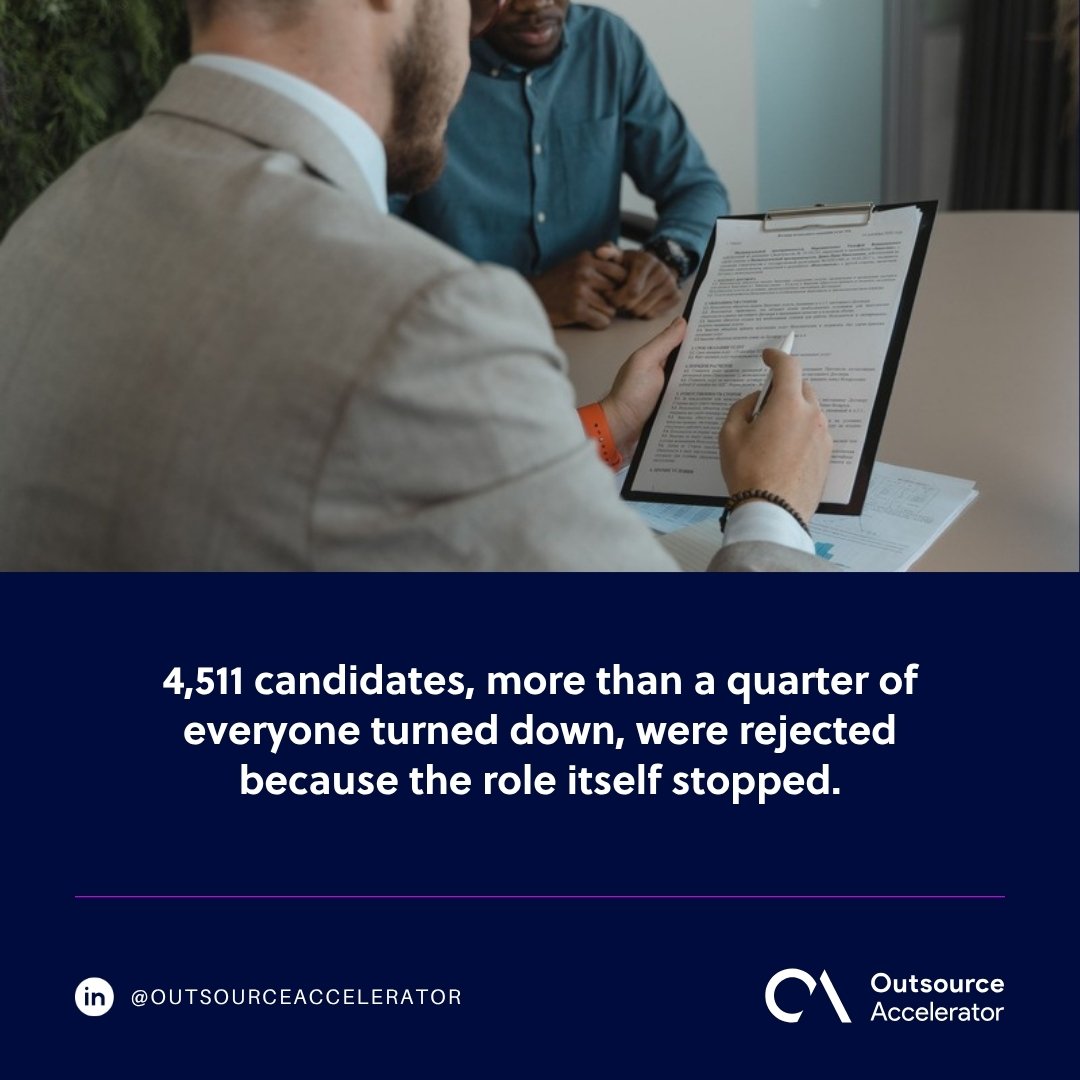
The second largest is the one worth pausing on. 4,511 candidates, more than a quarter of everyone turned down, were rejected because the role itself stopped. The client filled it another way, changed plans, or paused hiring. Nothing about the person came into it.
A separate analysis of what businesses actually outsource puts the median time to fill at 15 days, so these are not roles that sat open for a year. They closed inside a short window while good candidates were still moving through.
For anyone hiring, that number is a warning about your own process rather than about candidates. Every role you open and then freeze burns a pool of people who did the work and got nothing back.
The CV is not predicting what you think it predicts
| Reason recorded | Fluent or native English | Avg CV rating | Avg test score |
|---|---|---|---|
| Failed the skills test | 53.0% | 1.71 | 2.40 |
| Role closed or put on hold | 64.7% | 2.79 | 2.81 |
| Not enough relevant experience | 64.4% | 1.76 | 3.51 |
| Client chose someone else | 64.3% | 3.41 | 3.64 |
| Communication or role fit | 66.9% | 2.03 | 3.51 |
| Did not respond or withdrew | 63.5% | 3.57 | 3.92 |
CV rating and test score are internal five-point assessments. Not every rejected candidate has both, since a candidate rejected before the test stage has no test score.
Three things stand out in that table.
1. The skills test group is different from everyone else in every measure
Their CV rating is the lowest in the table and their declared English is well below every other group. Failing the practical assessment is not a surprise ending. It is visible in the application before the test is ever sent.
2. Experience and performance are separate things
Candidates rejected for thin experience score 1.76 on CV, almost identical to the 1.71 of those who failed the test. On the practical task they score 3.51 against 2.40. Same document, opposite outcomes. These are people who can do the work and did not have the background on paper.
That is the clearest evidence in this data for a point worth making. The CV has lost most of its predictive power. If you are screening a shortlist on background alone, you are discarding the group that scores highest when you actually watch them work.
3. The strongest candidates are the ones who leave
People who withdrew or stopped responding hold the best scores in the dataset on both measures, 3.57 on CV and 3.92 on the test. The most capable person in any applicant pool is the one with the most alternatives, and a slow process loses them first. If your hiring takes six weeks, this is the group you are paying for it with.
What the analysis looked for and did not find
Age has no relationship to rejection
Median age sits between 28 and 31 across all six categories. There is no group rejected more often and no group rejected for different reasons. In a market that talks a great deal about age in hiring, that is worth stating plainly on a sample of this size.
English explains one outcome and not the others
Across five of the six categories the share declaring fluent or native English is nearly identical, between 63% and 67%. It separates in one place only, the group that failed the practical test. A companion analysis of what declared English level predicts covers that pattern in full.
CV rating does not predict test performance
This is the finding above stated as a negative. The relationship between what a CV scored and what the person produced on the practical task is weak enough that the CV should not be treated as a forecast.
These are reported because a relationship that turns out not to exist is still a result, and because it shows which questions were asked rather than only which ones produced an answer.
What was removed from the table
A small number of recorded reasons, 564 in total, describe circumstances that are not appropriate to report as a category of hiring outcome. They are excluded from every figure above rather than folded into a group, and they represent 3.3% of the decisions in the source data.
They are flagged here as excluded rather than left to make the percentages quietly fail to add up. The published figures are calculated over the 16,308 decisions that remain.
About this data
This report describes what passes through one large offshore recruitment pipeline, not offshore recruitment as a whole. Every dataset of this kind reflects the business that produced it. The screening process behind it is built around a practical skills test tailored to each client’s role, so a rejection breakdown from a process built differently would look different. The share failing a skills test is high here partly because the process runs one.
The sample still says something real. 16,308 recorded decisions across twenty months is a substantial base, and the patterns are stable rather than driven by a short period or a single role type. But treat it as a detailed view of one large pipeline, not a measurement of the industry.
The source field holds twenty-six values, many describing the same situation in different words, consolidated here into six groups. Internal roles opened for the provider’s own team are excluded throughout, as is any pay or rate expectation data. Full methodology sits alongside the Filipino virtual assistant workforce dataset.






 Independent





