
Call center benchmark: A brief guide to call center success


What is a call center benchmark, and why does it matter?
A call center benchmark is a standard that lets a call center compare its performance against rivals or industry norms, so it can find gaps and improve.
- Benchmarks turn vague goals into clear, measurable targets.
- They show where a call center leads and where it falls behind.
- Common metrics include abandonment rate, first contact resolution, and service level.
Today, the business process outsourcing (BPO) industry’s success has led to a surge in BPO firms worldwide. As a result, these firms offer various services across many industries.
Among the best-known BPO services are call center functions. These include customer service, technical support, and other call-related work. In fact, many companies gain a lot from outsourcing customer service. So BPO firms work hard to keep their call center services top-notch and better than rivals. To do this, they often use a call center benchmark to lift their overall performance.
What is a call center benchmark?
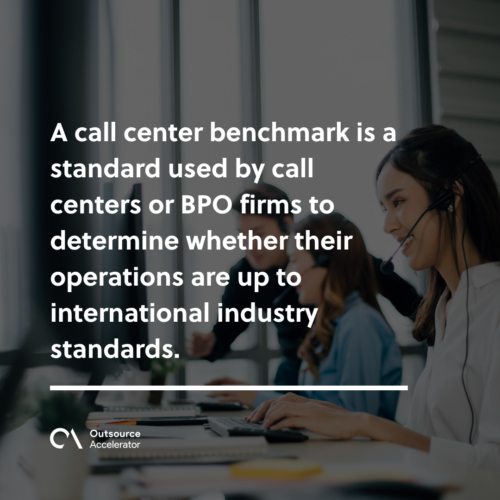
A call center benchmark is a standard used by call centers or BPO firms. In short, it shows whether their operations meet international industry standards.
These benchmarks are used in a process called call center benchmarking. Here, a call center or BPO firm compares its performance against rivals or similar firms. To do this, BPO firms use key performance indicators (KPIs) and other metrics as benchmarks[1]. As a result, they can gauge how well they fare against the competition.
2 types of call center benchmark
In short, there are two main types of benchmarks that call centers use to measure performance.
Competitive benchmarking
In competitive benchmarking, a BPO firm pits its call center performance against others in the same industry. For example, a health-industry call center compares itself with another health-industry call center.
This intra-industry comparison[2] helps call centers see how they stack up. So they learn where they excel and where they need work. More importantly, it shows them how to outperform rivals.
Process benchmarking
Meanwhile, this type compares call center processes with similar processes outside the call center industry. For example, a health-industry call center may compare its inbound call process against a financial firm, or the other way around. In this case, the process matters more than the industry itself.
Benefits of using a call center benchmark
Like all efficiency checks, call center benchmarking helps the firms that use it. So below are the main reasons call centers gain from this process.
Helps identify areas of improvement
First, by using a call center benchmark, BPO firms can spot the weakest points in their operations. Because of this peer comparison, the results stay fair and easy to assess. Some of the benchmarks BPOs can measure are:
- Complaint calls percentage
- Resolved in first call percentage
- Average sale value of calls
- Agent attrition rate
- Agent productivity
- Cross-sell and up-sell rate in calls
- Customer satisfaction
- Calls that turn into sales percentage
For a deeper list of numbers to track, see these call center metrics worth watching all year.
Speeds up call center improvement efforts
Peer data on successful and failed launches can speed up a call center’s progress. In short, firms learn from what others already tried. As a result, BPO firms avoid wasting time and money on campaigns that failed elsewhere. Meanwhile, they can copy the winning strategies of other call centers and improve faster.
Serves as team motivation
BPO firms can use a strong standing against rivals to motivate staff. In addition, it shows workers that their hard work pays off. So instead of vague praise, managers can use solid data. For example, they can show how the team beat peers at similar companies. On the flip side, weak data can push the team to do better and reveal what needs work.
Call center benchmark KPIs
There are plenty of call center benchmarks that BPO firms can use. For a wider view of industry norms, these call center statistics add helpful context. However, not all benchmarks are useful or give clear insight. Below are five of the most popular and helpful call center benchmark KPIs used across industries. For a broader view, these customer service standards pair well with the numbers below.
Abandonment rate
This is the percentage of callers who hang up before an agent answers. So the abandonment rate shows how available a call center is to customers. Naturally, a less reachable call center leads to worse customer experiences.
Of course, the number varies by industry and customer type. Still, call centers with an average abandonment rate below 5% are seen as doing well.
Global abandonment rate benchmark KPI: about 9%
First contact resolution
This KPI is the percentage of callers whose issue is resolved on the first call. That means no escalation, no transfer, and no second call. Measuring first contact resolution (FCR) across industries can be hard. In addition, looking at different channels makes it more complex. However, a strong FCR is a sure way to lift other KPIs too.
Global FCR benchmark KPI: about 70%
Service level
Service level is arguably the oldest call center benchmark. Even so, there is no single industry standard for it. Service level needs to fit each industry, and one fixed standard could hurt process improvement. However, this KPI is still widely used, so it earns a place on this shortlist. A strong service culture also supports call center coaching and lower agent turnover.
Global service level benchmark KPI: 80% of calls answered within 20 seconds
Frequently asked questions about call center benchmarks
What is call center benchmarking?
Call center benchmarking is the practice of comparing performance against rivals or industry norms. In short, it uses KPIs to show where a call center leads and where it lags. As a result, teams know exactly what to improve.
What are the most important call center KPIs?
The top KPIs include abandonment rate, first contact resolution, and service level. In addition, many firms track customer satisfaction and agent productivity. Together, these show both speed and quality of service.
What is a good abandonment rate?
Most call centers aim for an abandonment rate below 5%. The global average sits near 9%. So a lower number usually means better access for customers.
How often should a call center benchmark its performance?
Most call centers benchmark on a regular cycle, such as monthly or quarterly. Frequent checks catch problems early. Because of this, teams can act before small issues grow.
Does industry matter when benchmarking?
Yes, industry often matters. Competitive benchmarking compares peers in the same field. However, process benchmarking looks across industries when the process matters more than the sector.
Key takeaways
- A call center benchmark compares performance against rivals or industry norms.
- It helps firms spot weak points, improve faster, and motivate their teams.
- Key KPIs include abandonment rate, first contact resolution, and service level.
- Competitive benchmarking compares peers, while process benchmarking looks across industries.
- Regular benchmarking keeps a call center sharp and ahead of the competition.
References
[1] … benchmarks in these measurements. Goncharuk, A.G. et al. (2015). “Benchmarking as a performance management method.” Polish Journal of Management Studies, 11(2), pp. 27-36. Available at: https://ideas.repec.org/a/pcz/journl/v11y2015i2p27-36.html
[2] intra-industry comparison. Cukrowski, J. & Aksen, E. (2003). “Perfect competition and intra-industry trade.” Economics Letters, 78(1), pp. 101-108. https://doi.org/10.1016/S0165-1765(02)00170-2






 Independent





