
Building a Philippines team in 2026: What has changed and what businesses need to plan for

- The Philippines remains one of the strongest offshore staffing destinations in the world, but the market has shifted — salary expectations have risen, hybrid and remote-first work is now the norm, and AI tools have changed what roles are in highest demand.
- Businesses building Philippines teams in 2026 need to plan for a more competitive talent market, more sophisticated workforce expectations, and a legal and compliance environment that has tightened around data privacy and labor practices.
- The fundamentals that made the Philippines compelling — English proficiency, Western cultural alignment, deep professional talent — haven’t changed. The execution requirements have.
- KMC Solutions provides managed staffing and flexible office solutions across Metro Manila and key Philippine cities for international businesses building teams in the Philippines.
Businesses that last built a Philippines team five or more years ago are returning to a different market. Not a worse one — the core advantages that drew them in the first place are still intact.
But the assumptions that worked in 2018 or 2020 need updating. Salary benchmarks have moved.
Workforce expectations around flexibility have been set by the pandemic years and haven’t fully retreated. And the talent competition from other international businesses has intensified.
Planning with current market reality rather than historical assumptions makes the difference between a smooth team setup and a frustrating one. For businesses just getting started, KMC’s guide to building an offshore team in the Philippines covers the foundational steps specific to the Philippine market.
What has changed in the Philippines talent market
Hiring in this region has transformed significantly over the last few years. To successfully recruit today, organizations must adapt to the new market realities:
1. Salary expectations have risen
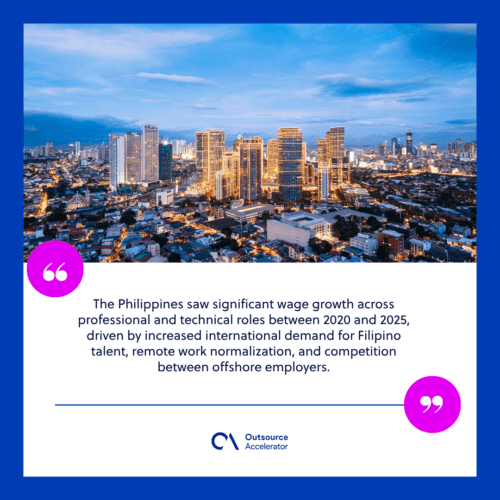
The Philippines saw significant wage growth across professional and technical roles between 2020 and 2025, driven by increased international demand for Filipino talent, remote work normalization, and competition between offshore employers.
Businesses benchmarking salaries against 2019 data will find themselves underbidding the market for experienced candidates. Current salary benchmarking against live market data — not historical ranges — is now a necessary step before advertising any role.
2. Remote and hybrid work is now an expectation
The pandemic established remote work as a viable and preferred option for a large segment of the Philippine professional workforce.
In 2026, many experienced candidates expect at least some flexibility. For businesses requiring fully on-site teams, this narrows the qualified candidate pool and extends hiring timelines compared to roles that offer hybrid arrangements.
Businesses should plan their work arrangement policies before hiring, not after.
3. AI tools have reshaped role requirements
Roles that were primarily data entry or document handling five years ago now often involve AI tool oversight, prompt refinement, or output review.
The skill profile for many back-office roles has shifted upward. Hiring for AI-adjacent capability — not just traditional task execution — produces teams that are more productive and more future-proof.
4. Data privacy compliance has tightened
The Philippines’ Data Privacy Act and its enforcement by the National Privacy Commission have become a more active compliance concern.
Using Philippine staff to manage customer data requires strict compliance. Your processes must satisfy both local privacy regulations and your home country’s laws.
What hasn’t changed — and still makes the Philippines compelling
| Factor | Status in 2026 |
|---|---|
| English language depth | Unchanged — among the strongest non-native English workforces in the world |
| Cultural alignment with Western markets | Unchanged — strong alignment with US, Australian, and UK working styles |
| Professional talent pipeline | Strong — 500,000+ university graduates per year across relevant disciplines |
| Cost advantage vs AU/US/UK | Remains significant — 50–60% below equivalent local hiring costs despite wage growth |
| BPO and professional services infrastructure | More mature — deeper talent pool for specialist roles than five years ago |
According to IBPAP data cited by the Philippine Daily Inquirer, the Philippine BPO and IT-BPM sector continues to grow, with headcount and revenue projections through 2028 remaining positive. The market is more competitive, not less viable.
For a comprehensive view of what drives the Philippines’ position as the world’s leading outsourcing destination, the Philippines outsourcing guide covers the market fundamentals in full.
And for businesses researching workforce management specifics, managing an outsourced workforce in the Philippines covers salary benchmarks and labor law considerations directly.
Planning your Philippines team setup in 2026
Building an offshore team shouldn’t feel like guesswork. By focusing on a few foundational planning pillars, your business can establish a seamless, scalable presence in the Philippines:
Decide on employment structure before you start
Building a Philippines team requires either registering a local entity or engaging a managed staffing or employer-of-record provider. Attempting to hire Philippine staff directly without either a local entity or an EOR arrangement creates legal and tax exposure.
The entity vs. managed staffing decision should be made based on team size, timeline, and long-term commitment — not deferred until the first hire is ready to start.
Budget at current market rates
Use current salary benchmarks from reputable sources, not historical ranges. Factor in statutory benefits (13th month pay, SSS, PhilHealth, Pag-IBIG), recruitment timelines of four to eight weeks for professional roles, and onboarding overhead.
Businesses that budget accurately start with realistic hiring timelines and avoid the compensation renegotiations that come from initially underbidding the market.

Structure your onboarding and communication rhythms
A successful offshore team requires active engagement rather than hand-off management. Define your training timelines, establish standardized daily or weekly syncs, and introduce clear collaboration tools to integrate your new hires into your company culture from day one.
How KMC Solutions supports Philippines team building
KMC Solutions provides managed staffing and office solutions for international businesses across Metro Manila and key Philippine cities.
Their model covers the full setup: recruitment, local employment and compliance, HR administration, and flexible office infrastructure for teams that need a physical presence.
- Managed staffing: end-to-end recruitment, employment, HR, and payroll in the Philippines
- Office solutions: flexible workspaces and managed offices across BGC, Makati, Ortigas, and beyond
- Current market salary benchmarking and role specification support
- Compliance management under Philippine labor law and data privacy requirements
- Scalable model: from first hires through large-scale team expansions
Learn more at kmc.solutions.
FAQs
How much have Philippines salaries increased since 2020?
Professional and technical roles in Metro Manila saw cumulative salary growth of 20–35% between 2020 and 2025 across most categories, with higher growth in IT, data, and AI-adjacent roles where international demand has been strongest.
Regional locations (Cebu, Davao) have seen smaller increases. Businesses should benchmark against 2025–2026 market data specifically.
Do Philippines staff need to work on-site or can they work remotely?
Both models work. Fully remote Philippine teams operate successfully for many international businesses, particularly in administrative, finance, and digital roles.
On-site teams are preferred where collaboration is important, equipment is company-provided, or data security requirements are stricter. Hybrid arrangements are increasingly common and help attract experienced candidates in a competitive market.
What’s the fastest way to legally hire staff in the Philippines as a foreign business?
Engaging a managed staffing provider or employer-of-record is the fastest route to legal employment without setting up a local entity — which can take several months.
A managed staffing model allows the first hire to start within weeks of role confirmation, with the provider holding the employment contract and handling all local compliance obligations.
Key takeaways
- Building a Philippines team in 2026 requires updated assumptions: salaries have risen, hybrid work is expected, and AI tool capability is now relevant to many back-office roles.
- The fundamental advantages remain intact: English proficiency, Western cultural alignment, deep professional talent, and a significant cost advantage over AU/US/UK hiring rates.
- Employment structure, current salary benchmarking, and data privacy compliance are the three planning decisions that most commonly catch businesses off guard.
- KMC Solutions provides managed staffing and office solutions for international businesses building teams in the Philippines, with end-to-end setup support.






 Independent





