
7 strategic approaches for global expansion and compliance in BPO


How can BPOs succeed at global expansion and compliance?
BPOs win at global expansion by pairing strong compliance with automation, flexible work models, and skilled talent.
- Global expansion works best when compliance is built into every process from the start.
- Automation, AI, and scalable systems keep teams fast and audit-ready across regions.
- The right people, tools, and partnerships turn a local BPO into a global one.
Business process outsourcing (BPO) was once a niche service. Most people linked it only to customer service and call centers. Over time, more businesses saw the value of handing tasks to a BPO. As a result, demand kept climbing.
The market is now set for new highs. In fact, it is estimated to grow at a CAGR of 9.6% all the way to 2030. Many BPOs now eye global expansion. Still, most of them need help to get there.
Enter Hubstaff’s Executive BPO Playbook. This report lays out several winning moves, backed by top industry leaders. So it gives firms clear steps to evolve their BPO models.
This article covers seven moves you can make. Each one helps your BPO stay fit for global expansion and compliance across markets.
Evolving the BPO model for global expansion and compliance
Outsourcing is here to stay, and small businesses lead the way. In fact, reports show that as much as 83% of small businesses outsource part of their work.
Still, old outsourcing models will not cut it for global growth. BPOs must evolve to match new rules and new tech. Because of this, the shift is now urgent.
This change lets firms handle the demands of global markets. Meanwhile, it also lowers the risk of falling out of compliance. To understand the wider rulebook, it helps to review how compliance works across borders. So transformative action is needed, and it is a race to see who adapts first.
The 7-point strategy for compliance-driven global expansion
Here are seven key moves that BPOs should weigh in this new outsourcing era.
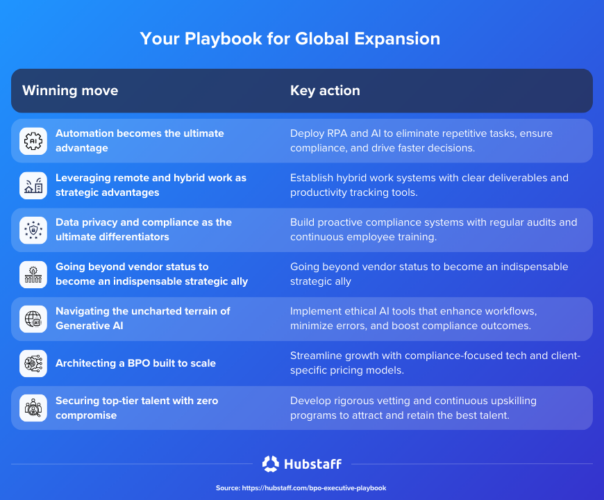
1. Incorporate automation
Automation keeps you compliant across global operations. At the same time, it makes work faster.
As part of your global expansion, get to know Robotic Process Automation (RPA) and Artificial Intelligence (AI). These tools help with compliance tasks like data checks, audit trails, and fraud detection. For a deeper primer, see this guide to how robotic process automation works.
AI tools watch workflows all day. So they flag compliance risks in real time. As a result, human error drops and you stay in line with local laws.
2. Harness the potential of new work models
Flexible work models like remote and hybrid setups are now widely accepted. So BPOs can use them with confidence.
These work styles help BPOs cut costs. Still, they keep staff productive.
Some people worry that remote work means less output. But this really points to a flaw in expectations. After all, does location matter if the work still gets done well?
So instead of counting hours, BPOs should measure results. This builds a culture of ownership. As a result, clients tend to be happier too.
Asynchronous workflows also aid in this. That matters, because global expansion means working across many time zones.
So leaders must adapt how they manage. In short, they need to build trust and give teams room to act.
3. Prioritize data privacy
Data privacy is a must for global expansion. This is doubly true for BPOs that handle sensitive client data.
First, firms must build a culture where compliance starts at the top. This way, every employee sees why data privacy matters and follows the rules.
Next, run regular training. Teach staff about data privacy laws like GDPR, CCPA, and PCI-DSS.
Of course, you cannot do it all alone. So accept that gaps exist, and hire consultants to strengthen your cybersecurity. Because of this, a solid risk management plan should sit behind every privacy control.
4. Partner with your client in new ways
BPOs must grow from plain vendors into trusted partners.
So invest time in learning how clients work. Then you can tailor your services to fit their needs. As a result, partnerships get stronger for global expansion.
In this case, it helps to focus on your client’s industry. For example, deep skill in fintech, healthcare, or legal work can set a BPO apart. In addition, fresh ideas in service delivery create real value for clients.
5. Implement generative AI
As noted, AI is the new wave, and generative AI has been embraced by BPOs.
Many BPOs report clear gains from these tools. For example, some see fewer compliance errors and faster processing once AI handles routine checks.
Still, any big change brings pushback. So if you plan to use generative AI in your global expansion, keep a few things in mind.
Implement transparency protocols. As AI tools become core to work, firms must explain how they use them. In turn, this builds trust with clients and staff.
Build AI systems with privacy embedded in their design. So put safeguards in place to protect sensitive data across the AI lifecycle.
Adopt a proactive stance on AI regulation. AI rules keep changing. So BPOs must stay informed and adjust fast. As a result, they can lead rather than follow.
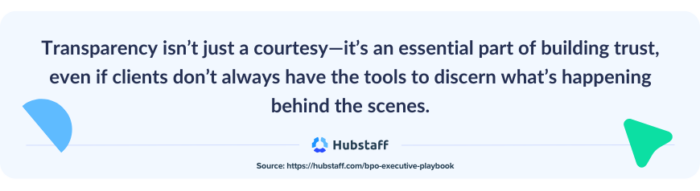
Transparency is not just a courtesy. Rather, it is a core part of building trust, even when clients cannot see what happens behind the scenes.
6. Design a scalable BPO framework
Global expansion needs scalable systems. Also, those systems must meet compliance rules in every region.
First, use platforms that help you run remote teams, such as Hubstaff. Next, invest in compliance-first tech to keep up with new rules and market shifts. It also helps to study the different offshore outsourcing models before you scale.
Overall, keep your processes flexible. So use remote and hybrid models, adjust your pricing, and test new ways to collaborate.
Scalability is the essence of growth. In short, a BPO model that cannot scale will soon fall behind.
7. Acquire top-notch talent
Finally, a BPO is nothing without its people. This is a people-first industry. So a skilled workforce keeps you competitive in global expansion.
To attract and keep top talent, build careful vetting steps. This way, you get great hires while you follow local labor laws. A strong talent base is also why the Philippine BPO industry keeps drawing global clients.
Still, finding people is not enough. You must also train and keep them. So invest in regular upskilling and employee engagement strategies.
Do not forget that diversity makes a global workforce strong. So widen your recruiting to reach a broader talent pool.
Take the next winning steps to global expansion with Hubstaff
Scaling a BPO worldwide takes a mix of compliance, new ideas, and agility. By using the points above, firms can handle complex rules while they grow in a steady way.
Hubstaff gives BPOs the tools to stay ahead of the pack.
The platform offers these benefits:
- Better visibility into productivity, so remote teams across time zones stay aligned and efficient.
- Automated reporting, so firms can adapt fast using real-time insights as they expand.
- Smooth payroll integration, so a global workforce stays well supported and motivated.
- Simple workforce management tools that improve operations and keep teams in sync.
- Peace of mind through data security and privacy, so sensitive data stays safe during global expansion.
A tool like Hubstaff lifts efficiency. In addition, it boosts engagement and helps you move into new markets with less friction.
Frequently asked questions
What is global expansion in BPO?
Global expansion means a BPO serves clients in more countries and regions. So it hires talent, sets up systems, and meets local rules in each new market. The goal is steady growth without a drop in service quality.
Why is compliance so important during global expansion?
Each country has its own data, labor, and tax rules. As a result, one mistake can bring fines or lost trust. Strong compliance keeps a BPO safe and credible as it grows.
How does automation support BPO compliance?
Automation and AI handle routine checks, audit trails, and fraud alerts. So they cut human error and flag risks in real time. In turn, teams stay audit-ready across regions.
What role does talent play in global BPO growth?
Skilled, well-trained people drive service quality. So careful hiring, upskilling, and engagement keep output high. A diverse team also helps a BPO serve many markets well.
How do you build a scalable BPO framework?
Start with flexible processes and compliance-first tech. Next, use remote and hybrid models and adjust pricing as needed. This way, the model can grow with demand instead of breaking under it.






 Independent





