
Automation and job transformation 101: the basics explained

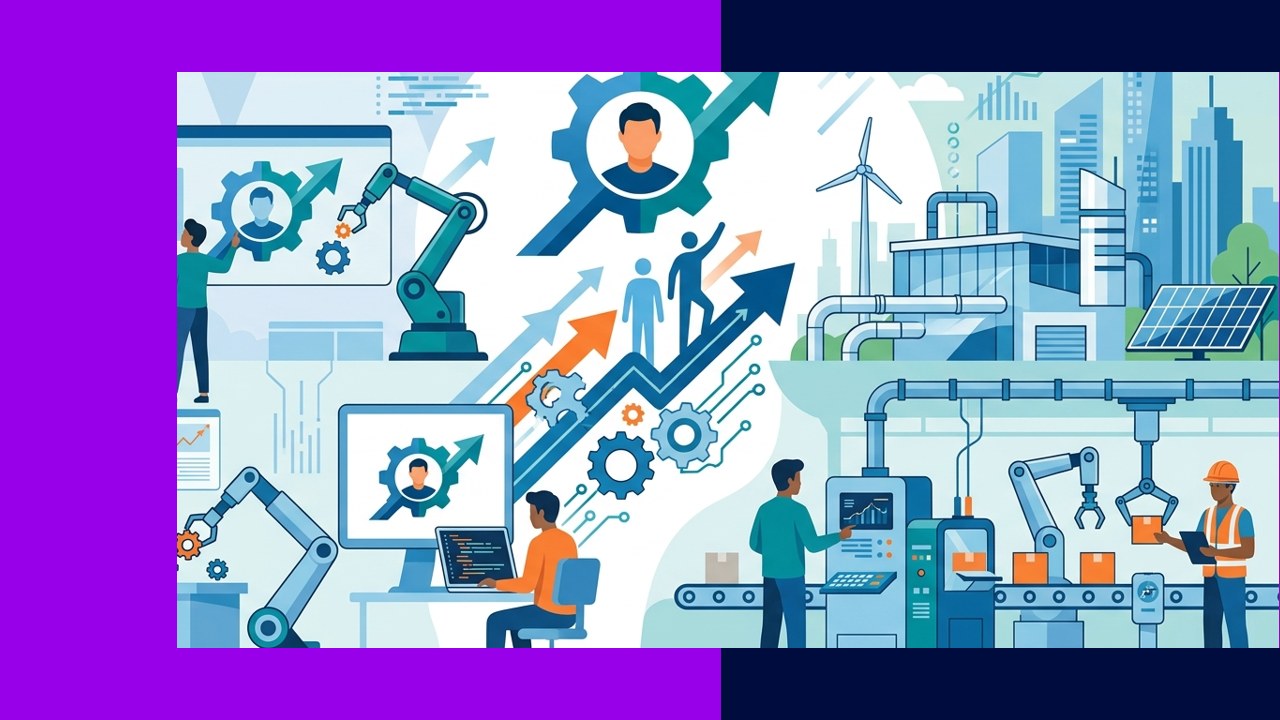
- Automation and job transformation describes how technology reshapes work by absorbing specific tasks rather than erasing whole jobs outright.
- Most roles are a mix of tasks. Automation absorbs the routine, predictable steps, while technology augments judgment, relationship, and oversight work.
- The businesses and workers that adapt best treat reskilling and role redesign as ongoing practice, not a one-time response.
Automation and job transformation is the process where software, robotics, and artificial intelligence take over parts of a job. This changes what a role does instead of simply removing it. The popular fear is mass replacement. But the evidence points to something more gradual. Tasks shift, roles change, and new work appears beside the work that disappears.
For business leaders, the practical question is not “will automation take jobs”. It is “which tasks will move, which will grow in value, and how do we prepare our people”. This explainer covers what gets automated versus augmented. It also covers the roles that emerge, the impact by function, and how organizations and workers adapt.
What automation and job transformation means
A job is a bundle of tasks. Automation rarely swallows the whole bundle at once. It picks off the parts that are repetitive, rule-based, and high-volume. What remains concentrates in areas where people still hold an edge.
That reshaping is why economists describe the effect as transformation rather than pure loss. The World Economic Forum’s Future of Jobs Report 2025 offers a useful snapshot. It projects 170 million new roles and 92 million displaced by 2030. That is a net gain of about 78 million jobs. The report also expects 39 percent of workers’ core skills to change over the same period.
Which tasks get automated, and which get augmented
The clearest way to predict transformation is to split a role into tasks. Then ask which tasks are candidates for automation and which are candidates for augmentation. Augmentation is where technology assists a person rather than replacing them.
Tools like robotic process automation handle structured, repeatable steps well. Work involving ambiguity, empathy, or accountability tends to stay with people. Those workers simply get faster support instead.
| Tasks commonly automated | Tasks commonly augmented |
|---|---|
| Data entry and reconciliation | Financial analysis and forecasting judgment |
| Invoice processing and matching | Vendor negotiation and exception handling |
| Routine ticket routing and replies | Complex customer problem resolution |
| Report generation and scheduling | Interpreting results and setting strategy |
| Screening large volumes of resumes | Interviewing and final hiring decisions |
The pattern is consistent. Automation absorbs the predictable middle of a process. The human role then moves toward the edges, where context and consequences matter.
The new roles automation creates
Transformation does not only subtract. Each wave of automation generates work to build, run, and supervise the systems themselves. It also adds roles that scale because routine costs fall.
Roles that build and maintain the tools
Automation specialists, data engineers, machine learning practitioners, and integration analysts exist for a reason. Someone has to design, connect, and fix the systems. These roles barely existed at scale two decades ago.
Roles that supervise and correct the output
Quality reviewers, exception handlers, and “human in the loop” checkers grow as automated volume grows. The more work a system does, the more it needs people. Those people catch errors and handle cases the rules never anticipated.
How automation lands across business functions
Impact is uneven. Functions heavy with structured, digital tasks feel automation first. Functions built on relationships and physical presence feel augmentation more than replacement.
Finance and back office
Bookkeeping, accounts payable, and reconciliation absorb automation quickly. The transformed role leans on analysis, controls, and exceptions rather than manual keying.
Customer support
Chatbots and routing handle common questions. Agents then shift toward complicated, emotional, or high-value cases, where resolution quality drives retention.
HR and recruitment
Sourcing and screening get automated, while interviewing, candidate experience, and workforce planning stay firmly human and grow in importance.
Reskilling and upskilling: the bridge across the change
Reskilling teaches a worker a new role, and upskilling deepens skills for a changing one. Both are how a person crosses from a shrinking task set to a growing one without leaving the workforce.
OA’s guide to upskilling and reskilling makes the case plainly. It notes that “companies that engage in staff training earn 24% more profit” than those that do not. That figure reframes training as an investment rather than a cost.
Effective programs are specific. They map the tasks leaving a role and identify the higher-value tasks arriving. Then they close the gap with targeted learning rather than generic courses.
How businesses and workers adapt
The organizations that transform well tend to redesign roles deliberately instead of laying off and hoping. They automate a task, redeploy the freed time, and measure the new work the role now owns.
The evidence supports a measured approach. A US Bureau of Labor Statistics Monthly Labor Review analysis looked at occupations often cited as automation targets. It found their trends did not consistently support fears of sweeping, near-term displacement.
For workers, adaptation means building skills automation cannot easily copy. Those skills include judgment, communication, and the ability to direct and check the tools. The point is to guide the tools rather than compete with them.
Frequently asked questions
Will automation eliminate more jobs than it creates?
Current projections point the other way over this decade. The WEF’s 2025 estimate is a net gain of roughly 78 million jobs by 2030, though the mix of roles shifts substantially, so displacement and creation happen at the same time in different parts of the economy.
What is the difference between automation and augmentation?
Automation replaces a task entirely, running it without a person. Augmentation keeps the person in the role but uses technology to make their work faster, more accurate, or higher in volume. Most jobs experience a blend of both.
Which jobs are most exposed to automation?
Roles built on repetitive, rule-based, digital tasks, such as data entry, routine processing, and high-volume screening, face the most task automation. Roles centered on judgment, care, negotiation, and physical dexterity are more likely to be augmented than replaced.
How should a business start preparing its workforce?
Begin by breaking key roles into tasks, then identify which are automatable and which will grow in value. Use that map to plan reskilling and role redesign before automation arrives, not after.
Key takeaways
- Automation transforms jobs task by task, so most roles are reshaped rather than eliminated outright.
- Routine, rule-based tasks get automated while judgment and relationship work gets augmented and rises in value.
- New roles emerge to build, run, and supervise automated systems, offsetting much of the displacement.
- Reskilling, upskilling, and deliberate role redesign are what let businesses and workers cross the transition successfully.






 Independent





