
AI privacy and security in 2026


- AI privacy has become one of the defining business risks of 2026. These risks span datasets, models, and infrastructure, making AI privacy a top concern.
- Companies must rethink how AI systems collect, process, and safeguard data.
- As demand grows for AI consulting services and AI technology consulting, privacy and governance are no longer optional add-ons. They are foundational requirements.
- Human oversight, privacy-by-design, and auditable controls help balance AI effectiveness with regulatory compliance.
- Acquire Intelligence helps companies embed privacy-aware controls, monitor regulatory obligations, and integrate governance seamlessly into AI operations.
The growing importance of AI privacy for AI consulting services
AI models rely on large datasets, often containing confidential information. Without strict privacy measures, AI systems can unintentionally:
- Leak private information from training data.
- Enable re-identification of anonymized data.
- Expose proprietary business insights or user details.
In some cases, privacy failures lead to regulatory penalties, reputational damage, and security risks. As a result, experts increasingly classify AI privacy risks across multiple dimensions, from dataset vulnerabilities to infrastructure gaps.
For AI consultants and analytics and AI consultants advising enterprise clients, privacy risk is no longer theoretical. It directly impacts procurement decisions, vendor selection, and long-term AI strategy.
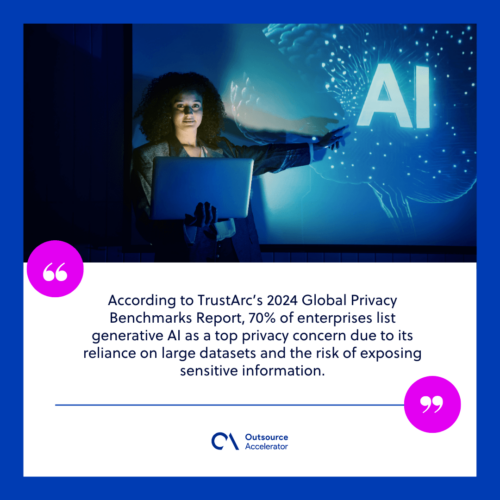
According to TrustArc’s 2024 Global Privacy Benchmarks Report, 70% of enterprises list generative AI as a top privacy concern due to its reliance on large datasets and the risk of exposing sensitive information.
Key regulations impacting AI technology consulting
Organizations seeking AI consulting services must navigate an increasingly complex regulatory landscape.
| Aspect | GDPR (EU) | HIPAA (USA) |
| Scope | Personal data of EU residents | Protected Health Information (PHI) |
| Legal Basis | Consent / legitimate interest | Covered entity / BAA |
| Key Rights | Access, correction, erasure (data subject rights) | Right to privacy and security safeguards |
| AI Obligations | Explainability, documentation, risk assessments | Encryption, access controls, audit trails |
| Enforcement | Fines up to €20M or 4% of global revenue | Civil & criminal penalties |
| Notes | Focus on automated decisions & profiling | AI must not expose PHI to non-BAA-compliant tools |
How GDPR and HIPAA shape AI privacy compliance
GDPR compliance for AI
The General Data Protection Regulation (GDPR) remains the global benchmark for data privacy and continues to influence regulations far beyond the EU.
GDPR requires:
- Lawful, fair, and transparent processing of personal data.
- Data minimization and explicit consent.
- Rights such as access, correction, and deletion.
- Impact assessments for high-risk processing.
AI systems that train on personal data must comply with GDPR principles, including new interpretations of automated decision-making and profiling.
Beyond Europe, GDPR continues to influence global policy. In Asia, regulators are introducing AI-specific legislation.
South Korea’s Basic2 AI Act, effective January 2026, establishes new obligations around training data documentation, risk classification, and explainability. This signals a broader shift toward AI-focused privacy regulation across the region.
For AI consultants delivering cross-border AI deployments, understanding regulatory overlap is critical.
HIPAA compliance in AI deployments
In the U.S., the Health Insurance Portability and Accountability Act (HIPAA) governs how Protected Health Information (PHI) is collected, stored, and shared.
HIPAA compliance for AI deployments requires:
- Formal Business Associate Agreements (BAAs) with AI vendors.
- Encryption and strict access controls for PHI.
- Audit trails and incident response procedures.
- Regular risk assessments and compliance reviews.
Failure to meet these standards can result in financial penalties, legal liability, and loss of patient trust.
What AI consulting firms recommend to stay compliant
AI privacy and security are board-level issues for any organization using artificial intelligence.
Compliance is no longer about checking a box. It’s about embedding responsible data practices into every stage of the AI lifecycle.
Leading AI consultants typically recommend:
1. Design privacy into AI from day one
Privacy must be built into product design rather than added as an afterthought.
Limit data collection to essentials, apply anonymization techniques, and ensure models cannot unintentionally reveal sensitive information.
Early incorporation of privacy concepts reduces downstream compliance costs and risk.
2. Conduct regular impact assessments
Before deploying AI systems that touch personal data, organizations should complete Data Protection Impact Assessments (DPIAs).
These structured evaluations identify potential privacy risks, clarify legal basis for processing, and document mitigation measures, especially for high-risk or automated decision-making use cases.
3. Document and track data throughout its lifecycle
Clear, auditable documentation is essential.
Organizations should maintain visibility into:
- Data sources
- Model training datasets
- Access controls
- Model updates and retraining cycles
Strong documentation supports regulatory audits and internal oversight.
4. Treat compliance as a continuous process
Privacy regulations and AI capabilities evolve rapidly. Staying compliant means ongoing monitoring of regulatory changes, periodic reassessment of risks, and continuous improvement of controls and documentation.
Done correctly, compliance becomes both a risk-management safeguard and a foundation for scalable AI adoption.
To implement these best practices, companies can leverage solutions like Acquire Intelligence.
How Acquire Intelligence helps in balancing data utility and AI privacy
Acquire Intelligence helps organizations transform AI compliance from a challenge into a competitive advantage.
Through its AI strategy, implementation, and governance services, Acquire Intelligence helps businesses:
- Embed privacy-aware controls into AI deployments from planning through execution
- Monitor regulatory obligations such as GDPR, HIPAA, and emerging AI-specific frameworks, and
- Integrate governance, documentation, and oversight into AI operations
- Align AI initiatives with board-level risk management and compliance objectives
As analytics and AI consultants, the team ensures that organizations balance innovation with responsible data use.
This approach allows leadership to unlock enterprise-grade AI value without introducing disproportionate privacy risk. It also provides boards and legal teams with the assurance required in a rapidly evolving regulatory environment.
Learn more about Acquire Intelligence’s AI solutions here.
Frequently asked questions (FAQs)
What are the main AI privacy risks in 2026?
AI privacy risks include re-identification of anonymized data, model inversion attacks that extract training data, unauthorized data use, shadow AI usage, and inadvertent disclosures through AI outputs.
How do GDPR and HIPAA affect AI deployment?
GDPR regulates personal data broadly and mandates transparency and individual rights. HIPAA focuses specifically on healthcare data (PHI), requiring security measures and formal vendor agreements.
Both directly influence how AI consultants design data pipelines, model training processes, and deployment architectures.
Can AI models be both effective and privacy‑compliant?
Yes, but with the help of strong governance, privacy-preserving techniques (e.g., differential privacy, encryption), and data minimization.
Companies can build AI systems that deliver value while remaining compliant with data protection laws.
Key takeaways
- AI privacy is a critical business risk in 2026
- GDPR, HIPAA, and emerging AI laws shape AI system design
- Compliance must be a continuous process, not a static milestone
- Responsible governance enables innovation without unnecessary risk
- Acquire Intelligence helps companies embed privacy controls and maintain compliance while unlocking AI value






 Independent





