
Why enterprises are combining AI and human support instead of replacing agents


- Enterprise investment in AI for customer support has grown significantly, but agent headcount hasn’t collapsed — because AI alone can’t handle complex, emotional, or high-stakes interactions.
- The most effective support operations use AI to handle routine tasks and human agents for everything that requires judgment, empathy, or accountability.
- The real efficiency gain from AI in support isn’t replacement — it’s making human agents faster, better informed, and more focused on high-value interactions.
- ContactPoint360 builds AI-integrated enterprise support operations designed around this hybrid model.
A few years ago, the prediction was clear: AI would automate customer support, and agents would become redundant. That hasn’t happened.
Enterprise support teams are still growing, but how they work has changed. The shift isn’t from humans to AI. It’s to humans working alongside AI, each handling what they’re actually good at.
Gartner research shows that 85% of customer service leaders planned to pilot customer-facing generative AI in 2025. However, Gartner later found that 95% of those leaders plan to retain human agents, specifically to manage interactions that AI handles poorly.
For enterprises, the hybrid model isn’t a compromise. It’s the approach that consistently outperforms both ends of the spectrum.
Why AI alone isn’t enough for enterprise support
So where does AI lack?
Complex interactions require human judgment
AI handles predictable queries well. It struggles with ambiguity: a complaint that spans multiple issues, a request that doesn’t fit a standard category, or a situation where the technically correct answer isn’t the right one.
These interactions don’t fail because AI is unintelligent. They fail because good judgment in customer support requires context, inference, and the ability to make exceptions.
These are capabilities that generative and rule-based AI systems both handle poorly at the edge cases that matter most.
Customers still want a human when it matters
Customer tolerance for AI in support is real but conditional. Most customers accept chatbots for simple tasks: checking a balance, tracking a delivery, resetting a password.
When a problem is complex, financially significant, or emotionally charged, the same customers want to speak with a person.
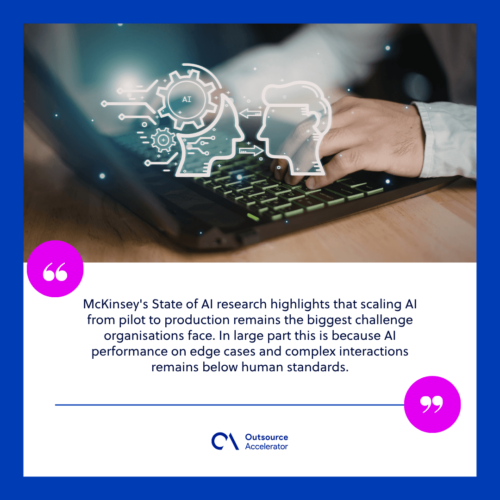
McKinsey’s State of AI research highlights that scaling AI from pilot to production remains the biggest challenge organisations face. In large part this is because AI performance on edge cases and complex interactions remains below human standards.
The cost of a failed automated interaction with a high-value customer rarely shows up in average handle time metrics, but it shows up in churn.
Compliance and accountability require human oversight
In regulated industries — banking, insurance, healthcare — many interactions require a human agent on record for compliance reasons. AI can assist with those interactions, but it cannot own the accountability that comes with them.
Enterprises in regulated sectors cannot fully automate interactions that carry legal or regulatory weight, regardless of how capable the AI becomes.
What enterprises are actually doing with AI in support
The reality looks different from the “AI replaces agents” prediction. Enterprises are deploying AI to reduce the time agents spend on low-value, repetitive work — not to eliminate agents.
Gartner predicts that agentic AI will autonomously resolve 80% of common customer service issues without human intervention by 2029 — but the operative word is “common.”
The complex interactions that define customer loyalty are precisely where human agents become more valuable, not less.
| “AI replaces agents” model | “AI + human” hybrid model | |
|---|---|---|
| Routine queries | Fully automated | AI-handled, with human fallback |
| Complex queries | Escalated awkwardly | Human-led from the first contact |
| Agent role | Diminished or eliminated | Elevated — focused on higher-value interactions |
| CSAT on complex issues | Lower | Higher |
| Cost efficiency | High risk of churn offsetting savings | Optimised — automation where it works |
| Agent retention | Low — repetitive, high-pressure | Higher — more meaningful work |
What a hybrid AI and human support model looks like in practice
Consider aiming for this model:
AI for Tier 1: Triage, routing, and routine resolution
Chatbots and AI tools handle FAQs, account lookups, order status enquiries, and other predictable queries. Intent detection routes incoming contacts to the right queue before a human touches them.
This is where AI genuinely saves time and reduces cost. AI absorbs the high volume of routine contacts, freeing agents to focus their capacity on more complex work.
Human agents for Tier 2 and Tier 3: Judgment and resolution
Complex complaints, escalated cases, technical issues, and any interaction where the customer’s emotional state is a material factor belong with human agents. These interactions determine customer loyalty far more than Tier 1 volume.
A company that gets AI right on simple queries but gets a human wrong on a critical complaint has solved the wrong problem.
AI-assisted agents: Where the real efficiency gains are
The most significant impact of AI in enterprise support isn’t replacing agents — it’s making agents better.
Real-time knowledge surfacing, suggested responses, sentiment detection, and post-call summarisation all cut average handling time. The human stays in the interaction throughout.
An agent working with AI assistance resolves more cases, more accurately, with less cognitive load. That’s where the compound efficiency gain comes from, and it’s what separates mature AI implementations from pilots that stall after the first cost analysis.
How ContactPoint 360 builds AI-integrated enterprise support operations
ContactPoint 360 builds enterprise support operations that use AI and human agents where each performs best. Their approach combines the operational discipline needed to manage complex, high-volume support environments with the technology integration required to deliver genuine AI-human collaboration.
For enterprise clients, ContactPoint360 designs support models where AI handles the predictable and humans own the consequential — with the governance and performance frameworks to measure both.
The result is an operation that delivers on efficiency and customer experience, rather than trading one for the other.
Find out more at contactpoint360.com.
FAQs
Will AI eventually replace human customer support agents entirely?
Not in any timeframe relevant to enterprise planning. The interactions that drive customer loyalty, like complex complaints, sensitive issues, high-value escalations, are the ones AI handles the worst.
Demand for skilled human agents on complex work is likely to grow as AI absorbs Tier 1 volume.
What types of interactions should always be handled by a human agent?
High-emotion complaints, financial or legal decisions, exception handling, failed AI escalations, and any interaction requiring a human on record for compliance. These categories carry the highest commercial stakes.
How does AI-assisted support differ from fully automated support?
Fully automated support runs end-to-end on AI. AI-assisted support keeps a human in the interaction while AI surfaces knowledge, suggests responses, and handles post-call admin.
The experience stays human; the agent gets faster.
How do enterprises measure the success of a hybrid AI and human support model?
CSAT on high-complexity interactions is the indicator that matters most. That’s where hybrid models either justify the investment or reveal AI has been applied to the wrong problem.
Key takeaways
- AI is most effective in enterprise support when it handles Tier 1 volume and assists human agents — not when it operates as a replacement for them.
- Complex, emotional, and compliance-sensitive interactions consistently perform better with human agents, and those interactions carry the most commercial weight.
- AI-assisted agents, real-time knowledge surfacing, and post-call summarisation deliver the biggest efficiency gains in hybrid support models.
- ContactPoint360 builds enterprise support operations designed around AI and human agents working together, each focused on what they do best.






 Independent





