
Five levels of remote work: How your team can transition to remote work more easily


What are the five levels of remote work?
The five levels of remote work, framed by Matt Mullenweg and discussed by Time Doctor and Running Remote co-founder Liam Martin, describe a company’s journey from no remote-friendly effort up to Nirvana, where a distributed team outperforms any traditional office.
- The levels build like Maslow’s hierarchy, from Level Zero in-person work up to Level Five.
- Asynchronous management is the key methodology that moves teams up the levels.
- The goal is more productive, autonomous teams that also look after employee welfare.
Remote work does not simply happen overnight. Like running a business, remote working takes time and effort to master and make it work for companies.
Indeed, the transition to remote work could be chaotic and stressful, especially in the first weeks. Even now, some companies struggle to make this setup work for them, especially when they are already used to the traditional office setting.
However, the pandemic proved that having a distributed team is possible when you navigate it properly.
Liam Martin, the co-founder of Time Doctor and Running Remote, takes a peak at the five levels of remote work and how asynchronous management contributes to the transition to remote work in episode 403 of the Outsource Accelerator podcast.
Five levels of remote work
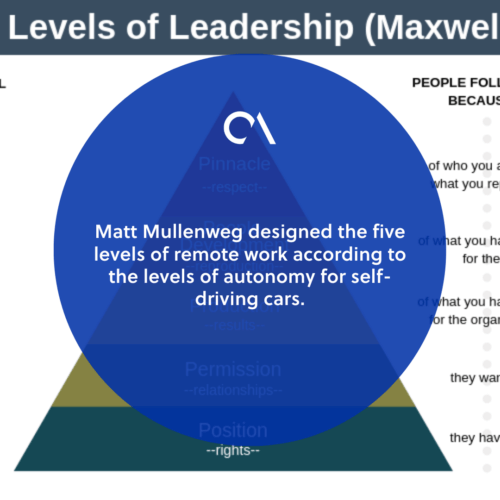
Matt Mullenweg designed the five levels of remote work according to the levels of autonomy for self-driving cars. He created this to make sense of a remote company’s journey from scratch.
As Derek and Liam agree, these levels work “almost like [the] Maslow’s Hierarchy of Needs… [where companies] start at the bottom then progress to the top.” Liam delves into this topic through the book Running Remote.
It usually starts with Level Zero, where most jobs cannot be done without the physical presence of employees. Construction workers, baristas, and other related work are included in this level.
Level one – not making things remote-friendly
Most companies, especially traditional ones, undergo the first level where they exert no effort in making things remote-friendly.
Most processes are put off until everyone is back in the office.
This level is where most employees use basic laptops, internet connections, and other resources at home to do basic workloads.
Level two – recreating offices in a remote setting
In level two, companies slowly start to realize that work will happen outside the office for a while. This is where companies will start to replicate their work in a remote setting.
At the same time, they have slowly adapted to online tools and virtual communication.
Level three – reaping the benefits of remote work
After a while, organizations will start to reap the benefits of a remote environment. This will lead them to invest in better equipment and tools to improve their processes.
Level four – asynchronous management
Level four is where businesses let their employees design their own ways of remote work.
As Liam observes, asynchronous management is a “big key that [he] realized” as he studied remote founders and operators.
Level five – Nirvana
Once an organization attains Nirvana, it means they are already performing better than any organization with a traditional office setting. This also indicates that they take care of their employees’ welfare better.
Why asynchronous management is crucial for remote work
While there are different ways to run a business, Liam emphasized that asynchronous management is “the biggest methodology that remote companies use to build their businesses pre-pandemic.” It is also “a forcing function from the early days of remote work.”
Liam does not see asynchronous work as a “black-and-white issue” for organizations. Rather, through this method, businesses can optimize more people by reallocating extra hours of meetings to doing “deep work.”
What’s more, asynchronous management can even help in keeping the new generation of hires engaged and disciplined at work.
Per Liam, mentorship is “a fantastic opportunity to craft [an established] network and develop [teams] that will hopefully get your career moving faster than [in a traditional office].”
Asynchronous remote companies have different approaches to mentorship for their employees.
Time Doctor and Running Remote as advocates for remote work
Time Doctor and Running Remote’s mission is to “empower the world’s transition toward remote work.”
Both companies iterate the importance of their mission statement to their employees, making it their core purpose of working. Like the leadership team, their workers are passionate about accomplishing their tasks and making the organizations’ visions come to fruition.
With 140 employees in 40 countries, Time Doctor manages to work as one in helping remote and traditional businesses manage their teams more flexibly.
Meanwhile, Running Remote teaches businesses how they can become more asynchronous and optimize their productivity.
The Running Remote conference takes place annually, with its upcoming edition to be held in Lisbon in 2023. Its similarly-titled book is available through https://www.runningremotebook.com/.
Frequently asked questions about the five levels of remote work
Who created the five levels of remote work?
Matt Mullenweg designed the five levels of remote work, modeling them on the levels of autonomy for self-driving cars to make sense of a remote company’s journey from scratch.
What is asynchronous management?
Asynchronous management lets employees design their own ways of working and reallocates hours that would go to meetings into deep work. Liam Martin calls it the biggest methodology remote companies used to build their businesses pre-pandemic.
What happens at Level Five, or Nirvana?
At Nirvana, an organization performs better than any organization with a traditional office setting and takes better care of its employees’ welfare.
How can asynchronous work help newer hires?
It helps keep the new generation of hires engaged and disciplined, and mentorship becomes an opportunity to build a network and move careers forward faster than in a traditional office.
What do Time Doctor and Running Remote do?
Their shared mission is to empower the world’s transition toward remote work. Time Doctor, with 140 employees in 40 countries, helps businesses manage teams flexibly, while Running Remote teaches businesses to become more asynchronous and productive.






 Independent






