
Why Australia is outsourcing to the Philippines


The Philippines has become a top outsourcing destination in the global market. It sits between eastern and western time zones, which makes it an easy entry point into Asia. Many firms worldwide, and Australian firms in particular, now outsource work here.
Why is Australia outsourcing to the Philippines?
Australia outsources to the Philippines for its shared language, low labor costs, skilled workers, and small time gap.
- Filipinos speak fluent English with a neutral accent.
- Labor costs run well below Australian rates.
- The two countries sit just two to three hours apart.
Factors to consider when you outsource to the Philippines
Here is a look at why Australian firms should keep the Philippines on their radar when they plan an offshore strategy.
No cultural barriers
Cross-cultural gaps often show up in outsourcing. This is common in an “east meets west” setup. The provider’s technical skill is rarely in doubt. Still, some firms worry about language and culture.
English fluency is key to good teamwork. Voice work also needs a clear, easy-to-follow accent. Providers invest in accent training, yet small gaps can creep in. The good news is that English and Filipino are both official languages here. So locals speak fluent English with a neutral accent.
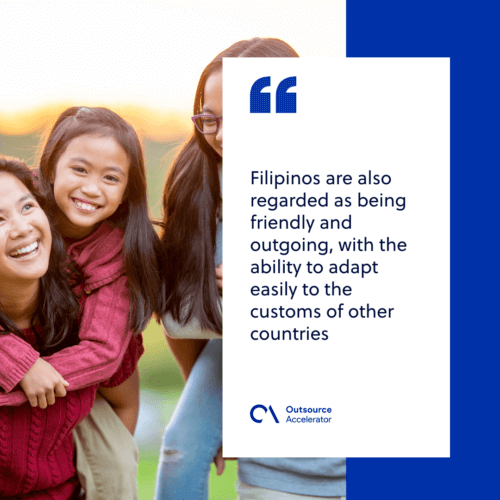
The country was once a Spanish and an American colony. As a result, many western customs blend into daily life. Filipinos are also known as warm and friendly. They adapt easily to other cultures. Because of this, they work well with free-spirited, achievement-focused Australians.
Good rapport drives a healthy client-provider bond. It also helps you get the best out of a Filipino team. So managers spend less time smoothing over communication. Instead, they focus on the technical and creative work.
A small time difference
Australia is about two to three hours ahead of the Philippines. So clients and offshore teams work together with ease. Neither side needs late-night or early shifts.
This helps most on time-sensitive projects. Team members can sign off on tasks without delay. When the gap tops five hours, one side must adjust. Here, though, that is rarely a problem. In addition, the flight from Australia takes under 6.5 hours.
Short travel also saves time on in-person training and meetings. Firms avoid the hassle of long-haul trips. As a result, managers face far less jet lag on frequent visits.
Skilled labor
The Philippines has a high literacy rate. Its Commission on Higher Education counts over 2,300 higher-education institutions. About 71% sit in the private sector. The rest are public or state and local colleges. Post-secondary enrollment runs into the millions and keeps rising.
As noted, Filipinos are fluent in English. They gain this edge early at school. English and Filipino are taught from the first grade, with a focus on speaking. From grades 4 and 6, they become languages of instruction. So by grade 6, most subjects use them.
The K-12 basic education program aims to build well-rounded learners with modern skills. As a result, graduates are more ready for work or study. For Australian firms, this means a deep pool of offshore staffing talent. As supply grows, so does the chance to pick the best people.

Employment rate
IT-BPO has driven the economy for years. Today the sector earns over $40 billion a year. The IT and Business Process Association of the Philippines (IBPAP) keeps investing in worker training. Its focus is IT and business process outsourcing. The sector now employs around 1.9 million people. To see the wider picture, look at the state of the Philippine BPO industry.
Cost competitiveness
On labor costs, the Philippines is among the most competitive in ASEAN. According to Willis Towers Watson’s 2015-2016 Global 50 Remuneration Planning Report, its low labor costs beat mainland China. The gap is clearest in professional and mid-management roles. In China, average base pay can run up to 2.2 times higher.
Wages in Hong Kong, Taiwan, and South Korea have climbed over the years. Meanwhile, labor supply there has fallen. So many foreign firms look elsewhere. The Philippines has gained from this shift.
Take a call center outsourcing setup as an example. Costs depend on the hourly rate, staff numbers, and performance pay. Across all these factors, the Philippines costs less than a worker in Melbourne or Sydney.
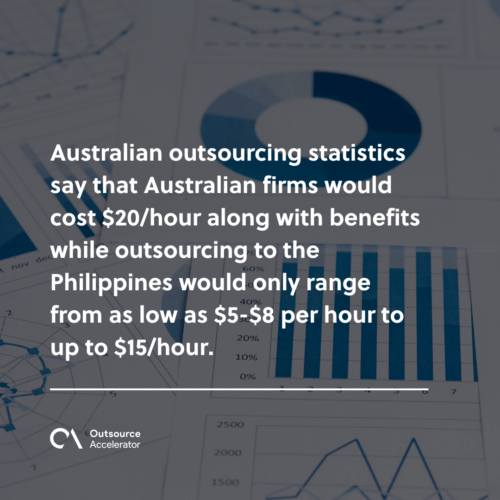
Australian outsourcing figures show local staff can cost about $20 an hour with benefits. In the Philippines, rates often run from $5 to $15 an hour. These numbers shift with experience. As with any offshore deal, firms can also negotiate lower prices.
Outsourced Global specialises in helping Australian businesses build offshore teams in the Philippines, managing recruitment, compliance, and infrastructure so clients can focus on directing the work rather than setting up local operations.
Improving ICT infrastructure and skills
According to financial group Nomura, the Philippines has lagged on infrastructure quality. Still, it has climbed the rankings over the years. So this points to steady gains in ICT.
The Filipino population is tech-savvy. Internet use has grown fast and now reaches most homes. The country also leads the world in social media use. These habits span all income levels.
A digital-first workforce is a big draw for employers. Early tech use makes people job-ready. As a result, firms spend less time on basic training. Government and industry groups have also funded skills programs. Examples include game programming, 3D animation, and web design.
Top providers in Special Economic Zones enjoy tax breaks too. So they can invest more in IT and training. Given this momentum, the workforce should keep updating its skills. This covers cloud computing, business intelligence, data analytics, fintech, and app development. Firms can also tap freelancers and startups with niche expertise.
Australian outsourcing statistics
IBISWorld tracks the Australian BPO market. Its recent data puts the sector at about $49.6 billion in 2024-25. Demand stays steady as firms look to control costs. So many still move work to cheaper providers overseas.
The reasons above are just some of the many drivers behind this trend. In short, outsourcing lets firms hand off the roles and tasks they need. It also supports the sector’s growth. Most of all, it helps you tap the benefits of outsourcing while you meet daily business needs. For a full primer, see this guide to outsourcing to the Philippines.
Australia outsourcing to the Philippines FAQs
Why do Australian companies outsource to the Philippines?
They gain lower labor costs and strong English skills. The small time gap also helps teams work in sync. Together, these factors make the Philippines a natural fit.
How much can Australian firms save by outsourcing to the Philippines?
Savings vary by role and skill level. Local staff can cost about $20 an hour with benefits. Meanwhile, rates in the Philippines often run from $5 to $15 an hour.
What is the time difference between Australia and the Philippines?
Australia sits about two to three hours ahead of the Philippines. So both teams can work through the same core hours. As a result, communication stays quick and simple.
What roles do Australian firms outsource to the Philippines?
Common roles include customer support, IT, finance, and admin work. Many firms also outsource creative and technical tasks. The deep talent pool makes hiring easier.
Is outsourcing to the Philippines safe for small businesses?
Yes, many small firms outsource here with success. First, start with a clear scope and a trusted provider. Then scale the team as your needs grow.






 Independent






