
What is employee engagement?


What is employee engagement?
Employee engagement is how committed, motivated, and emotionally invested your people feel about their work and your company.
In short, engaged staff care about results. They show up, share ideas, and tend to stay longer. Here is what strong employee engagement looks like day to day:
- People feel tied to the company’s goals and values.
- Staff put real effort into tasks, not just the bare minimum.
- Teams talk openly and back each other up.
Employee engagement also means gauging how passionate your people are about their work. It is one of the most important factors in a healthy workplace. As a result, it should be a steady, ongoing effort, not a one-off survey.
Some companies use employee satisfaction in place of engagement. However, this can be counterproductive. Almost everyone sits at a different level of satisfaction, so it is a weak proxy for true commitment. For a wider view of how people feel at work, it also helps to track the full employee experience across their time with you.
How to increase employee engagement
When you work to lift morale, know that the real results will not come overnight. People need time to process and absorb any changes you make. So patience matters here.
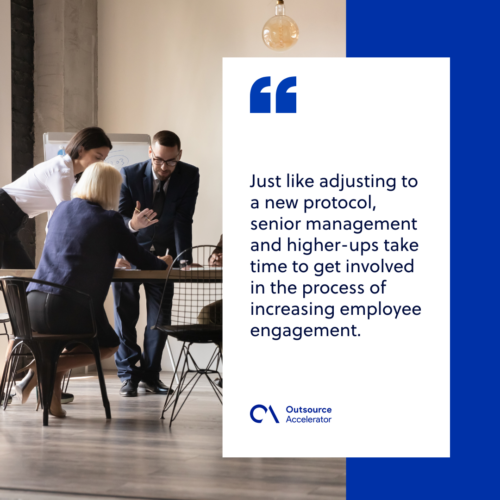
Just like adjusting to a new protocol, senior leaders also take time to get involved. Still, their buy-in drives the whole effort, so bring them in early.
Empathy in the workplace
Empathy plays a big role in keeping your employees engaged in their roles. At work, people may mirror their day-to-day, out-of-office personality. Because of this, it helps when empathy is a clear, deliberate choice for everyone.
Clear and transparent communication
Day in and day out, workplaces cannot thrive without open communication. Good news or bad, employees have the right to stay informed. So managers should set up a clear channel for updates. This matters even more in remote setups.
Genuine feedback and professional opinions
The best people grow with honest, well-meant feedback about their work. These are the staff who love to learn and grow with the company. In addition, candid feedback is what makes an employee more engaged over time. Pairing it with motivational rewards for employees keeps that momentum going.
You can also get professional opinions from firms that give businesses efficient performance management, like Booth.
This firm offers managed services around employee engagement activities, which shows a real commitment to each client’s growth. As a result, it can help you design a plan of activities that make your employees more engaged and satisfied at work.
Personal and career growth
Some people treat a company as a stepping stone for their careers. Be sure to encourage this kind of growth. After all, more and more people get burned out after years in the same role. For teams spread across locations, a few simple remote employee recognition ideas can keep that growth visible and rewarded.
Employee engagement ideas
A simple growth plan and a positive break from routine can boost morale at work. Work does not have to feel like work. This is especially true when an employee is engaged and happy with their tasks.
Avoiding the workday slump
Ever heard Wednesday called a hump day? It is a word for staff just waiting for the week to end. Of course, on a smaller scale, there are days when people would rather go home right after their break.
So avoid the slump with group lunches, flexible work arrangements, and other fun activities. Think about the setting your team thrives in, then use that to your advantage.
Celebrate the people and their achievements
Working with different people means everyone moves at their own pace. Some reach the goal faster, while others take their time. Either way, celebrate the people, their milestones, and their process.
Be attentive and motivate your team
“Be a leader, not a boss.” There are many versions of that line, yet it still rings true. An attentive leader makes sure staff feel engaged and satisfied at every point of their work. As a result, small adjustments get made when needed. Attentive leadership is also one of the clearest fixes for employee retention problems.
Top three employee engagement software
With many teams now working from home, staying connected with colleagues can feel like a chore. So bring back the sense of camaraderie and accountability with these employee engagement apps.
When you use these tools, remember they are not for micromanagement. Instead, they simply help hold your employees accountable for their tasks. For a wider toolkit, it also helps to compare employee productivity apps that keep remote work on track.
Tip: Need to spice up the week? Try remote team-building games. Set up a prize for the winners and have fun before the week ends.
15Five Continuous Performance Management
15Five is a people-first performance tool. It helps managers lead better, workers stay engaged, and companies perform well. For example, you can schedule one-on-ones and track progress, which helps employees improve.
Lattice Performance Management
With Lattice, managers can trade regular feedback, run one-on-ones, set goals, survey staff, and build clear paths for growth.
The platform also nudges teams to celebrate goals and progress. In addition, positive feedback gives everyone a real morale boost.
Fond
Fond is a Software-as-a-Service platform that rewards employees for a job well done. Staff and managers can recognize each other, redeem rewards, unlock company discounts, and track wins. As a result, HR teams can focus on driving results rather than running programs.
Most companies run engagement surveys at least once a year, yet many do nothing useful with the results. So drive your team with positive reinforcement and real change instead. This is one of the best ways to keep people engaged.
As an employer, it is your job to listen and act on survey results. At the very least, acknowledging them is a step in the right direction.
Partner with Outsourced Global today to access top-tier remote talent and boost your team’s productivity and collaboration.
Frequently asked questions about employee engagement
What is the difference between employee engagement and employee satisfaction?
Satisfaction measures how content someone feels in their job right now. Engagement goes deeper. It measures emotional commitment and the drive to help the company succeed. So a happy employee is not always an engaged one.
How do you measure employee engagement?
Most teams use short pulse surveys, one-on-ones, and simple metrics like retention and absenteeism. However, the numbers only help if you act on them. For the best read, combine survey data with honest manager conversations.
Why does employee engagement matter for business results?
Engaged staff work harder, stay longer, and serve customers better. As a result, companies with high engagement often see lower turnover and stronger output. In short, engagement protects both morale and the bottom line.
How often should you run engagement activities?
Engagement works best as a steady habit, not a yearly event. So mix quick weekly check-ins with larger quarterly reviews. This keeps feedback fresh and shows staff that you are listening.
Can remote teams stay engaged?
Yes, remote teams can be highly engaged with the right support. For example, clear communication, regular recognition, and the right apps all help. Still, leaders must be intentional, since casual office moments happen less often.






 Independent






