
About CREATE Tax Law: Its impact on the Philippines, businesses and the outsourcing industry


What is the impact of the CREATE tax law?
The impact of the CREATE tax law is a lower corporate income tax and a modern incentive system that makes the Philippines more competitive for investors.
- It cut corporate income tax from 30% to 25%, and to 20% for many small firms.
- It aimed to attract more foreign investment and create jobs.
- A 2024 update, CREATE MORE, refined the incentives even further.
After almost a year of waiting, President Rodrigo Duterte finally signed the Comprehensive Recovery and Tax Incentives for Enterprises (CREATE) bill into law. CREATE is also known as Republic Act (RA) 11534. In short, it set stimulus measures to help the economy recover and grow.
The CREATE Law slashed a big chunk of corporate income taxes. So lawmakers hoped it would attract more foreign investment.
What is the CREATE tax law (Republic Act (RA) 11534)?
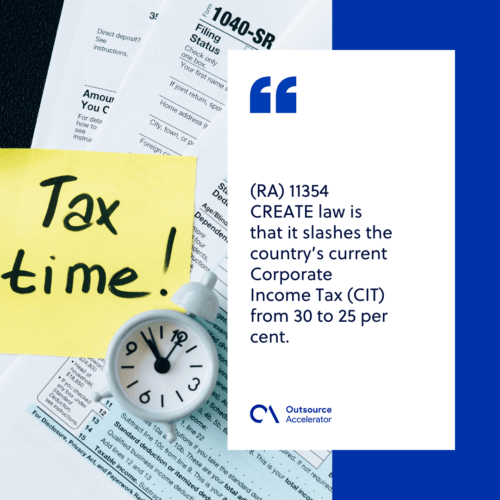
The main selling point of RA 11534 is simple. First, it cut the Corporate Income Tax (CIT) from 30 to 25 per cent. In addition, small domestic firms got a bigger break. For those with taxable income of PHP5 million and below, and total assets of no more than PHP100 million, the CIT dropped from 30 to 20 per cent.
The lower rate was retroactive to July 1, 2020. However, the law itself took effect on April 11, 2021.
Because the 25% CIT was retroactive, Atty. Alex Cabrera of PwC Philippines said an effective tax rate of 27.5 per cent should be applied to a company’s taxable income in 2020.
Key provisions of the CREATE bill
Here are some of the key provisions of the law. For reference, a PwC summary of current corporate income tax rates in the Philippines lays out the numbers:
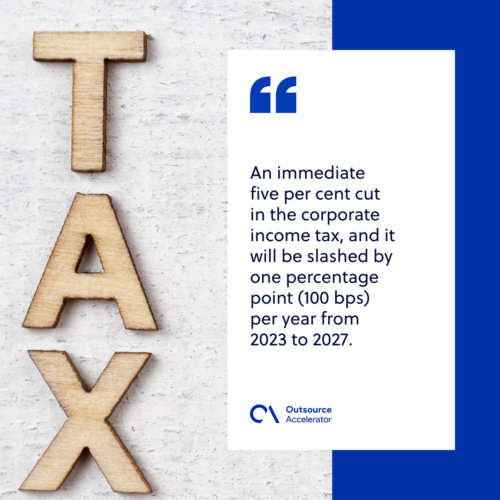
- The CIT dropped right away from 30 to 25 per cent. In addition, qualifying small domestic firms pay just 20 per cent.
- The Minimum Corporate Income Tax also fell from 2 to 1 per cent for a set period.
- Registered businesses can enjoy incentives for long periods, in some cases up to many years.
- The Board can add non-fiscal support beyond tax breaks. For example, it can offer help with logistics, product testing, training, and shared service facilities.
The president then approves these extra incentives. So qualified firms can access them for longer when needed.
How can CREATE Law improve the Philippine economy?
Lawmakers and officials were upbeat about the law’s likely impact. So they expected clear gains for local business.
For example, DOF Secretary Carlos Dominguez III said the law “will right away benefit Micro, Small, and Medium Enterprises (MSMEs).”
The DOF estimated that lower taxes would reduce government revenue by around P37 billion in the second half of 2021. However, officials framed this as an investment. In turn, the savings could fund MSME operations and help firms keep staff.
For the following five years, the DOF estimated about P476.8 billion in foregone taxes. Meanwhile, the goal stayed the same: attract more investors to the Philippines. As a result, the combined savings were expected to create new jobs for Filipino workers. Strong incentive zones, like those under PEZA incentives, support that same goal.
“In the long run, savings from the reduction in CIT rates will provide enterprises with more resources to re-invest in their businesses or expand their operations and thus create more jobs,” said Dominguez.
CREATE Law (Republic Act (RA) 11534) and the Philippine outsourcing industry
The Business Process Outsourcing (BPO) industry stayed a counter-cyclical sector. So it took only relatively minor damage during a hard economic stretch.
However, the sector still needs support to play its role well. After all, it is one of the main pillars of the country’s economy. The health of the Philippines BPO industry is closely tied to the wider Philippine economy.
The CREATE Law brought the country’s corporate tax rate closer to its neighbors. For example, regional competitors like Vietnam, Indonesia, and Singapore have long kept competitive corporate tax rates. So the reform helped the Philippines compete for the same investors.
According to Acting Socioeconomic Planning Secretary Karl Kendrick Chua, the law put the country in a “better position to compete for investments.” In his words, it “enhances our fiscal incentives system to help attract more foreign direct investments (FDIs), which will help generate more jobs.” Later trade deals, such as RCEP, added to that push.
Where the CREATE Law stands now
The reform did not stop with the 2021 law. In November 2024, the government signed the CREATE MORE Act (RA 12066). So it built directly on the original CREATE framework.
CREATE MORE refined the incentive system and clarified the rules for registered business enterprises. For example, it improved incentive packages and eased some VAT conditions. As a result, the Philippines aimed to stay attractive to both local and foreign investors. Firms should still track key deadlines, so this guide on when corporate taxes are due can help.
Frequently asked questions
What is the CREATE tax law?
CREATE is Republic Act 11534, signed in 2021. In short, it cut the corporate income tax and updated tax incentives. So it aimed to help the economy recover and grow.
How much did CREATE cut corporate income tax?
It lowered the corporate income tax from 30 to 25 per cent. In addition, many small domestic firms now pay only 20 per cent. So most companies saw a real tax break.
How does CREATE affect the BPO industry?
Lower taxes and stronger incentives help attract investment. As a result, the BPO sector gains more room to grow. In turn, that supports jobs across the Philippines.
What is CREATE MORE?
CREATE MORE is RA 12066, signed in November 2024. It amends and improves the original CREATE Act. So it further refined incentives for registered enterprises.
Key takeaways
- The CREATE Law (RA 11534) cut corporate income tax from 30% to 25%, and to 20% for many small firms.
- It aimed to attract foreign investment and create jobs.
- It made the Philippines more competitive with its regional neighbors.
- The BPO industry stands to gain from lower taxes and stronger incentives.
- CREATE MORE (2024) built on the law and refined the incentive system.






 Independent





