
Mexico vs Philippines for nearshore support: A comparison

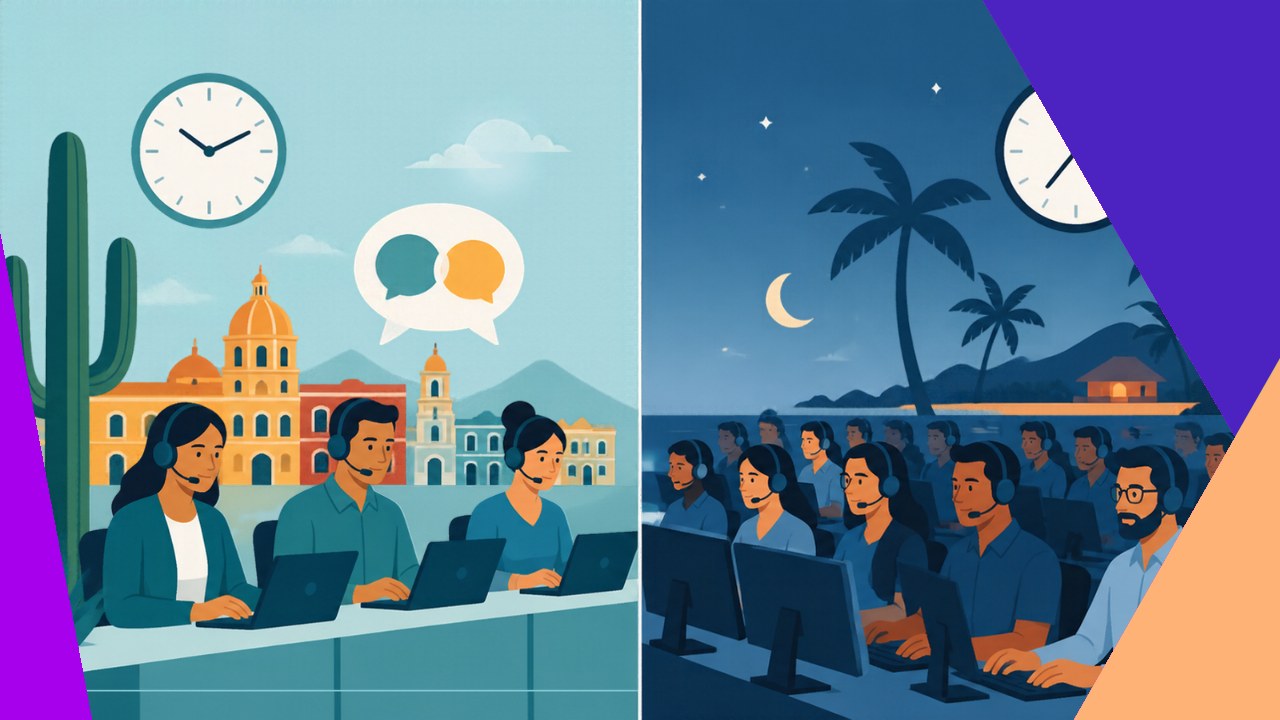
At a glance
- Mexico is a true nearshore option for US companies, sharing time zones and strong in Spanish; the Philippines is an offshore hub with higher English and bigger scale.
- Choose Mexico for real-time, bilingual, US-aligned support; choose the Philippines for high-volume, English-first service at the lowest cost.
- Time zone, language, and scale should guide the decision more than cost alone.
US companies weighing support locations often land on these two. The Mexico vs Philippines for nearshore support comparison is a little unusual, because only Mexico is truly nearshore to the US. Mexico shares US time zones, while the Philippines sits offshore on the other side of the world. The two are often compared head to head, so it helps to see where each one fits.
Mexico is a nearshore country for US firms, close by and strong in Spanish and English. The Philippines is an offshore hub famous for its huge, English-speaking support workforce.
Here is how the two compare for customer support.
Mexico for support
Mexico’s biggest draw is proximity. It sits in US time zones, so teams work the same hours as their customers and collaborate in real time.
It is also strong for Spanish and bilingual service, which suits the large US Hispanic market. General English is more moderate: Mexico scores 440 on the EF English Proficiency Index, ranking 103rd. The real edge is nearshore convenience and cultural closeness to the US, not rock-bottom cost.
The Philippines for support
The Philippines is an offshore powerhouse with deep scale and strong English. It ranks 28th worldwide with a score of 569 on the EF English Proficiency Index, among the highest in Asia.
Its strengths are English, scale, and low cost. You can staff large English teams fast and cheaply. The trade-off is distance. The Philippines is many hours ahead of the US, so live daytime overlap means night shifts for agents, though that also enables round-the-clock support.
Head-to-head comparison
| Factor | Mexico | Philippines |
|---|---|---|
| Time zone vs US | Nearshore, same hours | Offshore, night shifts |
| English proficiency | Moderate (rank 103) | High (rank 28) |
| Spanish and bilingual | Strong | Limited |
| Cost | Low, slightly higher | Lowest |
| Scale and maturity | Growing | Very large |
In short, Mexico wins on time zone and Spanish, while the Philippines wins on English, scale, and cost.
When Mexico wins
Mexico is the better choice when real-time work and Spanish matter. If your team needs to collaborate live with US staff, or you serve many Spanish-speaking customers, its nearshore fit is a genuine advantage.
The shared hours also make management, training, and escalations easier, since everyone is online together. For companies that value this closeness, nearshore support from Mexico can be worth a slightly higher cost.
When the Philippines wins
The Philippines is the better choice for large, English-first support at the lowest cost. If you need to hire many agents, serve mostly English-speaking customers, and keep spending down, its depth is hard to match.
It also suits around-the-clock coverage, since agents already work through the US night. For high-volume, English-centric service, the Philippines remains a default for good reason.
How to choose
Start with your customers’ languages and your need for live overlap. Spanish or same-hours needs point to Mexico. English-only and cost-driven needs point to the Philippines.
Then weigh scale. Very large English operations favor the Philippines, while leaner, US-aligned or bilingual teams favor Mexico. Some companies use both, with Mexico handling daytime and Spanish work and the Philippines handling overnight English volume.
Culture and fit matter too
Numbers only tell part of the story. Culture shapes how well a support team connects with your customers.
Mexico’s closeness to the US goes beyond time zones. Agents often share cultural references and a feel for the US market, which helps on sensitive or Spanish-language calls. That familiarity can make conversations feel more natural.
The Philippines brings a different strength. Its agents are known for a warm, service-focused style and a neutral English accent that US and UK customers find easy to follow. Both work well, so the question is which cultural fit suits your customers best.
Weigh this alongside the hard factors. A team that connects with your customers is worth as much as one that costs a little less. In the end, the right choice balances language, hours, scale, and this human fit.
Frequently asked questions
Is the Philippines really nearshore?
No, not for US companies. The Philippines is offshore, far across the Pacific, while Mexico is the true nearshore option with shared US time zones. The two are often compared together, but only Mexico fits the nearshore label for North American buyers.
Which is cheaper, Mexico or the Philippines?
The Philippines is usually cheaper, thanks to its scale and mature supplier market. Mexico’s costs are still well below US levels, but its value lies in nearshore convenience and Spanish support rather than offering the absolute lowest price.
Which is better for Spanish-language support?
Mexico, by a wide margin. Spanish is native there, and agents understand the culture of the US Hispanic market firsthand. The Philippines can supply some Spanish speakers, but not with the depth or natural fluency that Mexico offers.
Can I use both countries together?
Yes, and many companies do. A common setup uses Mexico for daytime, bilingual, and US-aligned work, and the Philippines for high-volume English support and overnight coverage, matching each location to what it does best.






 Independent






