
Colombia vs Philippines for call centers: A 2026 comparison

At a glance
- The Philippines is the larger, more established call center hub with stronger English; Colombia is a rising nearshore option close to US time zones.
- Choose the Philippines for scale, cost, and English-first voice support; choose Colombia for real-time US overlap and Spanish-English bilingual service.
- The right pick depends on your customers’ languages, your working hours, and the volume you need.
Two countries top the shortlist when companies look abroad for voice support. The Colombia vs Philippines for call centers choice comes down to three things: language, time zone, and scale. Each country leads on different ones. Both offer skilled agents at a fraction of onshore cost, yet they suit different needs.
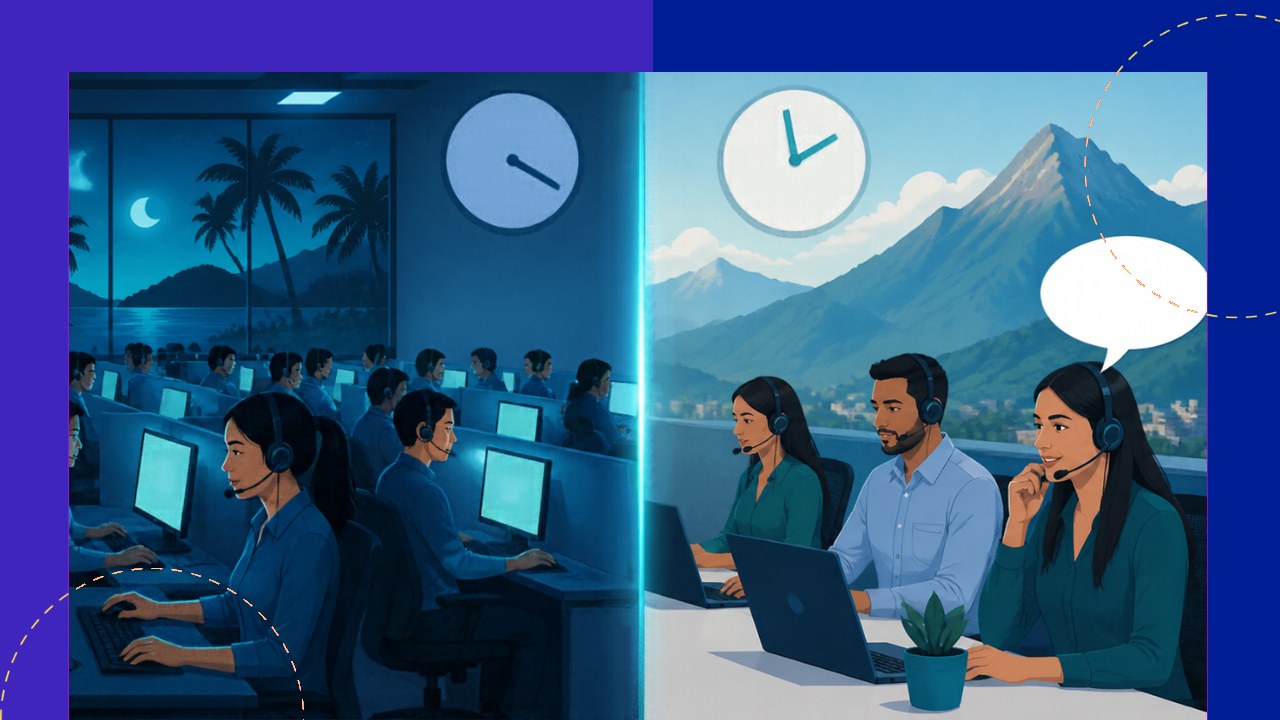
The Philippines is a long-established, English-first call center powerhouse on the other side of the world from the US. Colombia is a fast-growing, bilingual nearshore hub that shares business hours with North America.
Here is how the two compare for a call center operation.
The Philippines for call centers
The Philippines has been a top global call center destination for decades, with a deep, experienced talent pool. Scale and maturity are its biggest strengths.
English is another strength. The country ranks 28th worldwide, with a score of 569 on the EF English Proficiency Index. That is well above the global average, and the accent is neutral for US ears. The main trade-off is time. The Philippines sits many hours ahead of the Americas. To cover the US day, agents work night shifts.
Colombia for call centers
Colombia has emerged as a leading nearshore hub for North American companies. Its headline advantage is location: it sits in a time zone close to the US, so teams work the same hours as their customers.
It is also strongly bilingual, which suits companies serving English and Spanish speakers. Colombia scores 480 on the EF English Proficiency Index and ranks 76th. So its English is solid, just less dominant than in the Philippines. For Spanish and bilingual support, though, Colombia is hard to beat.
Head-to-head comparison
| Factor | Philippines | Colombia |
|---|---|---|
| English proficiency | Higher (rank 28) | Solid (rank 76) |
| Spanish / bilingual | Limited | Strong |
| Time zone vs US | Offshore, night shifts | Nearshore, same hours |
| Industry maturity and scale | Very large and established | Growing fast |
| Cost | Very competitive | Competitive, often slightly higher |
In short, the Philippines leads on English, scale, and cost, while Colombia leads on time-zone overlap and bilingual support.
When the Philippines wins
The Philippines is the stronger choice for large, English-first voice operations. If you need to hire hundreds of agents, want the lowest cost, and serve mostly English-speaking customers, its scale and proficiency are hard to match.
It also suits around-the-clock support, since agents already work through the US day on night shifts. For high-volume, English-centric customer service, the Philippines remains the default for good reason.
When Colombia wins
Colombia shines when real-time collaboration and Spanish matter. If your team needs to work the same hours as US staff, or you serve a large Hispanic customer base, its nearshore location is a genuine edge.
The time-zone overlap also makes management, training, and escalations easier, since everyone is online together. For companies that value this closeness, nearshore call center support from Colombia can be the better fit, even if raw cost runs a little higher.
How to choose
Start with your customers’ languages and your need for live overlap. English-only and cost-driven points toward the Philippines; bilingual or same-hours needs point toward Colombia.
Then weigh volume and maturity. For very large, complex operations, the Philippines’ depth is reassuring. For leaner, collaboration-heavy teams close to the US, Colombia fits naturally. Some companies even split work across both to get the best of each.
Both beat onshore costs
Whichever you pick, the savings are real. Agents in both countries cost far less than US or UK staff for the same work.
The Philippines tends to be the cheapest, thanks to its huge supplier base. Colombia costs a little more, but still well below onshore rates. So cost rarely rules out either one. The deciding factors are usually language and time zone, not price alone.
Many companies run a small pilot in each country before they commit. A short trial reveals the real differences in accent, culture, and management fit far better than any spec sheet.
Frequently asked questions
Which is cheaper for call centers, Colombia or the Philippines?
The Philippines is usually slightly cheaper, thanks to its scale and mature supplier market. Colombia’s costs are still well below US levels and competitive, but its nearshore convenience often carries a small premium that many companies find worth paying.
Is English better in the Philippines or Colombia?
The Philippines ranks higher for English proficiency and has a more neutral accent for US and UK customers. Colombia’s English is solid and improving, but its real language strength is bilingual Spanish-English service, which the Philippines cannot easily match.
Does the time zone really matter for call centers?
It depends on your model. For 24/7 support, the Philippines’ offshore hours are an asset, since agents cover the US overnight. For teams that need live collaboration with US staff during the day, Colombia’s matching hours are a clear advantage.
Can I use both countries together?
Yes, and some companies do. A common setup uses the Philippines for high-volume English support and Colombia for bilingual or daytime-overlap work, spreading risk across two regions while matching each to the tasks it does best.






 Independent






