
Workforce Planning

Definition
Workforce Planning
Workforce planning is the discipline of forecasting how many people and which skills a business will need over a set horizon, then measuring that demand against the supply it expects to have. The output is a quantified gap, not a wish list.
The work sits where finance and human resources have to agree. Finance owns the headcount budget. Human resources owns hiring, retention and the time it takes to fill a seat.
It is deliberately quantitative. A plan that cannot say how many people, in which roles, by when and at what cost is a staffing wish, and executives read it that way.
Scope varies wildly. One team models a single contact centre twelve weeks out. Another models an entire company three years out, across every site it runs.
Key takeaways
- Workforce planning compares forecast demand for roles and skills against forecast supply, then sizes the difference.
- The planning horizon picks the method — short horizons run on operational volume data, long horizons run on scenarios.
- Supply forecasting is mostly subtraction, driven by leavers, internal moves and confirmed hires already signed.
- Every gap resolves into a build, buy or borrow decision, and each option carries a different cost and lead time.
- A plan with no named owner and no review cadence decays inside one quarter.
How it works
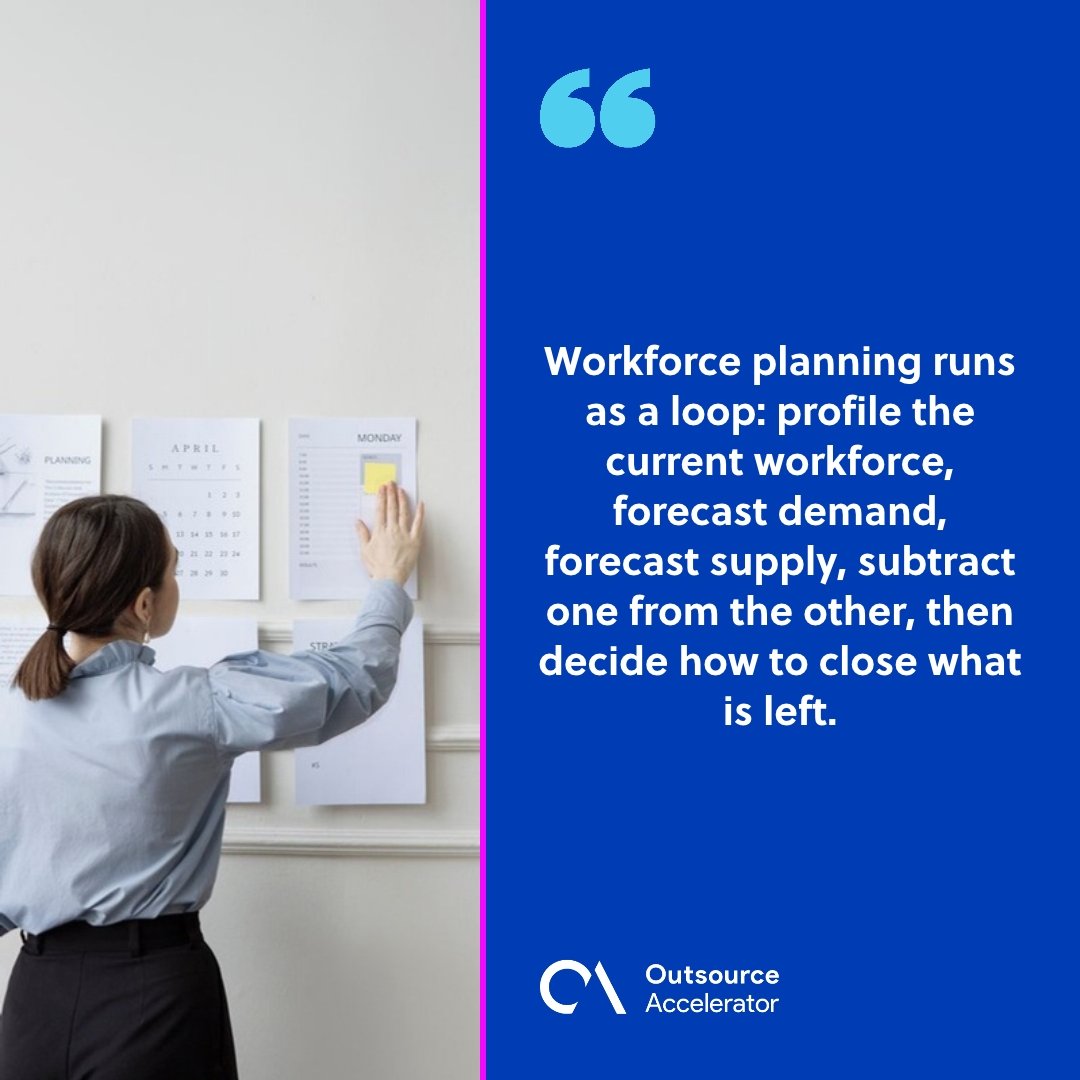
Workforce planning runs as a loop: profile the current workforce, forecast demand, forecast supply, subtract one from the other, then decide how to close what is left. Each pass feeds the next cycle.
The Chartered Institute of Personnel and Development frames the discipline as balancing labour supply against the demand in numbers needed. That is the cleanest test of whether a plan is actually finished.
Demand forecasting starts from whatever drives the work: call volume, ticket counts, loan applications, claims, orders. Those volumes convert to hours, hours convert to full-time equivalents, and that figure becomes the demand line.
Supply forecasting is the mirror image. Start with today’s headcount, remove expected leavers using the attrition rate, remove internal moves and promotions, then add hires already signed.
Subtract supply from demand and you have the gap — role by role, never in aggregate. A positive gap means hiring, training or contracting. A negative one means a freeze or a slower backfill.
Aggregating is the classic mistake. A company can be exactly on headcount overall and still be forty analysts short in one function and forty too heavy in another.
Then comes the decision every gap funnels into.
| Option | What it means | Best when |
|---|---|---|
| Build | train people you already employ into the gap role | the skill is adjacent and the horizon runs 6–18 months |
| Buy | hire the skill from the external labour market | the gap is permanent and the market has real supply |
| Borrow | contract, second or outsource the capacity | the gap is temporary, seasonal or outside the core |
Arithmetic covers the near term. Beyond about eighteen months it stops working, because the volume drivers themselves become uncertain, so planners switch to scenario planning and model two or three futures instead of one.
Most teams now refresh the numbers on a rolling forecast rather than in a single annual set-piece. A plan written in October is stale by February — the assumptions underneath it have already moved.
Time-to-competence belongs in the model too. A seat filled is not a seat producing, and a role with a twelve-week ramp has to be hired twelve weeks before the demand curve turns.
Boards rarely read the model. They read the summary, and they sanity-check it against a headcount to revenue ratio before approving anything.
Examples
Workforce planning looks different at twelve weeks and at fifteen years, but the arithmetic underneath is the same. Three cases show the range, from a seasonal support ramp to a national health service modelling a decade of training places.
Seasonal retail support, offshore. A Manila contact centre serving a United States retailer plans its fourth-quarter peak from July — five months ahead. Volume history gives the demand curve, and a six-week training lead time sets the hire-by date.
NHS England, June 2023. The NHS Long Term Workforce Plan was the service’s first fifteen-year projection, modelling training places, retention and productivity together rather than as three separate arguments.
Global job churn to 2030. The World Economic Forum’s Future of Jobs Report 2025, published on 7 January 2025, projects 170 million jobs created and 92 million displaced by 2030.
That last figure is the demand side of every long-horizon plan. Net growth is positive, but the roles growing are not the roles shrinking, which is exactly the problem a plan exists to surface early.
Related terms
Workforce planning sits upstream of scheduling and downstream of strategy, so it borrows vocabulary from both. These are the terms that come up most often once a planning cycle is running.
- Workforce Management: the day-to-day scheduling and adherence layer that executes against the plan.
- Skills Gap: the measured distance between the capability a business holds and the capability it needs.
- Attrition Rate: the leaver percentage that drives the supply side of every forecast.
- Talent Pipeline: the pool of identified candidates a plan draws on when it chooses to buy.
- Workforce Planner: the role that owns the models and runs the cycle each period.
FAQ
What is the difference between workforce planning and workforce management?
Workforce planning decides how many people with which skills you need and when. Workforce management then schedules the people you have against the work that arrives.
How far ahead should a workforce plan look?
Match the horizon to your longest lead time. If a specialist role takes nine months to recruit and train, a six-month plan is already too late to act on.
What data does workforce planning need?
At minimum: current headcount by role and location, historical attrition, time-to-hire, time-to-competence, and the volume driver that generates the work.
How do you calculate a workforce gap?
Forecast demand in full-time equivalents, forecast supply over the same period, then subtract supply from demand for each role rather than for the organisation as a whole.
Can workforce planning be outsourced?
Yes, and the modelling itself is often run by an external analytics partner while the decisions stay in-house.
Browse the Outsource Accelerator directory when your plan points toward borrowing capacity rather than building it.






 Independent






