
From Corporate Contact Center to EOR Entrepreneur with Phil Murphy of Smart Outsourcing Solution

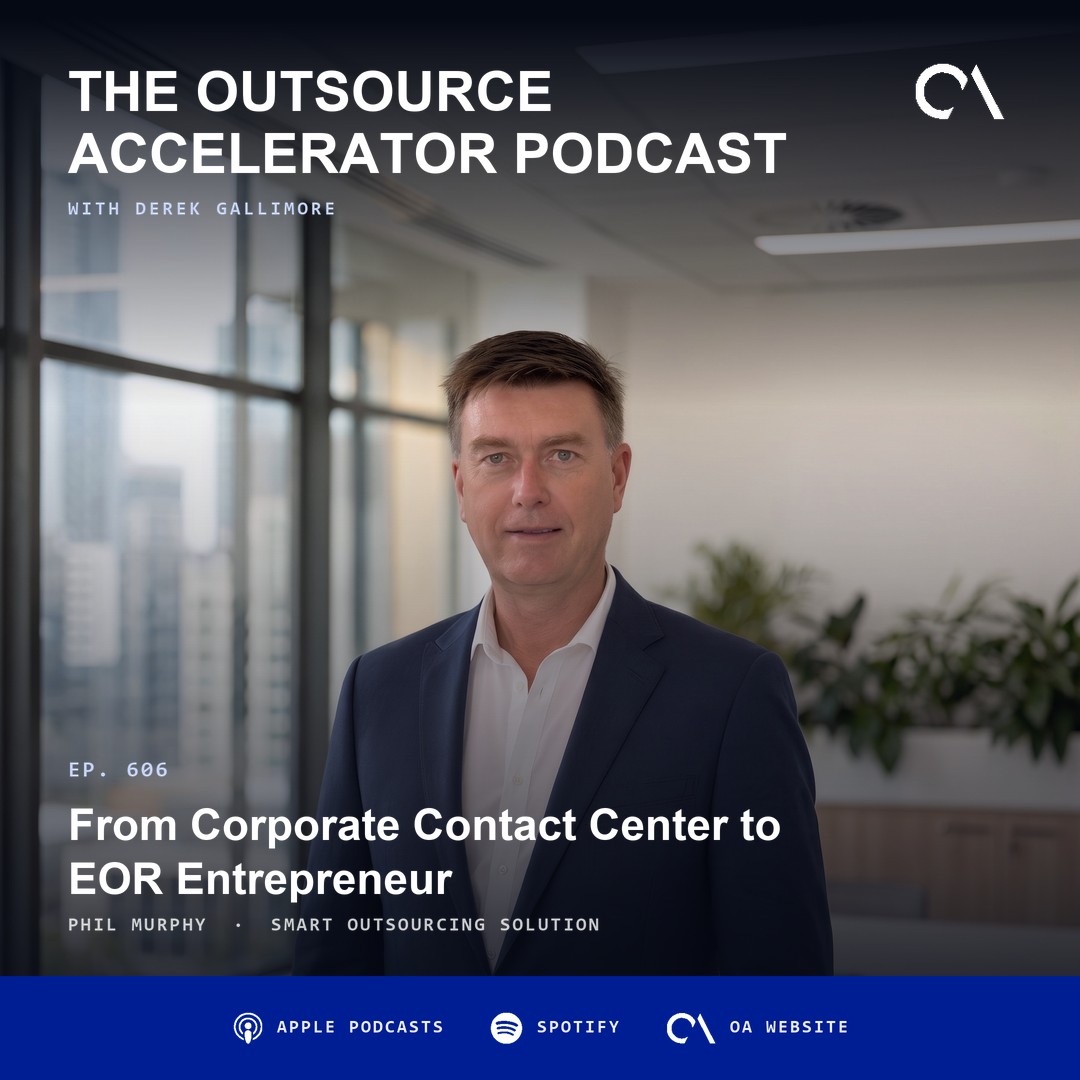
Phil Murphy spent 35 years in outsourcing, 17 of them running APAC operations, before taking what he calls a big leap into building his own firm.
As founding partner and CEO of Smart Outsourcing Solution, he has grown an employer of record (EOR) business to nearly 1,000 Philippine staff serving around 250 clients worldwide. He joins the Outsource Accelerator Podcast to talk through the model and his move from corporate to entrepreneur.
The conversation covers what an EOR actually does, why employing staff properly matters, and a measured take on AI.
Inside Smart Outsourcing Solution
Phil describes a business built around employment, not end-to-end delivery.
“At Smart Outsourcing Solution, we provide predominantly employer of record services, also contractor of record services. We’re mainly based in the Philippines… our Philippines presence is around about 1,000 employees and roughly 250 clients across the globe. We’ve been operating since 2017.”
From the phones to founder
His own path is the classic outsourcing story, taken to its limit.
“From starting off on the phones, I’ve now been in the industry around 35 years and worked my way up through the operations. And now, as you said, switched over to the other side, which is a big leap of running our own company.”
The EOR hidden economy
Coming from full-service BPO, Phil was struck by how large and how invisible the EOR world was.
“We didn’t really know much about what we call employer of record. It was almost like a hidden economy… You would come across companies that would have a thousand people. I think one I came across had almost 10,000 people. And we thought, wow, that’s a really big industry that’s going under the radar.”
How the model works
The split of responsibilities is the heart of it. SOS owns the employment; the client owns the output.
“We look after everything from a legal perspective in the Philippines… payroll… employee taxes, anything from a legal and compliance and HR perspective. And what that means, it leaves the companies who connect with us to manage the end output.”
He frames it as a hybrid that hands control back to the client.
“It’s almost like a hybrid model. We’re providing the skilled professionals who are legally employed. And that allows the company to really take more control of their own operations and manage the output rather than have an outsourcer do the end-to-end.”
For many clients, he adds, it is a lower-commitment way in.
“Rather than just sign into a full outsourcing contract, it’s a middle ground for them. So they’ll maybe start with one role and then they soon realize that, hey, this is a model that really works.”
Why employing staff properly matters
Phil’s biggest competitor is companies paying Filipino workers directly, and he is clear about the risk of misclassification.
“It’s not just the paper of the contract that says they’re either a contractor or employee, it’s how they’re set up… If the answer to most of those questions is, ‘Yes, I am,’ well then you’re probably better suited to an employment agreement, because you’re effectively misclassifying them as a contractor.”
Doing it properly, he argues, also unlocks real benefits that keep people.
“Things such as HMO, which is the private health benefits in the Philippines, typically don’t come with a contracted role… the 13th month pay.
And so those benefits, when you put them all together, they really stack up to make it worthwhile to convert across from a contractor to a full-time employee.”
Simple on the surface, complex underneath
SOS keeps its pricing deliberately plain.
“We just have one fee that’s really transparent. We have a US $190 per employee per month, and that’s it. So we don’t have any sign-on fee.”
But Phil is candid that the simplicity hides real depth.
“On the surface, we do staff leasing. We pay the staff, you look after the people. In a nutshell, that’s what it is. But peeling back the layers of that is really quite complex.”
It is also why clients who think about building their own Philippine entity usually stay put.
“Why they might have ideas of doing the build-operate-transfer, to actually get it done in the Philippines is extremely difficult… there’s always something around the corner that’s a gotcha.”
A measured view of AI
Far from fearing AI, Phil is putting it to work across his own company, without cutting headcount.
“We fully embrace AI… We’re just launching this week a large automation project… But in planning this, we’re not planning on removing any roles. We’re planning on keeping the teams, and as we expand, we’ll continue to expand.”
His read is that AI shifts the nature of the work rather than removing it.
“It’s moving people away from the repetitive, mundane tasks into more complex, thinking roles.”
And in his business, the hardest parts still need people.
“You can’t run AI through the labor cases and have the full confidence that it’s gonna give you the right decision. You have to have professionals who understand the laws, who know the case studies.”
For Phil, the move from corporate contact centers to running an EOR has been a bet on a quieter, stickier model: employ people properly, keep it transparent, and let clients focus on the work while the hard compliance sits with the experts.
To learn more about Smart Outsourcing Solution, visit smartoutsourcingsolution.com or reach Phil Murphy directly at [email protected]. And if you would like to learn more about what we do in the outsourcing space, send us an email at [email protected].






 Independent





