
Why Australian finance teams are building permanent offshore capacity instead of hiring for EOFY


This article was contributed by the team at Satellite Office, which builds dedicated offshore teams in the Philippines for Australian businesses.
Most Australian accounting firms plan for the end of the financial year as if it’s a single peak, but the lodgment calendar says otherwise.
Under the ATO’s registered agent lodgment program, deadlines start in October and keep coming: overdue prior-year returns, then larger trusts in January and February, then higher-liability clients in March, and finally the bulk of remaining returns in May and June.
Add BAS, payroll and year-end close, and there’s no real quiet season. There’s a team that’s stretched most of the year and overwhelmed for about six weeks of it.
That’s why more practices are no longer asking how to find extra people for EOFY. They’re asking how to build permanent offshore capacity that turns EOFY into a productive period instead of an annual emergency.
Why hiring for the peak isn’t solving the problem anymore
The standard answer to a heavy period is temporary staff. In Australian finance, the timing works against that answer. Recruitment for skilled finance roles takes time, and the market has not become easy.
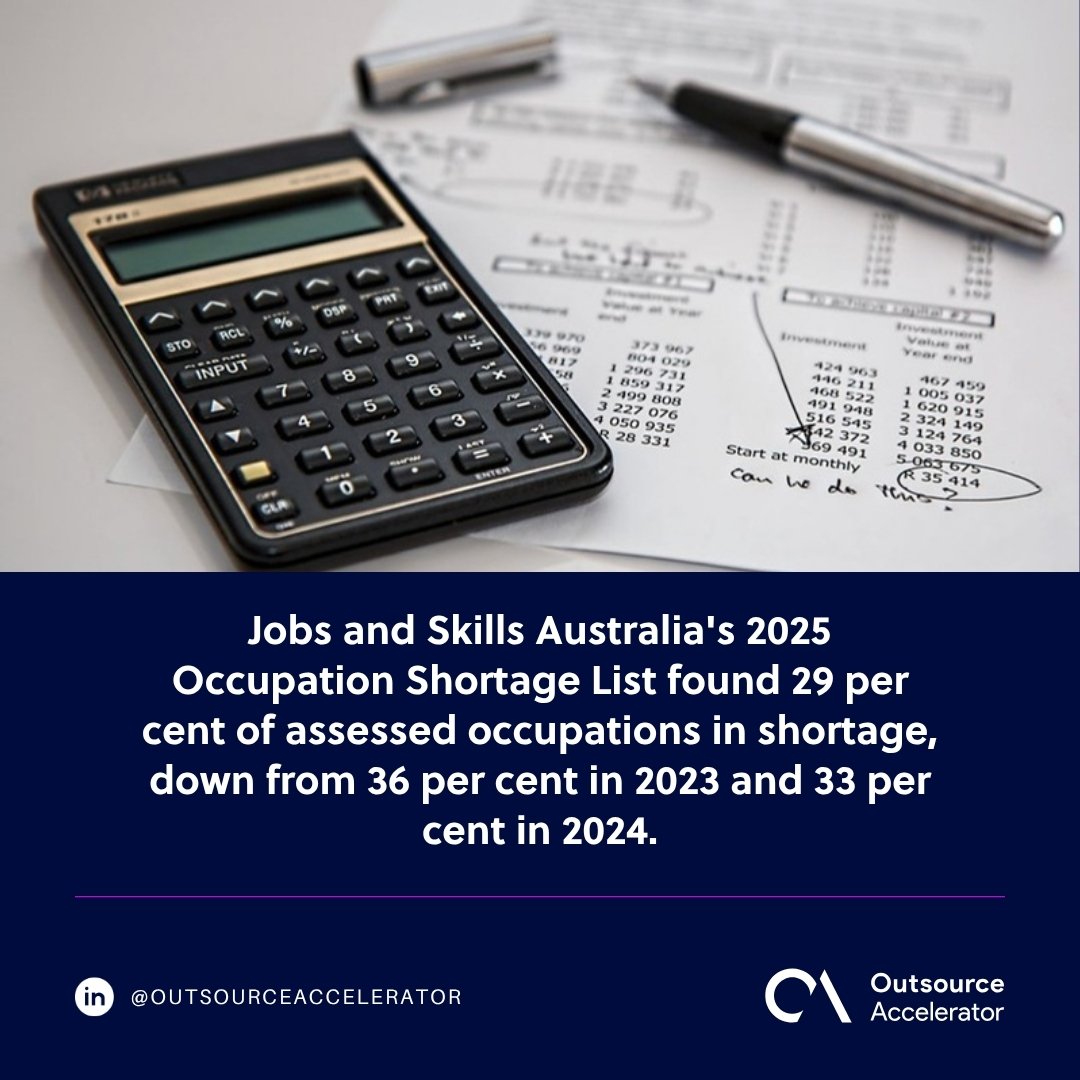
Jobs and Skills Australia’s 2025 Occupation Shortage List found 29 per cent of assessed occupations in shortage, down from 36 per cent in 2023 and 33 per cent in 2024. Conditions have eased, but they have not been reversed. Taxation Accountants still remain among the occupations in shortage.
So the sequence tends to run like this. Demand becomes visible in March. Approval follows in April. Advertising, shortlisting, interviewing, and notice periods consume the rest. The new person starts in June or July, competent and useful, but misses the compression entirely.
Contract labour solves the timing better but buys nothing durable. The knowledge of your chart of accounts, your clients, your systems and your exceptions leaves with the contractor, and the following year the whole exercise starts again. Finance teams that have been through that cycle twice tend to be the ones who stop repeating it.
This is where a permanent offshore finance team becomes a more viable solution for overloaded onshore teams during the EOFY period.
What a permanent offshore finance team takes on
Offshore finance teams can share the load with your onshore teams throughout the year and provide extra support during peak periods. Your offshore teams can handle high volume, rules-driven and documentable processes, whether it is May or September.
These include:
- Bank and balance sheet reconciliations
- Accounts payable and accounts receivable processing
- Payroll processing and award interpretation support
- Bookkeeping and ledger maintenance
- Working paper preparation and schedule building
- Data entry, document collection and client information chasing
- Fixed asset and depreciation schedules
What stays onshore is anything requiring judgement, client relationship or a signature. They should also cover final reviews and sign-offs, technical positions, advisory conversations, and anything involving a professional obligation attached to a named individual.
That division is not a compromise; it is the point. Moving preparation work frees senior people to do the review and advisory work that only they can do, which is usually the real bottleneck in May.
A useful test when deciding what to move: if the task has a documented process and a checkable output, it transfers. If the task is mostly a decision, it does not.
A step-by-step guide to building your offshore finance team
- Map the calendar against your own capacity. Plot your actual lodgment and close obligations across twelve months and mark where the team is over capacity. The shape is usually more spread out than people assume, which is itself the argument for a permanent answer.
- Separate preparation from review. List every recurring task and mark it as preparation, review or judgement. Only the first column is a candidate.
- Document the top five processes properly. If a process cannot be written down, it cannot be transferred, and writing it down usually improves it onshore, too.
- Start in the quieter part of the cycle. Establish and train the team between July and September so it is productive long before the compression, and so training happens without stealing hours from a deadline.
- Run a narrow pilot through a real deadline. A quarterly activity statement cycle is a good proving ground.
- Hold the same standards you hold onshore. Same templates, same review, same measures. Different location, identical bar.
- Plan for year two from day one. The value is in continuity. Treat turnover as a quality risk, not an administrative one.
Australian firms that have made this shift generally describe the same outcome. EOFY stops being an annual emergency and becomes a busy period, which is a different thing.
Senior people spend the compression window reviewing and advising rather than reconciling. Many now structure offshore finance teams as a permanent part of the function rather than as seasonal relief, precisely because the second year is where the model pays.
Why the second year is where the model pays
The common mistake is to think of an offshore team as capacity that can be switched on in April and off in July. A team like that has to be recruited, trained and made productive under deadline pressure, and then loses everything it learned when it is stood down. It is the contractor problem again, in a different time zone.
A dedicated team that stays across the whole year behaves differently. It works only on your account, on your systems and your processes, as an extension of your finance function rather than a separate vendor. By its second EOFY, it carries last year’s working papers, last year’s exceptions and last year’s client quirks. The compounding is the actual return, and it is precisely the part a seasonal model cannot give you.
The practical enablers matter here, too. Philippine Standard Time sits at UTC+8, which is two to three hours behind Australian Eastern Time. That means same-day overlap for review cycles, queries and coaching rather than an overnight handoff.
The Philippines also sits in the “High” proficiency band of the EF English Proficiency Index, which matters more than it sounds when the work involves chasing missing information from clients.
How to keep the quality of your offshore finance team under deadline pressure
The risk everyone raises is that quality slips exactly when the pressure is highest. That’s exactly why you need to have controls in place even before you start engaging with an offshore provider.
Here are the things you need to prepare before conversations start:
- Document the process before the handover, not during.
- Standardise working paper templates so review is fast and consistent.
- Define the escalation path so an offshore preparer knows precisely when to stop and ask rather than guess.
- Keep review with the person who holds the professional obligation, always.
- Track a small number of quality measures, such as rework rate and first-pass acceptance, from the first week rather than the first crisis.
- Start with a narrow scope. Two or three process types, measured for a quarter, then widened.
Teams that move everything at once tend to discover their processes were less documented than they believed, and they discover it in May when it’s already too late.
The calendar is not going to loosen. The lodgment dates are fixed, the shortage in skilled finance roles has eased rather than ended, and the work still has to be done by someone.
The question worth asking is whether the next EOFY will be handled by a team that already knows your ledger, or by one you are still trying to hire.






 Independent





