
The bilingual retention gap: Why Spanish-English agents leave and how to keep them


This article is a submission by Connext, a back-office BPO service provider. Connext helps companies build custom, dedicated support teams in the Philippines, India, Mexico and Colombia. The company has been providing highly skilled professional staffing services at a minimal cost since 2014.
Most companies building a Spanish-English support team spend their evaluation on location. Colombia or Mexico, Bogotá or Medellín, nearshore or offshore. Those are real decisions, but the question that gets far less attention is whether the team will still be there in a year.
A good bilingual customer service representative is one of the most sought-after hires in customer support. The same qualities that make them valuable also make them easy to lose.
Most retention advice is written for a general contact center floor. Bilingual agents leave for different reasons, so keeping them takes a different design.
This article looks at what those reasons are, what a bilingual call center should do differently, and what buyers should ask their vendor before the first agent resigns.
Why bilingual talent is harder to keep than it looks
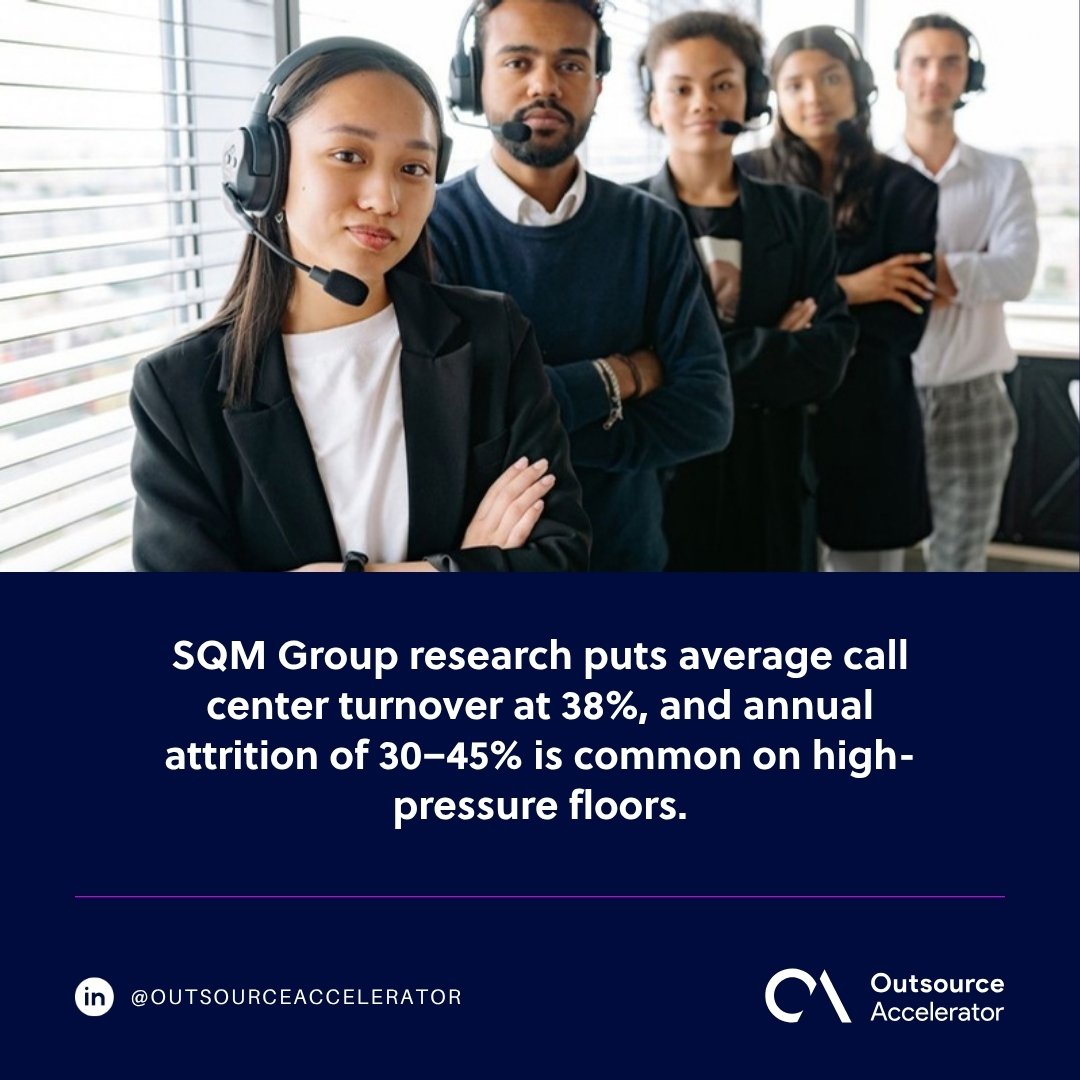
Contact center turnover is a known problem. SQM Group research puts average call center turnover at 38%, and annual attrition of 30–45% is common on high-pressure floors. Top-quartile operations hold it under 20%.
Bilingual teams face every pressure behind those numbers, plus two more:
- The buyer’s talent pool is also everyone else’s – The deep Spanish-English talent pool in Bogotá and Medellín attracts local BPOs, domestic companies, US remote employers, and tech firms alike.
- The skill travels with the agent – Language and cultural fluency transfer seamlessly between jobs. Because the skill carries over to any employer, switching costs the agent very little, and a small pay bump or a better schedule can be enough to leave.
Neither of these is a flaw in the talent. They are simply the market conditions any bilingual team is built in, and retention has to be designed with them in mind.
What drives bilingual attrition that generic retention advice misses
The fundamentals of call center retention are well established: hire for fit, pay fairly, offer growth, and manage burnout.
All of that applies to bilingual teams. But three drivers sit underneath the fundamentals, and standard programs rarely reach them.
1. Being treated as a translation layer, not a skilled hire
In some operations, bilingual agents become the organization’s informal “Spanish line.” Calls are transferred to them whenever an English-speaking colleague encounters a language barrier, and their value is measured mainly by whether they keep the queue covered.
That framing can be demoralizing. Spanish-preferring customers may choose Spanish for trust-sensitive conversations involving billing disputes, claims, or financial hardship.
Resolving those interactions requires judgment, cultural awareness, active listening, and de-escalation—not vocabulary alone.
Yet recognition programs often reward the same generic metrics used for every agent, such as handle time, adherence, and CSAT. They rarely recognize the language judgment that prevents escalation, builds trust, or saves an account.
Over time, agents may conclude that the organization relies on their specialized skill without truly valuing it.
2. No career path specific to bilingual work
Most contact centers already have a career ladder: agent, senior agent, team lead, supervisor. The problem is that the ladder treats the language skill as neutral. A bilingual agent who is promoted to team lead is valued for leading, not for the skill that made them hard to hire in the first place.
There is usually no distinction between a bilingual agent and a senior bilingual specialist, and no role that rewards deeper language expertise without requiring a move into people management.
For an agent whose main asset is portable, a ladder that ignores that asset is not much of a reason to stay.
3. Code-switching fatigue
Customers code-switch mid-conversation, and bilingual agents are expected to follow without friction. That expectation carries a cost that workload design almost never accounts for.
Cognitive research helps explain why. Studies have long found that switching languages draws on cognitive control, and that holding two languages active at once carries its own “mixing cost”. More recent work adds an important nuance.
Switches bilinguals choose for themselves are much less effortful than switches triggered by an external cue, and switching costs can disappear when speakers have time to prepare.
A blended bilingual queue is close to the worst case on both counts. The next call decides the language, not the agent, and there is no preparation time between contacts.
Generic burnout advice looks at call volume, hostile callers, and metrics, not an eight-hour shift of unplanned language switches.
What retention design looks like for a bilingual team
Each fix below is the bilingual-specific version of a standard lever. The difference is that it’s built around the language skill rather than around generic agent headcount.
Pay and recognition tied to the language skill
The most common mistake is folding bilingual ability into standard agent pay. If the language skill is simply expected, the agent has no financial reason to value it more with you than with anyone else.
A defined bilingual pay differential fixes that. It makes the value of the skill visible, and it gives the employer a clear lever to adjust as the local bilingual jobs market moves.
Recognition should follow the same logic. Quality programs should score Spanish-language interactions with native reviewers, and awards should include outcomes that depend on language judgment, such as retained accounts and resolved disputes.
A defined bilingual growth track
A bilingual team needs its own ladder alongside the standard one. A practical version includes four steps:
- Bilingual customer service representative
- Senior bilingual specialist, handling escalations and trust-sensitive queues
- Bilingual QA analyst or trainer, scoring and coaching Spanish-language interactions
- Bilingual team lead
Steps two and three matter most. They let an agent grow by deepening the language skill, without having to leave it behind for people management. They also give the agent something a domestic employer or a generic BPO ladder is unlikely to match.
Workload design that accounts for code-switching load
If unplanned, cue-driven switching is the costly kind, the fix is to plan more of it. Several options work in practice:
- Schedule language blocks, such as a morning in the English queue and an afternoon in the Spanish queue, instead of fully blended queues all day.
- Rotate agents between blended and single-language assignments across the week.
- Build short transition gaps into schedules when agents move between language blocks.
- Watch handle time and quality by language and by hour. A late-shift dip on blended queues is an early warning sign.
None of this is expensive. It simply treats bilingual agents as specialists with a distinct workload, rather than standard headcount with an extra skill tag.
What to ask a vendor about bilingual retention
Most buyers ask a bilingual call center vendor about language testing, accent, and cost. Far fewer ask how the vendor keeps the agents it hires. Four questions cover the gaps described above:
- “What is your attrition rate for bilingual roles specifically, compared with your general floor?” – A blended company-wide figure can hide a bilingual problem. If the vendor cannot split the number, that itself is useful information.
- “Do bilingual agents have a distinct career ladder?” – Ask what the next step looks like for a strong bilingual agent who does not want to manage people.
- “Is there a bilingual pay differential, and how is it structured?” – Look for a defined, visible premium rather than a vague reference to “competitive pay.”
- “How does your queue and workload design account for language switching?” – A good answer will mention scheduling, rotation, or monitoring by language, not just headcount.
The answers reveal whether a vendor treats bilingual agents as specialists or as standard headcount. At Connext, for example, a bilingual support team built in Colombia for a digital lending company has seen agents promoted into Team Lead and Senior Specialist roles as the account grew. That kind of internal mobility is what buyers should be looking for evidence of.
Designing bilingual retention around the language skill
The location decision gets most of the attention when companies build a Spanish-English support team. It deserves that attention, but it only determines who you can hire. Retention design determines who is still there in a year.
Bilingual agents work in a market where their skill is in demand everywhere and costs them almost nothing to take elsewhere.
Generic retention programs were not built for that. Paying for the language skill, giving it a career path, and designing workloads around its real cognitive cost are what close the gap.
The logic is simple. Engaged people stay, and people who stay perform. For a bilingual team, engagement starts with treating the language skill as the specialist capability it is.
Key takeaways
- Bilingual agents are harder to keep than monolingual hires because they are fielding competing offers from every direction, not just from other BPOs.
- The standard retention levers still apply: pay, career paths, and burnout prevention. In their generic form, though, they miss why bilingual agents specifically leave.
- Retention for a bilingual team should be designed around the language skill itself: how it is paid, how it is promoted, and how much cognitive load it adds to the working day.






 Independent





