
7 global HR support examples worth knowing

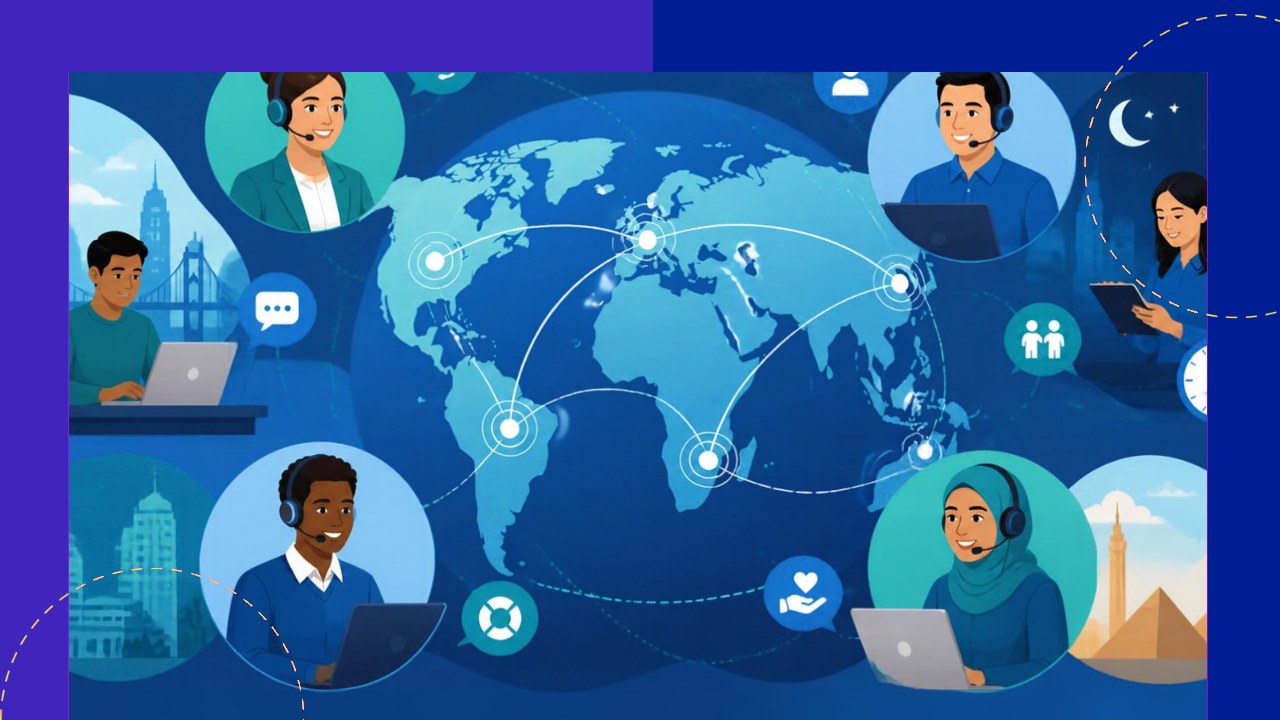
- Global HR support is the set of people services a company needs in every country where it employs staff, from pay runs to compliance.
- Seven functions cover most of this work: payroll, benefits, compliance, a help desk, onboarding, mobility, and analytics.
- Many firms run these across time zones with a shared-services team or an offshore partner to keep service steady and costs low.
When a company hires in more than one country, its HR team suddenly has more rules, more pay runs, and more questions to answer. Global HR support is the set of services that keeps all of that running, wherever an employee sits and whatever time zone they work in.
The work spans the simple and the complex. One hour you are fixing a payslip in Manila. The next you are checking a leave law in Germany. Good support makes both feel routine.
Below are seven examples of what global HR support covers. Each one is a distinct function. Together they show why growing firms often lean on a shared-services model or an offshore partner.
1. Multi-country payroll
Payroll is the backbone of global HR support. Every country has its own tax rules, pay dates, and filing deadlines. Miss one and you risk a fine or an unhappy team. A global payroll function runs each cycle, applies local deductions, and keeps records ready for audits. It also handles off-cycle payments and year-end reporting.
Scale makes this hard. Deloitte’s global payroll benchmarking survey tracks how large employers manage pay across many countries, including “the utilization of third-party business process outsourcing (BPO) services.” So many firms centralize the data and let local experts handle each filing.
2. Benefits administration
Benefits look different in every market. Health insurance, pensions, and leave entitlements all vary by country. A global benefits function sets up the right plans per location and enrolls staff. It answers questions, tracks eligibility, and syncs with payroll so deductions stay correct. It also keeps plans compliant as laws change.
For a worker, good benefits admin means a clear answer when they ask about coverage. For finance, it means fewer surprise costs. Because rules shift often, this function needs people who follow each market closely.
3. Global compliance and labor law
Rules change from border to border. Working hours, notice periods, and data privacy all differ. A compliance function tracks these rules and keeps policies current. The U.S. Bureau of Labor Statistics notes that HR specialists “ensure that all human resources functions comply with federal, state, and local regulations.”
Now multiply that across a dozen countries and you see the real challenge. Each one adds its own version of the same duty. Good support flags a risk early, before it turns into a penalty. You can read more about how global companies split these duties when they move transactional HR work offshore.
4. Employee help desk
Employees have questions every day. How much leave is left? When does the new policy start? A global HR help desk answers these across time zones, often by chat, email, or phone. It uses a shared knowledge base so answers stay consistent.
Most desks work in tiers. Tier-one agents handle common cases, then pass harder ones to a specialist. Because queries never really stop, many firms staff the desk from an offshore location. That way, someone is on hand at night and over the weekend.
5. Cross-border onboarding and offboarding
A new hire’s first week sets the tone. Global HR support manages onboarding in every market: contracts, IDs, equipment, and system access. It makes sure each step follows local law, so nothing stalls on day one.
Offboarding matters just as much. The team handles final pay, collects assets, and closes accounts. It also confirms the exit meets notice rules in that country. Done well, both ends of the journey feel smooth and leave a good impression.
6. Global mobility and relocation
Sometimes staff move across borders for a role. Mobility support handles visas, work permits, tax questions, and the logistics of the move. It coordinates with immigration advisers and keeps the employee informed at each step.
This function also tracks who is working where. That record matters for tax and for compliance, because a person’s location can change what the company owes. A smooth move keeps talent happy and keeps the business on the right side of the law.
7. HR analytics and reporting
Data ties the rest together. An HR analytics function pulls numbers from payroll, benefits, and the help desk into one clear view. It tracks headcount, turnover, cost per hire, and ticket volume over time.
Leaders then use these reports to spot trends and plan ahead. For example, a spike in help-desk tickets from one country may signal a policy that needs work. In short, good analytics turns scattered records into decisions you can act on.
Frequently asked questions
Is global HR support the same as an HR shared services center?
Not quite. A shared services center is one delivery model, a central team that serves many business units at once. Global HR support is the work itself. A shared center, an offshore partner, or local teams can each deliver it, and many firms blend all three.
How many countries before a company needs global HR support?
There is no fixed number. Even two countries add new payroll rules and tax filings. Most firms formalize support once local workarounds start to cause errors or delays. The trigger is complexity, not headcount alone.
What is usually kept in-house versus outsourced?
Firms tend to keep strategy, sensitive cases, and leadership decisions in-house. They often outsource repeatable tasks instead, such as payroll processing, benefits enrollment, and tier-one help-desk queries. The split lets senior staff focus on judgment calls rather than admin.
How do time zones affect global HR support?
They shape staffing more than anything else. A desk that serves Asia, Europe, and the Americas needs cover around the clock. So many firms split shifts or use an offshore team, which means someone is always ready to help when a worker reaches out.






 Independent





