
What is electronic health record (EHR) support?

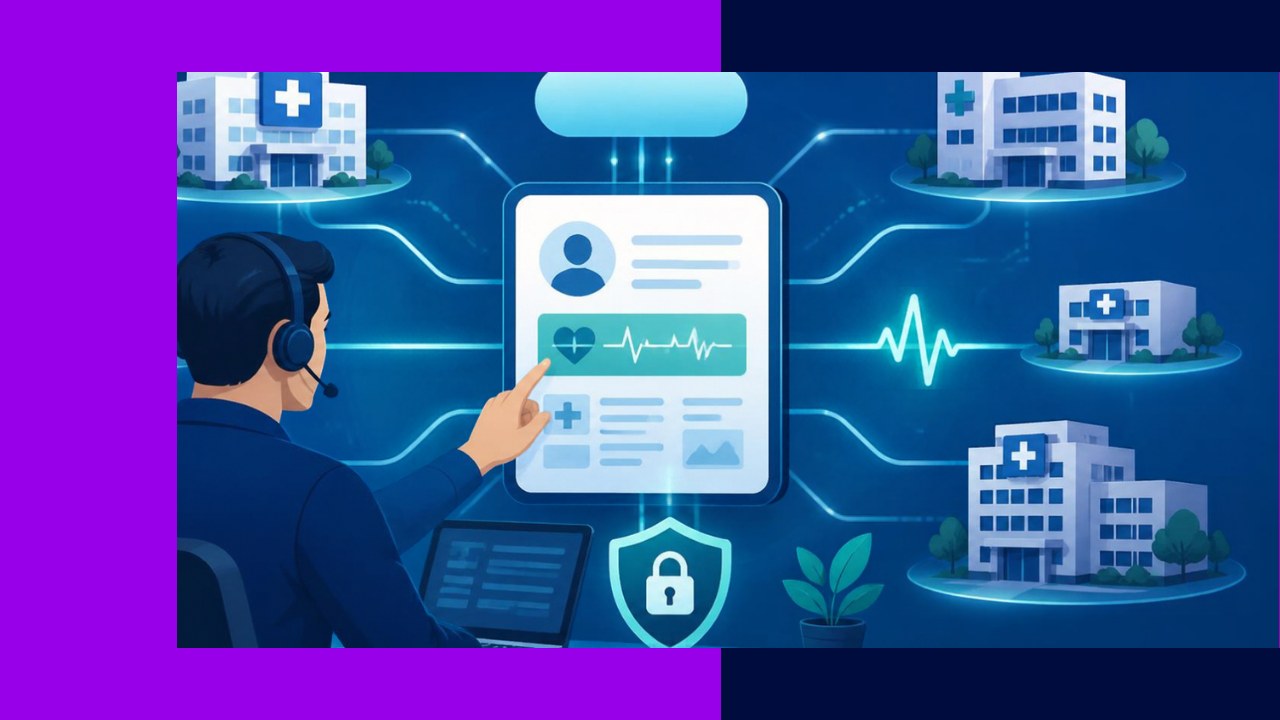
- Electronic health record support covers the people and services that keep an interoperable, cross-provider EHR running: setup, data work, optimization, training, and a responsive helpdesk.
- Because an EHR shares data across many care settings, support work leans heavily on interoperability, uptime, and clean data, not just fixing one clinic’s software.
- Many healthcare organizations outsource this support to control costs and staff a round-the-clock helpdesk without pulling clinicians away from patients.
Electronic health record support is the ongoing service that keeps an EHR usable, accurate, and connected. An EHR is the shared record. It pulls a patient’s history together across hospitals, clinics, labs, and specialists. That reach is useful, but it creates work. Someone has to set up the system and move old data across. Someone has to fix login tickets and tune the screens so nurses chart faster.
Support teams sit between three groups: the software vendor, the IT department, and the clinical staff who use it daily. When it works well, providers barely notice it. When it fails, charting stalls.
Adoption is nearly universal, and demand for support grows with it. According to HealthIT.gov data, “As of 2024, 91% of office-based physicians and nearly all non-federal acute care hospitals (>99%) adopted a certified EHR.” With so many systems live, the real question is how to keep one running.
What electronic health record support actually includes
Support is broader than a helpdesk. It covers the full life of the system. That runs from the first install to daily fixes years later. Most programs sort the work into a few clear groups.
Implementation and configuration
This is the build phase. Teams set up the software. They connect it to labs and pharmacies. They also build templates for each specialty. A poorly built workflow slows every user for years. So this early work pays off long after go-live.
Data entry and migration
Old charts rarely move cleanly. Support staff map fields, remove duplicates, and enter backlog data. That way the new record is complete. An EHR pulls data from many providers over time. So clean migration is what makes the shared record worth trusting.
Optimization and helpdesk
After go-live, the focus shifts to fine-tuning. Teams cut extra clicks, build order sets, and answer daily tickets. Meanwhile a tiered helpdesk handles password resets, printing errors, and interface faults. Uptime is the quiet priority here. A record no one can open is worse than paper.
Training and change management
New hires, new modules, and new rules all call for training. Support teams write quick guides, run refresher sessions, and coach super-users. As a result, adoption sticks and workarounds fade.
Why the interoperable angle changes the support job
An EHR is not just one clinic’s chart. It is built to travel. Here is the one-line difference worth remembering. An EMR is the digital chart inside a single practice. An EHR is the broader record built to move across many providers and care settings.
That difference shapes the support work. An EHR shares data with outside systems. So teams spend real time on interfaces, data standards, and failed exchanges. The ONC notes that “interoperability helps clinicians deliver safe, effective, patient-centered care.” Supporting that promise means watching the links between systems, not just the screens in one building. You can see how the shared record is meant to work in this overview of the move from paper charts to a connected digital record.
In-house support versus an outsourcing provider
Small practices often lean on a single IT generalist. Large systems build full teams. Many land in the middle. They outsource part of the load to an offshore partner, often the overnight helpdesk. The table below sums up the trade-offs.
| Factor | In-house team | Outsourced provider |
|---|---|---|
| Coverage | Limited by local staffing and hours | Round-the-clock, follow-the-sun shifts |
| Cost | Higher fixed salaries and benefits | Lower, variable, scales with volume |
| Clinical context | Deep, on-site knowledge | Strong with training and clear playbooks |
| Scaling | Slow to hire and onboard | Fast to add trained agents |
Outsourcing is not all or nothing. Many groups keep clinical decisions in-house. They hand tier-one tickets, data entry, and after-hours coverage to a provider. Still, any outside team that touches patient data must sign a business associate agreement. It must also follow HIPAA safeguards. That rule is non-negotiable.
What good EHR support looks like day to day
The best programs are boring in the best way. Tickets close fast. Interfaces stay green. Clinicians rarely think about the system at all. To get there, strong teams track a few clear signals.
They watch response and fix times on the helpdesk. They track interface uptime. They flag failed data exchanges before a clinician does. They check data quality so the shared record stays clean. Then they feed user feedback back into the build. In short, support becomes a loop, not a one-off project.
Frequently asked questions
How much does EHR support typically cost?
Pricing usually blends a monthly platform fee with per-user or per-ticket charges. Setup is billed on its own. It often runs into five or six figures for larger sites. Outsourced tier-one support tends to price per seat or per resolved ticket. That makes overnight coverage cheaper than a local night-shift hire. Budget for training refreshes too, since staff turnover raises support demand each year.
Is EHR support the same as IT support?
Not quite. General IT support covers networks, devices, and email. EHR support is a specialty within it, focused on the clinical record, its interfaces, and its workflows. An IT technician may reset a laptop, while an EHR analyst rebuilds an order set or fixes a lab feed. Many organizations run both, with clear escalation paths between them.
What certifications should EHR support staff hold?
Vendor-specific credentials matter most. Each major platform certifies analysts on its own build tools. Beyond that, HIPAA privacy and security training is a must for anyone near patient data. Some teams add health information or project management credentials for senior roles. Ask a provider for named, current certifications, not vague claims.
How long does an EHR implementation take?
A small clinic can go live in a few months. A multi-hospital system often needs a year or more, plus a stabilization period after launch. The timeline depends less on the software and more on data migration, interface count, and staff readiness. Rushing the build usually trades a shorter project for years of workarounds.






 Independent





