
Where revenue cycles break down and how outsourcing can help


This article is a submission by FGC+, a people-driven BPO company headquartered in New York, with offshore teams based in the Philippines. FGC+ helps growing businesses scale through customer support, technical support, medical billing, accounting, and data management services.
Revenue cycle management (RCM) performance depends on more than accurate billing. From eligibility verification and claims processing to payment posting and denial management, every stage of the revenue cycle requires consistent execution.
For management services organizations (MSOs), medical billing companies, and healthcare management organizations, maintaining that consistency becomes increasingly difficult as claim volumes grow, new practices are added, and administrative workloads increase.
When internal teams are stretched thin, routine tasks can turn into operational bottlenecks. Backlogs grow, follow-ups are delayed, and employees spend more time managing repetitive processes instead of focusing on higher-value priorities.
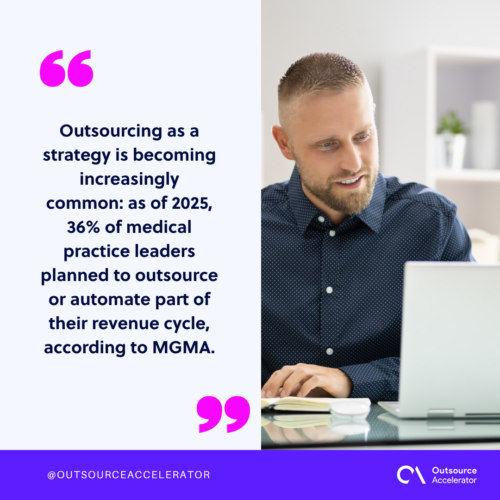
RCM outsourcing can provide the specialized expertise and additional capacity needed to keep these functions moving without continually expanding internal teams. Outsourcing as a strategy is becoming increasingly common: as of 2025, 36% of medical practice leaders planned to outsource or automate part of their revenue cycle, according to MGMA.
When is it time to outsource part of the revenue cycle?
The decision to outsource should start with a simple question: where is limited internal capacity affecting revenue cycle performance?
Healthcare support organizations can benefit from outsourced RCM support when they consistently experience:
- Growing billing or claims backlogs
- Delayed follow-ups and unresolved accounts
- Difficulty keeping pace with increasing transaction volumes
- Staffing shortages or challenges finding specialized talent
- Inconsistent performance across practices, locations, or accounts
- Internal teams spending too much time on repetitive administrative work
These issues can become challenging for MSOs and medical billing companies supporting multiple providers or practices.
As the organization grows, simply adding more internal staff may not be the most efficient, scalable, or sustainable solution. Instead, outsourcing specific administrative functions can create a clearer division of labor between internal teams and dedicated RCM specialists.
Which RCM functions create the biggest operational bottlenecks?
Some of the most persistent revenue cycle bottlenecks are created by high-volume, repetitive tasks. Manual data entry, claim status checks, insurance verification, payment posting, and documentation follow-up may appear manageable individually.
At scale, however, thousands of small transactions can consume significant employee capacity and create delays throughout the work being done consistently.
It can also allow internal teams to redirect their attention toward areas where their institutional knowledge and expertise create greater value, including provider relationships, financial oversight, client management, performance improvement, and revenue cycle strategy.
The objective is not simply to move work outside the organization. It is to determine which responsibilities are best handled internally and which can be managed more efficiently by a specialized outsourced team.
Which parts of the revenue cycle can be outsourced?
Many of the functions best suited for outsourcing share three characteristics: they are high-volume, process-driven, and require consistent attention to detail.
Commonly outsourced RCM functions include:
- Medical billing: adds dedicated capacity for billing workflows while helping organizations manage growing transaction volumes.
- Claims processing: helps prevent backlogs and keeps claims moving through the revenue cycle.
- Payment posting: supports timely, accurate posting and reconciliation.
- Eligibility verification: provides dedicated resources for confirming coverage and helping prevent avoidable administrative delays.
- Prior authorization support: adds capacity to one of healthcare’s more time-intensive administrative workflows.
- Accounts receivable follow-up: helps organizations maintain consistent follow-up on outstanding balances.
- Denial management: supports timely resolution while helping identify recurring denial patterns.
- Medical coding: provides access to specialized expertise while supporting coding accuracy and consistency.
The right combination will vary by organization. Some medical billing companies may outsource a single function experiencing significant backlogs, while others may build dedicated teams across multiple stages of the revenue cycle.
Outsourcing should create capacity, not complexity
Effective RCM outsourcing requires more than transferring a list of tasks to an outside provider.
Organizations should establish clear ownership, defined workflows, performance expectations, compliance requirements, and communication processes.
An outsourced team should integrate into the organization’s existing revenue cycle process rather than create another operational layer that internal leaders have to manage.

This is especially important for growing MSOs and medical billing companies. As new practices, providers, or client accounts are added, the outsourcing model should provide enough flexibility to increase capacity without requiring the organization to repeatedly recruit, hire, train, and build additional infrastructure internally.
A full-service outsourcing partner can also provide support beyond staffing, including recruitment, workforce management, training, quality oversight, and operational support. This allows organizations to expand RCM capacity while maintaining greater consistency as operations grow.
Building a more scalable revenue cycle
Revenue cycle outsourcing is most effective when it addresses a specific operational constraint. For MSOs, medical billing companies, and healthcare support organizations, that often means identifying the high-volume administrative functions consuming the most internal capacity and determining where specialized external support can improve performance.
Done strategically, outsourcing creates a more sustainable operating model: dedicated resources manage defined RCM workflows while internal teams maintain control over strategy, provider relationships, financial performance, and other high-value priorities.
The result is not simply additional staffing. It is greater flexibility to manage volume, reduce operational bottlenecks, and scale revenue cycle operations as the organization grows.
Key takeaways
- RCM bottlenecks often begin with capacity constraints. High-volume administrative work can quickly create backlogs and delays as organizations grow.
- Outsourcing works best when it targets specific pressure points. Claims processing, payment posting, eligibility verification, prior authorizations, A/R follow-up, denial management, and coding are all functions that can benefit from dedicated support.
- The goal is a more scalable division of labor. Outsourced teams can manage repeatable workflows while internal teams focus on strategy, oversight, and provider or client relationships.
- A full-service RCM outsourcing partner builds dedicated healthcare support teams that integrate with existing workflows, helping MSOs, medical billing companies, and healthcare organizations expand capacity and scale with greater consistency.






 Independent





