
How to fix a limited talent pool with global talent sourcing

This article is a submission by Remote Employee, a Philippines-based offshore staffing and remote hiring company serving businesses across the U.S., UK, and Australia. Remote Employee provides dedicated offshore staff across customer service, accounting, IT support, creative and marketing, software development, and more.
Finding skilled talent has become harder for businesses across almost every industry.
Even companies with strong hiring systems are struggling to fill roles, especially when they are recruiting tech workers, software engineers, accountants, and other highly skilled professionals from a limited talent pool.
The numbers show just how much the hiring market has changed:
- Recruiting Headlines reported that around 72% of employers globally have difficulty finding qualified, skilled talent, compared with 35% 10 years ago.
- Tech jobs are projected to grow at around twice the rate of the overall workforce over the next decade.
- CBRE Insights shows continued demand for specialized roles across areas such as cybersecurity, data engineering, and cloud computing.
This isn’t just a temporary hiring problem. It’s a bigger shift in where skilled professionals are located, what skills businesses need, and how companies need to recruit.
As Ruffy Galang, CEO of Remote Employee®, explains:
“Hiring becomes difficult when companies limit where they look. Expanding access to global talent removes that limitation and makes hiring faster and more predictable.”
So if your local hiring market keeps coming up short, the answer may not be posting another job ad. It may be expanding where you look.
Here’s why talent shortages are growing, what they mean for businesses, and how global talent sourcing can help companies expand their talent pool, control hiring costs, and scale more efficiently.
What a limited talent pool really means for your business
A limited talent pool doesn’t just make recruitment harder. It affects the rest of the business too.
When positions stay open, the work doesn’t disappear. Your existing employees take on additional responsibilities. Managers spend more time filling gaps. Projects move slower. Productivity can drop.
Eventually, hiring problems become operational problems. This becomes especially difficult for growing companies because staffing needs to keep up with new clients, projects, services, and expansion plans.
Many businesses respond by increasing salaries or posting vacancies across more job boards. That can help. But if every company is competing for the same small group of qualified candidates, you’re still dealing with the same underlying problem: there simply aren’t enough people in your existing talent pool.
The global talent shortage is expanding across industries
Talent shortages aren’t limited to one type of position. Businesses are struggling to recruit experienced professionals across technology, accounting, operations, supply chain, healthcare, and other specialized fields.
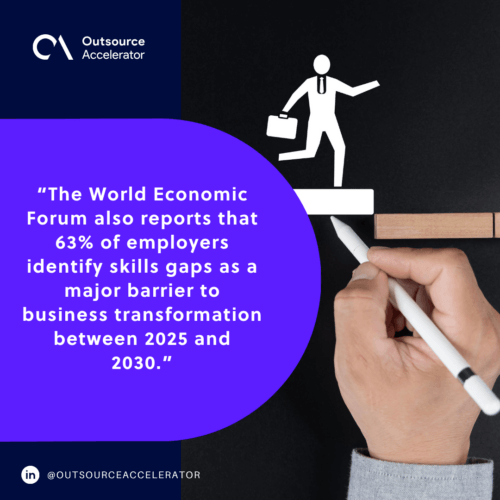
The World Economic Forum also reports that 63% of employers identify skills gaps as a major barrier to business transformation between 2025 and 2030.
And the problem isn’t only the number of available workers. Businesses also need people with increasingly specialized digital, technical, operational, and problem-solving skills. That makes the qualified candidate pool even smaller.
Why traditional recruiting strategies are breaking down
A lot of companies are still recruiting the same way they have for years. Post a job. Wait for applications. Review résumés. Interview the strongest candidates. Make an offer.
There’s nothing inherently wrong with that process. The problem is that almost everyone else is doing the exact same thing.
When dozens of businesses are recruiting from the same geographic market, using the same job boards, and targeting the same skills, they’re all competing for the same limited talent pool. And that’s where traditional recruitment starts becoming less effective. The impact is already showing up across major industries.
1. Supply chain talent shortages are disrupting operations
Supply chain operations depend on people. Coordinators, analysts, logistics professionals, planners, customer support teams, and administrative staff all help keep goods and information moving.
Deloitte has highlighted workforce and talent challenges among the concerns facing supply chain organizations.
When these positions remain unfilled, the effects can spread quickly. Orders get delayed. Communication between teams becomes harder. Existing employees take on additional responsibilities. And operations that should be moving smoothly start developing bottlenecks.
2. Accounting talent shortages are creating more pressure
The accounting talent shortage is another major challenge. Businesses still need accountants, bookkeepers, financial analysts, accounts payable professionals, accounts receivable specialists, and other finance employees. But the pipeline isn’t keeping pace.
At the same time, businesses still have financial reporting, compliance, bookkeeping, and accounting responsibilities that need to be completed. The work doesn’t stop because the position is empty. That can leave companies choosing between paying increasingly competitive salaries or asking existing employees to carry a heavier workload.
3. IT talent shortages are slowing innovation
The shortage of IT talent has become especially noticeable as technology changes faster. CompTIA continues to highlight strong demand across the technology workforce.
AI, cloud computing, cybersecurity, data, automation, and other emerging technologies are changing what businesses need from their technical teams. That creates two challenges at once. Companies need more technology professionals, while the skills required for those positions keep changing.
Cybersecurity is a good example. Businesses increasingly need professionals who can protect systems, networks, customer information, and company data from cyberattacks and other digital threats. But every company looking for those skills is competing in the same market.
4. Tech talent shortages are driving hiring costs higher
Limited supply usually does one thing: it pushes prices up. The tech talent shortage is no different.
Research published through the University of Chicago examines the supply of technology talent and its relationship with labor market demand.
For businesses hiring developers and software engineers, that competition can translate into higher salary expectations and longer hiring cycles. Larger companies may be able to keep increasing compensation. Smaller and mid-sized businesses don’t always have that option. At some point, businesses need another way to access the skills they need.
Why hiring top talent requires a different approach
Hiring top talent today takes more than writing a better job description. You’re competing against businesses with larger recruitment teams, stronger employer brands, bigger compensation budgets, and established candidate networks.
So instead of simply recruiting harder, businesses need to recruit differently. One way is to put more emphasis on skills-based hiring. Look at whether candidates actually have the technical and soft skills needed to succeed in the position instead of relying entirely on résumés and interviews. Depending on the role, that could mean:
- Practical skills assessments
- Portfolio reviews
- Technical evaluations
- Work samples
- Role-specific exercises
- Structured interviews
The goal is to identify the right talent faster and reduce the risk of making an expensive hiring mistake. But better evaluation only solves part of the problem. You still need enough qualified people to evaluate in the first place. That’s where global talent sourcing becomes important.
Hiring offshore talent expands your candidate pipeline
If your talent pool is too small, expand the market. Hiring offshore talent gives businesses access to skilled professionals outside their existing geographic hiring area. Instead of recruiting from one city or region, companies can tap into established talent markets around the world.
Regions such as the Philippines, Latin America, and Eastern Europe have become popular destinations for businesses looking for skilled professionals and more scalable workforce options.
Depending on the business model and role, companies may build teams using full-time offshore employees, contractors, freelancers, or a combination of different workforce models. The biggest advantage is access. You’re no longer choosing from only the people available locally. You have a much larger candidate pipeline.
Benefits of hiring offshore talent vs. local hiring
Offshore hiring isn’t simply about reducing costs. It changes the number of candidates a business can potentially reach.
| Factor | Local hiring | Offshore hiring (Philippines) |
|---|---|---|
| Talent pool | Limited & competitive | Large & accessible |
| Cost | Higher & rising | Can be 50–70% lower |
| Hiring speed | Can be slower | Access to broader candidate pipelines |
| Scalability | Dependent on local supply | Larger talent market |
| Control | Full | Full |
The exact results will depend on the position, compensation, hiring model, and staffing provider. But for companies repeatedly struggling to find qualified people locally, offshore recruitment gives them another market to recruit from rather than another job board to advertise on. That’s an important difference.
A smarter alternative to traditional staffing agencies
Staffing agencies can help businesses expand their reach and reduce some of the workload associated with recruitment. Staffing experts can source candidates, conduct initial screening, and help businesses reach talent they may not find independently.

But traditional staffing models can also come with trade-offs. Businesses may have limited visibility into employees, less control over day-to-day workforce management, or higher long-term costs depending on how the arrangement is structured.
That’s why global staffing models are changing too. Instead of simply supplying a worker, modern offshore staffing can combine recruitment, HR support, payroll, workforce management, and operational infrastructure into a more complete system. The client can still choose the employee and manage their day-to-day work. The staffing partner handles much of the infrastructure behind the employment relationship.
Solve limited talent pool issues with the right hiring partner
Hiring is already difficult when qualified professionals are easy to find. A limited talent pool makes it even harder. Businesses can improve job descriptions, speed up interviews, and strengthen their recruitment processes, but those changes can only go so far if the underlying problem is a lack of qualified candidates.
This is where a global staffing partner can help. Remote Employee® gives businesses access to vetted professionals in the Philippines across a wide range of roles, helping companies expand beyond the limitations of their local hiring markets.
Instead of spending months competing for the same local candidates, businesses can access a broader talent pool while potentially reducing labor and operational costs by up to 70%, depending on the role and hiring requirements.
The client still maintains control over the employee:
- Businesses interview candidates and decide who they want to hire.
- Employees work within the client’s systems and processes as part of their team.
- Remote Employee® supports recruitment, HR, payroll, and local employment administration.
- Employees can work from Class A office facilities with business equipment and access to 24/7 IT support.
Remote Employee® also supports professional development through training and opportunities designed to help employees continue building relevant skills.
The goal isn’t simply to find someone cheaper. It’s to give businesses access to a bigger talent market and the infrastructure needed to turn that access into a reliable long-term workforce.
Expand your talent pool and scale faster
If hiring continues to feel slow and unpredictable, the problem may not be your recruitment process. It may be your access to talent.
Expanding the candidate pool gives businesses more options, reduces dependence on a single local labor market, and makes it easier to find the skills needed for growth.
For companies exploring global talent sourcing, Remote Employee® provides offshore staffing solutions that connect businesses with skilled professionals in the Philippines while supporting the recruitment and workforce infrastructure behind them.
Businesses can explore Remote Employee® staffing solutions to learn how offshore hiring can expand their talent pool, reduce workforce costs, and support long-term growth.






 Independent





