
US Healthcare Outsourcing with Warren Ratley of Connext Global

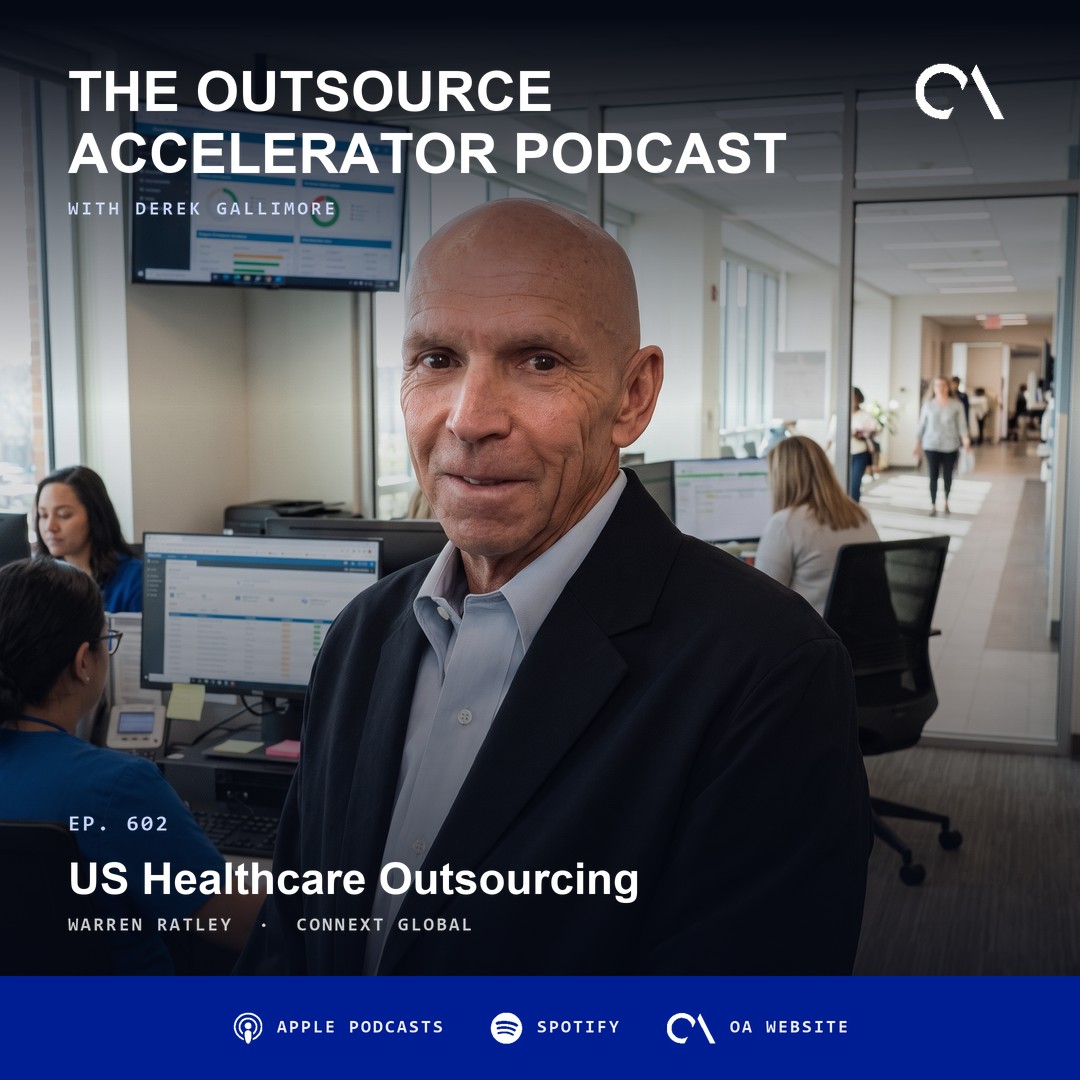
Warren Ratley spent 30 years inside the US healthcare system before crossing over, in his words, “to the dark side” of offshore outsourcing. Now Vice President and Managing Director of the healthcare division at Connext Global, he brings a rare operator’s view to a conversation he shared on the Outsource Accelerator Podcast.
The discussion covers why US healthcare is turning to offshore support, where that support fits best, and why this corner of outsourcing looks unusually resilient to AI.
Inside Connext Global
Connext is a twelve-year-old outsourcing firm with roots in healthcare. It began in Hawaii, where its founder faced a staffing shortage of his own.
“Connext has been in business for twelve years now, and it started in Hawaii to serve healthcare clients. There was a labor shortage of being able to find the right kind of healthcare worker in that market.
Right now, Connext has roughly twenty-six, twenty-seven hundred employees throughout the Philippines, Colombia, and India, with ninety percent of those being in the Philippines.”
What sets the firm apart, Warren says, is a layer of co-management rather than simply supplying staff.
“We invest in putting a layer of management to really customize the solution of not just putting workers in seats, but merging the worker with the workflows and the needs of the organization.”
A system under strain
US healthcare demand is climbing fast, skilled workers are scarce, and costs keep rising. Warren’s starting point is a simple design principle: keep clinical people at the top of their license.
“What absolutely has to be done where a provider or a staff person has to touch and feel and look a patient in the eye? And let’s design an efficient workflow for that.
But then to support all those operations, what can be done anywhere in the world, be it the other side of town or the other side of the globe?”
That split, between care that must happen in person and support that can happen anywhere, is where offshore teams come in.
Relationship, not transaction
Warren is emphatic that healthcare outsourcing is not about filling seats. It is about trust.
“We’re not solving operational problems all the time. We’re establishing trust with our partners to be able to be an extension of their mission.”
He also points to a cultural trait that suits patient care.
“There is a natural empathy that helps folks to understand the patient’s needs… It’s easy to align the culture of the Philippine healthcare worker with the US healthcare organization just because of the way they’re wired.”
Where offshore support fits first
The easiest wins are administrative. Warren points to the revenue cycle as the obvious place to start.
“[The] low-hanging fruit is the administrative functions. Start with everything to get the patient in the door, collecting the patient information, scheduling the appointment, the whole revenue cycle, the prior authorizations, then all the way through to the billing, collection, follow-up, accounts receivable management.”
From there, the work is edging closer to care itself.
“We’re also seeing lately a lot more need for clinical support in doing things like providing patient education, remote patient monitoring, chart abstraction, moving clinical information from one system to another.”
AI as a partner, not a threat
Unusually for outsourcing, Warren sees AI as an ally in healthcare rather than a threat. Often his teams sit directly behind it.
“A lot of our clients with AI scheduling systems or AI as the first level of communication, we’re the human behind the AI. There’s an escape button where they say, ‘I’m ready to talk to a human,’ and then our human appears and is aware of the conversation.”
His view is that AI reshapes roles rather than removing them.
“It’s not gonna change the need to have a human, it’s just gonna change the need for what that human is doing… AI will augment but not entirely replace it either.”
He notes the industry is moving faster than many expect.
“If you use as a frame of reference the adoption curve that went from paper charts to electronic medical records, they are adopting AI a lot faster than they did that.”
Partnering with US providers
The best results, Warren says, come from partnership rather than a vendor transaction.
“It works a lot better and the outcomes are a lot better when we approach it as a partner relationship… Success for us looks like your success.”
After three years offshore, his biggest takeaway is simple and human.
“Good people are good people. It doesn’t matter where they are. And that’s part of our job is connecting good people to good people.”
For Warren, US healthcare outsourcing is not about replacing people but about connecting a stretched system to skilled, caring teams who can carry the work that does not need to happen at the bedside.
To learn more about Connext Global’s healthcare solutions, visit connextglobal.com or connect with Warren Ratley on LinkedIn. And if you would like to learn more about what we do in the outsourcing space, send us an email at [email protected].






 Independent





