
How much does call center workforce management outsourcing cost?

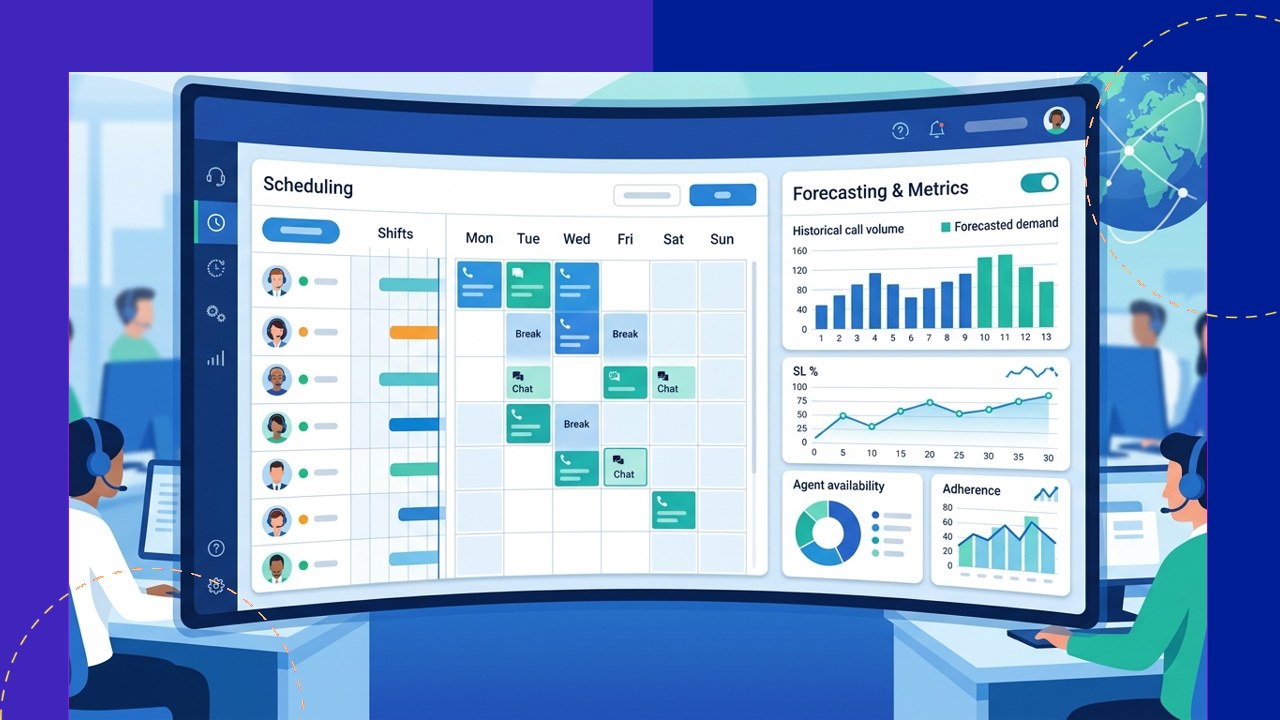
- Call center workforce management (WFM) outsourcing moves forecasting, scheduling, real-time adherence, and capacity planning to a specialist partner.
- Cost depends mainly on four levers: the pricing model, the scope of work, your call volume, and the provider’s location.
- Done well, WFM outsourcing trims overstaffing, cuts overtime, and protects service levels, so the fee often pays for itself.
Call center workforce management outsourcing hands the forecasting, scheduling, and real-time staffing of your contact center to a specialist partner. It answers one operational question. How do you put the right number of trained agents on the phones at the right moment? Get it wrong and you pay twice, first in idle agents, then in long queues and lost customers.
This guide explains what the service covers. It also breaks down what drives the price, what ranges to expect, and how to judge the return.
What is call center workforce management outsourcing?
Workforce management is the discipline of matching staff supply to customer demand. When you outsource it, an external team runs that work for you. They may use your WFM software or bring their own. The scope usually splits into four core tasks.
Forecasting
Analysts predict contact volume by channel, day, and half-hour. Good forecasts start from history, then adjust for promotions, seasonality, and known events. Because every other decision rests on this, accuracy matters most here.
Scheduling
The team builds agent schedules that cover the forecast. They balance shifts, breaks, skills, and labor rules. The goal is simple. Meet service targets without paying for idle time.
Real-time adherence
During the day, a real-time desk watches the floor. They track who is on queue, who is late back from break, and where volume spikes. When gaps appear, they move staff or trigger overtime fast.
Capacity planning
Over a longer horizon, planners size the team for the months ahead. They model hiring, attrition, and training pipelines. As a result, you stay ahead of growth instead of scrambling to catch up.
What drives the cost?
Price is not one number. Four levers move it the most: the pricing model, the scope, your volume, and the provider’s location.
Pricing model
Providers package WFM in different ways. Each model shifts risk and predictability. The table below compares the common options.
| Pricing model | How you pay | Best fit | Watch for |
|---|---|---|---|
| Per FTE (dedicated analyst) | Flat monthly rate per full-time analyst | Ongoing, predictable workload | Paying for idle capacity in quiet months |
| Hourly | Rate for hours actually worked | Project work or variable coverage | Costs climb fast at high volume |
| Managed service (subscription) | Flat fee bundling people and tools | Teams wanting staff plus software | Check what sits outside the bundle |
| Outcome-based (SLA-linked) | Fee tied to adherence or accuracy targets | Mature centers with clear metrics | Needs strong, agreed definitions |
Scope and volume
A full WFM function costs more than a single real-time desk. More channels, sites, and languages add complexity. Higher contact volume also raises the workload. However, larger accounts often earn a lower unit rate.
Location
Labor rates vary widely by country. Offshore analysts in the Philippines or India usually cost less than onshore staff. In-house teams carry more than salary too. For example, the US Small Business Administration notes that employers also pay Social Security, workers’ compensation, and unemployment insurance on top of wages. Outsourcing folds many of those costs into one fee.
What does it typically cost?
Public pricing is rare, and every contract differs. Still, a few patterns hold. A dedicated offshore WFM analyst is usually the cheapest building block. Onshore or specialist roles cost more per hour. Managed subscriptions bundle people and tools into a flat monthly fee.
Treat any headline rate as a starting point, then ask what it includes. Software licenses, reporting, and overnight coverage may sit inside or outside the quote. For a wider view of provider fees and transition costs, see this breakdown of how outsourcing costs and value fit together.
In-house versus outsourced WFM
Building WFM in-house gives you full control. However, it also means hiring scarce analysts, buying software, and covering nights and weekends. Small and mid-size centers often struggle to staff a 24/7 real-time desk. Outsourcing spreads that cost across the provider’s shared team.
Scope should still be deliberate, because not everything belongs with a vendor. MIT Sloan Management Review advises leaders to keep activities in-house that have direct impacts on product performance. For WFM, that often means owning strategy and targets while outsourcing the daily execution.
The ROI of WFM outsourcing
The payback shows up in a few clear places. Better forecasts cut overstaffing and idle pay. Tight real-time control reduces overtime and abandoned calls. Steady service levels also protect revenue and retention. For centers weighing the wider model, this overview of call center outsourcing and its trade-offs adds useful context.
Measure the return against your own baseline. Track schedule adherence, forecast accuracy, and cost per contact before and after. If those numbers move in the right direction, the fee is working.
Frequently asked questions
Is WFM outsourcing only for large call centers?
No. Smaller centers often gain the most. They rarely justify a full in-house WFM team, so a shared partner fills the gap at a lower cost.
Do I keep my own WFM software?
Usually yes, if you want to. Many providers work inside your existing platform. Others bring their own tools as part of a managed service.
How fast can an outsourced team start?
It depends on scope and data quality. A real-time desk can ramp in weeks. Full forecasting and capacity planning take longer, because analysts need clean history first.
Will outsourcing WFM reduce my control?
Not if you set clear targets. You keep the service goals and the final say. The provider simply handles the daily execution against those goals.
Key takeaways
- WFM outsourcing covers forecasting, scheduling, real-time adherence, and capacity planning under one partner.
- Pricing model, scope, volume, and location drive most of the cost, so define each before you compare quotes.
- Offshore and shared-service models lower the unit cost, while in-house control stays best for strategy and targets.
- Judge ROI against your own baseline for adherence, forecast accuracy, and cost per contact.






 Independent





