
Workplace equity for remote vs on-site staff

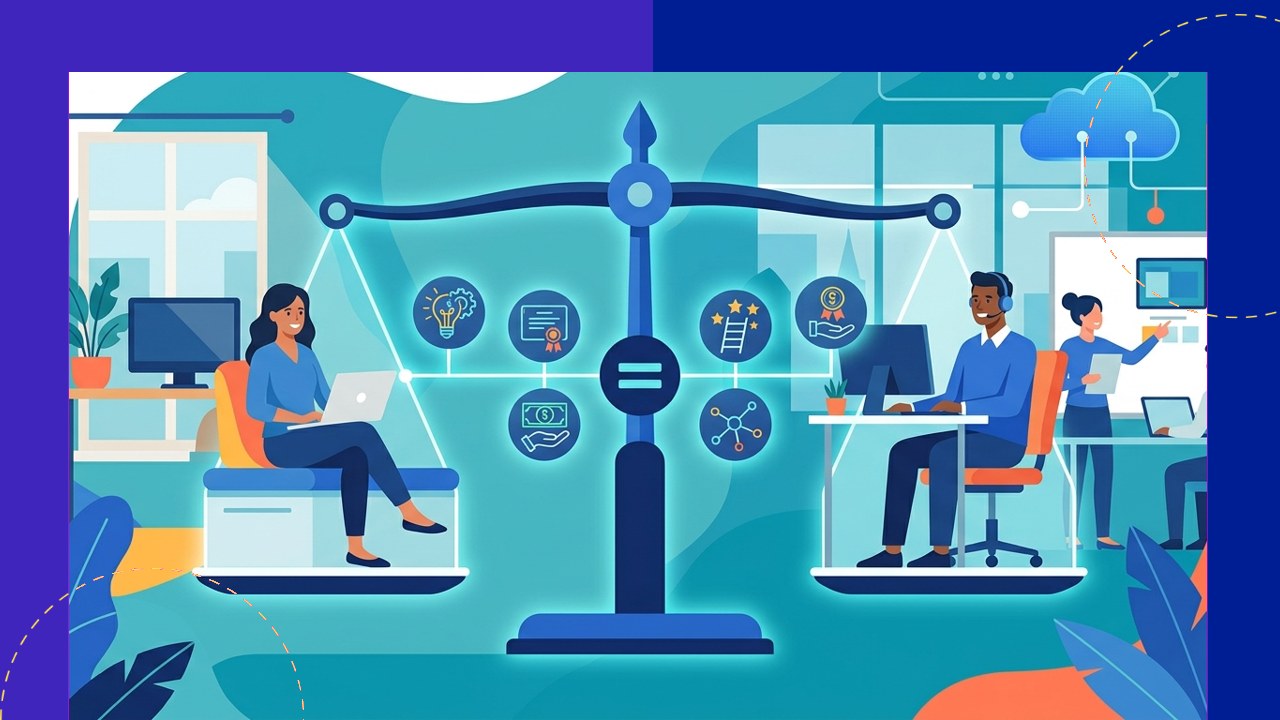
- Workplace equity for remote vs on-site staff means contribution decides outcomes, opportunities, pay, and visibility. It should never come down to who sits closest to leadership.
- Proximity bias is the main threat. Managers tend to reward the people they see, which quietly disadvantages remote and offshore staff in reviews and promotions.
- Fair hybrid teams run on location-neutral criteria, deliberate documentation, and inclusive meetings. They also track equity metrics and act on them.
Workplace equity for remote vs on-site staff means one thing. Employees earn pay, promotions, projects, and recognition on results, not on physical presence. Hybrid and distributed teams are now standard. The risk is not that remote people work less. It is that leaders see them less. That perception then leaks into decisions that shape careers.
This matters most where teams span offices and time zones. It matters even more for offshore staff, who may never share a room with the leaders who evaluate them. Left unmanaged, small daily habits compound into measurable gaps in advancement and pay. This guide explains where inequity comes from. It also covers the practices companies use to close it across in-office, remote, and offshore workers.
Why proximity bias is the core problem
Most remote-versus-onsite inequity traces back to proximity bias. Harvard Business Review defines it plainly: proximity bias “describes how people in positions of power tend to treat workers who are physically closer to them more favorably, and stems from the antiquated assumption that those who work remotely are less productive than those who work from the office.” The penalty often has little to do with actual output.
The bias is usually unconscious. A manager shares news with whoever is at the next desk. The visible project goes to the person in the room. The manager reads office presence as commitment. Over months, those micro-decisions become an uneven playing field.
SHRM frames this as a leadership responsibility. It warns managers against “offering the most interesting projects, assignments or development opportunities to onsite employees.” When the best work routes to the nearest people, remote and offshore staff lose the experiences that build a promotion case.
The main dimensions of equity to manage
Equal access to opportunities and promotions
Leaders should post career-defining assignments and award them against clear criteria, not hand them out through hallway conversations. Track who gets stretch projects, client exposure, and promotions by work location. If in-office staff advance faster at equal performance, fix the process, not the people.
Pay and benefits parity
Decide deliberately how location affects pay. Many companies anchor compensation to role and market rather than to office attendance. This stops managers from quietly underpaying a remote or offshore employee who does the same work at the same level. Benefits also need parity. Home-office stipends, learning budgets, and wellness perks should not favor those who happen to walk past the office pantry.
Visibility and recognition
Remote contributions are easy to overlook because they happen off-screen. Build recognition into the system through written updates, shared dashboards, and credit given by name in team channels. The goal is simple. Everyone sees good work regardless of where it happened.
Common inequities and corrective practices
The table below maps the everyday inequities that surface in hybrid and distributed teams. Each one comes with a practical correction leaders can put in place.
| Common inequity | Corrective practice |
|---|---|
| Onsite staff hear news and decisions first in the hallway | Make written channels the source of truth so information reaches everyone at once |
| High-visibility projects default to people in the room | Post opportunities openly and assign against documented criteria |
| Reviews reward “engagement” managers witnessed in person | Score performance on outputs and deliverables, not observed presence |
| Hybrid meetings favor the confident voices at the table | Run one-screen-per-person meetings with a facilitator and round-robin input |
| Remote and offshore staff are forgotten when work is handed out | Keep a location-visible task log so distribution is auditable |
| Pay quietly tracks office attendance | Anchor compensation to role, level, and market with a clear location policy |
How to build inclusive meetings and communication
1. Level the meeting itself
When some people share a conference room and others dial in, the remote group loses out. A common fix is to have everyone join from their own device. That way all participants are equal on screen. Assign a facilitator to draw in quieter and remote voices.
2. Default to writing
Decisions made verbally in the office vanish for everyone else. Document decisions, action items, and context in a shared space. Asynchronous, written communication is one of the strongest equalizers for offshore teams working across time zones. Guidance on best practices for thriving with offshore teams echoes this point.
3. Rotate the inconvenience
If recurring meetings always land in the head-office time zone, the same remote staff always take the late call. Rotate meeting times instead. You can also record sessions and let people contribute asynchronously, so everyone shares the burden fairly.
Measuring equity so it actually improves
Equity tends to drift when no one measures it. Gallup’s research points to fairness as a trust driver in hybrid teams. It also notes that letting teams shape their own schedules sharply raises the share who see the policy as fair. Perceived fairness is a signal worth tracking alongside hard outcomes.
Review promotion rates, pay bands, project assignments, and attrition by work location at least twice a year. A gap may appear between remote, offshore, and onsite staff at equal performance levels. If it does, treat it as a process defect and trace the decision points that produced it.
Pair the numbers with direct input. Simple pulse questions on whether people feel included, informed, and fairly evaluated will surface problems before they show up in turnover. For distributed and offshore setups, a consistent management rhythm is the connective tissue. This overview of building a hybrid workforce for the future of work covers that in more depth.
Frequently asked questions
What is proximity bias in simple terms?
It is the tendency to favor people you physically see more often. Managers unconsciously give closer staff more trust, better projects, and higher ratings. This happens even when remote or offshore colleagues perform just as well or better.
Does workplace equity mean everyone gets identical pay?
No. Equity means the same role at the same level and performance is rewarded consistently, regardless of location. Companies still set pay by role and market. They simply avoid quietly penalizing someone for working remotely or offshore.
How do we keep offshore staff from being overlooked?
Make information written and shared, assign work through a visible log, rotate meeting times across time zones, and credit contributions by name. Then review assignment and promotion data by location to confirm the practices are working.
How often should equity be reviewed?
At least twice a year. Segment promotions, pay, project distribution, and attrition by work location. Combine that with short inclusion pulse surveys so you catch both the measurable gaps and the perceived ones.
Key takeaways
- Equity between remote and on-site staff is decided by process design, not good intentions. Proximity bias is the default that leaders must actively counter.
- Manage four dimensions together: access to opportunities, pay and benefits parity, visibility, and inclusive meetings.
- Location-neutral evaluation criteria and written-first communication protect remote and offshore workers from being unseen.
- Measure promotions, pay, and attrition by work location twice a year, and act on any gap as a fixable process defect.






 Independent





