
7 ways real estate firms use Dynamics 365 to manage clients and deals


- Real estate firms that implement Dynamics 365 as a simple contact database capture only a fraction of the platform’s value across deal tracking, lease management, and financial compliance.
- The platform’s modular architecture (covering sales, customer service, finance, and business intelligence) maps directly to the full lifecycle of a real estate transaction or tenancy.
- The global real estate CRM market was valued at USD 5.31 billion in 2026 and is growing at 8.1% CAGR through 2030, driven by demand for automated lead management and integrated transaction tracking.
- Itransition has 10+ years of CRM and ERP delivery experience, certified Microsoft Solutions Partner status since 2008, and Dynamics 365 implementations across real estate and adjacent verticals.
Most real estate firms that adopt Dynamics 365 start with the CRM module, managing contacts, tracking leads, logging communications. That’s a reasonable first step, but it captures perhaps 20% of what the platform can do for a real estate organization.
Business Research Insights values the global real estate CRM market at USD 5.31 billion in 2026, with projected growth to USD 14.97 billion by 2035 at a 12.2% CAGR. The growth is driven by demand for automated lead management, AI-enhanced client analytics, and integrated transaction tracking tools.
Understanding the full range of benefits that CRM systems deliver sets the baseline for evaluating whether Dynamics 365 is being used at the depth it supports.
How real estate firms use Dynamics 365 across operations
These seven use cases represent the most common ways real estate organizations extract operational value from Dynamics 365, from front-office client management through back-office compliance and reporting.
| Use case | Dynamics 365 module | Primary benefit |
|---|---|---|
| Client and prospect pipeline | CRM | Full interaction history, segmentation, follow-up tracking |
| Deal tracking and commissions | Sales | Pipeline visibility, automated commission calculation |
| Property and lease management | Real estate configuration | Lease lifecycle, critical date alerts, IFRS 16/ASC 842 compliance |
| Financial reporting and accounting | Business Central | Integrated financial statements, ERP-level compliance reporting |
| Tenant service and support | Customer Service | Case management, SLA tracking, escalation workflows |
| Retail tenant management | Retail module | Occupancy tracking, turnover rent, retail lease workflows |
| Portfolio dashboards and BI | Power BI (native Dynamics integration) | Real-time portfolio analytics, AI-assisted reporting |
1. Client and prospect pipeline management
The Dynamics 365 CRM platform tracks every prospect interaction from initial inquiry through closing or tenancy: call logs, email history, document exchanges, and next-action tasks. Pipeline views at the team and portfolio level make it visible which leads are stalled and which are progressing, a capability that informal spreadsheet tracking cannot replicate at scale.
2. Deal tracking and commission management
The Dynamics 365 Sales module manages deal stages, close probability, expected revenue, and commission structures tied to specific transaction outcomes. Commission rules can be configured for split arrangements, referral fees, and tiered structures that vary by agent, property type, and transaction value.

Automated commission calculations reduce manual reconciliation at month-end and generate audit-ready records for finance.
3. Property and lease administration
The Dynamics 365 real estate configuration supports property records, lease lifecycle management, maintenance schedules, and portfolio-level reporting. Lease records include critical dates (renewal options, break clauses, rent review triggers) with automated alerts to prevent missed actions.
For property managers handling mixed portfolios, standardizing lease data across all asset types in one system is operationally significant.
Pro Tip: When configuring Dynamics 365 for a portfolio that includes retail or mixed-use assets, include retail tenant data integration in the initial implementation scope. Retrofitting the data flow between tenant-reported sales and lease records onto an established deployment is significantly more complex than building it from scratch.
4. Financial reporting and accounting
Dynamics 365 Business Central handles the financial management layer: general ledger, accounts payable and receivable, budgeting, and statutory compliance reporting. For real estate firms operating across multiple entities or portfolios, Business Central’s integrated financial statements eliminate the manual consolidation that separate accounting systems require.
5. Tenant service and support management
Dynamics 365 Customer Service manages tenant and buyer service requests (maintenance tickets, billing queries, dispute resolution) with full case history, SLA tracking, and escalation workflows. Service requests are linked to the relevant property record, giving customer-facing staff immediate context on the asset and tenancy behind each inquiry.
For commercial property managers handling hundreds of tenant relationships, structured case management replaces the informal email tracking that frequently causes requests to go unresolved.
6. Retail tenant management
Dynamics 365 for retail handles the lease structures that commercial and mixed-use portfolios require: turnover rent calculations, occupancy tracking, and lease workflows tied to tenant-reported sales.
Retail tenant records integrate with the core property and financial modules, keeping all lease data consistent across the portfolio.
7. Business intelligence and portfolio dashboards
Power BI, integrated natively with Dynamics 365, aggregates data across all modules into real-time portfolio dashboards. Real estate firms use these dashboards to track occupancy rates, AR aging by property, lease expiry distribution, pipeline conversion rates, and agent performance across their full portfolio.
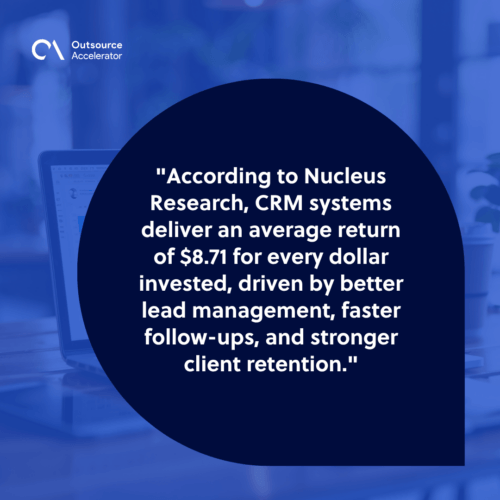
According to Nucleus Research, CRM systems deliver an average return of $8.71 for every dollar invested, driven by better lead management, faster follow-ups, and stronger client retention.
Pro Tip: Configure dashboards for both operational managers (asset-level data) and executive leadership (portfolio-level KPIs) from the start of your implementation. The data model is the same, the views are different. Building both early avoids the common pattern of executives reverting to spreadsheet exports because the system views weren’t designed for their use case.
What Dynamics 365 implementation actually requires
Dynamics 365’s modular architecture means that implementation scope and complexity vary significantly by the number of modules deployed and the degree of customization required.
The most common challenges for real estate organizations are:
- Data migration. Lease records, property data, and contact histories often exist across multiple legacy systems with inconsistent formatting that requires cleaning before migration.
- Custom workflow configuration. Commission structures, approval hierarchies, and lease administration workflows vary by organization and require configuration beyond standard module defaults.
- Integration with third-party systems. Property management platforms, accounting systems, and document management tools need integration design to eliminate duplicate data entry.
Understanding what digital transformation services actually cover helps set accurate scoping expectations before an engagement starts.
How Itransition implements Dynamics 365 for real estate
Itransition brings 10+ years of CRM and ERP delivery experience, certified Microsoft Solutions Partner status since 2008, and Dynamics 365 projects across commercial, residential, and mixed-use real estate portfolios.
- Consulting. Advisory support across module selection, integration design, and change management, from initial scoping through go-live.
- Implementation. Full lifecycle deployment of Dynamics 365 modules across sales, customer service, finance, and business intelligence.
- Customization. Configuration of commission structures, lease workflows, approval hierarchies, and third-party integrations to match specific organizational requirements.
- Ongoing support. Post-implementation monitoring, compatibility updates, and enhancement development as business requirements evolve.
- Microsoft expertise. Certified Microsoft Solutions Partner since 2008, with specialist knowledge across Dynamics 365 Sales, Customer Service, Business Central, Field Service, and Customer Insights.
Organizations ready to implement Dynamics 365 across the full real estate module suite can connect with Itransition for end-to-end delivery across consulting, implementation, and support.
Frequently asked questions
How long does a Dynamics 365 implementation typically take for a real estate firm?
A single-module implementation (CRM only) typically takes 2-4 months. Multi-module deployments covering sales, customer service, and finance run 6-12 months, depending on data migration complexity, customization scope, and integration requirements.
Phased rollouts (starting with one module and expanding) are common for organizations managing change management risk.
Can Dynamics 365 integrate with existing property management software?
Yes. Dynamics 365 integrates with most major property management platforms through standard APIs and, for platforms without native connectors, through Power Automate or custom integration development.
The integration design phase is typically where implementation complexity concentrates for organizations running established property management systems alongside a new Dynamics 365 deployment.
Key takeaways
- Dynamics 365 supports the full real estate operational lifecycle, from prospect management through deal closing, lease administration, tenant service, and portfolio analytics.
- The seven primary use cases each map to a specific Dynamics 365 module: CRM, Sales, real estate configuration, Business Central, Customer Service, retail management, and Power BI.
- The most common implementation challenges for real estate firms are data migration from legacy systems, custom commission and lease workflow configuration, and third-party integration design.
- Itransition delivers end-to-end Dynamics 365 implementations for real estate as a certified Microsoft Solutions Partner, covering consulting, deployment, customization, and support across the full module suite.






 Independent





