
How to structure an offshore development team for a SaaS product


At a glance
- An offshore SaaS team needs more than engineers. QA, DevOps, and a technical lead belong in the structure from day one.
- Communication and workflow integration matter as much as technical skill. Teams handed task lists without product context underperform those in sprint cycles.
- Treating offshore engineers as an isolated vendor pool underperforms an integrated model where they join planning, retrospectives, and architectural decisions.
- ConnectOS specializes in Integrated Resourcing for SaaS companies, building dedicated offshore development teams that embed with the product workflow rather than operating as a separate contractor pool.
Building a SaaS product with an offshore development team requires more than finding capable engineers. The structure of the team, how roles are distributed, how communication flows, and how accountability is managed across time zones — these determine whether the engagement accelerates product development or slows it.
Most of the failure modes in offshore SaaS development are structural, not technical. The engineers are capable. The setup is wrong.
This article covers how to structure an offshore development team that actually integrates with a SaaS product workflow, and what gets overlooked when companies build offshore for the first time.
What an offshore SaaS development team should include
The minimum functional team for a SaaS product is larger than most founders initially plan for. Starting with just frontend and backend engineers, then adding QA and DevOps as afterthoughts, creates the bottlenecks it was supposed to avoid.
Core roles:
- Frontend engineers (framework-matched to the product stack)
- Backend engineers
- QA engineers — present from the start, not added post-release
- DevOps or infrastructure specialists
Recommended additions:
- An offshore technical lead or delivery manager
- UX or design, if product iterations require frequent design input
Offshoring QA alongside engineering — rather than keeping QA onshore — captures the full cost benefit of the offshore model without the quality risk of shipping untested features. DevOps offshore similarly reduces infrastructure management costs without creating a separate silo that engineers cannot access directly.
How to structure communication across an offshore development team
Communication structure is where most offshore SaaS engagements either succeed or fall apart. The goal is not to replicate a co-located team experience — it is to create a workflow where context travels across time zones without degrading and decisions do not stall waiting for a synchronous window.
A functional structure typically includes:
- One shared standup per day within an overlapping window — usually early morning for the onshore side, late afternoon for the offshore team
- Sprint planning and retrospectives with full team participation — offshore engineers need to be in the room where product priorities are set, not briefed after the fact
- Clear ownership split — onshore product lead owns the backlog and prioritization; offshore technical lead owns delivery and technical decision-making
- Defined escalation paths — what blocks can the offshore team resolve independently, and what requires onshore input?
- Shared tooling: Jira or Linear for task tracking, Confluence or Notion for documentation, Slack or Teams with defined response windows for async communication
Research from Great Place To Work, analyzing 1.3 million employees, found that team members who feel they can rely on colleagues are 8.2 times more likely to give discretionary effort.
This finding underscores why integrating offshore engineers into ceremonies and product context produces better output than managing them as an isolated task pool.
Why integration beats isolation for offshore SaaS development
The isolated offshore model — where engineers receive task lists and return completed work — exists on paper as a cost-reduction strategy. In practice, it delivers worse output than a smaller, well-integrated offshore team.
SaaS product decisions require context that does not travel well in task descriptions. Why a feature works the way it does, what the upcoming sprint is trying to validate, what the most common user failure mode is — this context only accumulates through participation in planning and retrospectives.
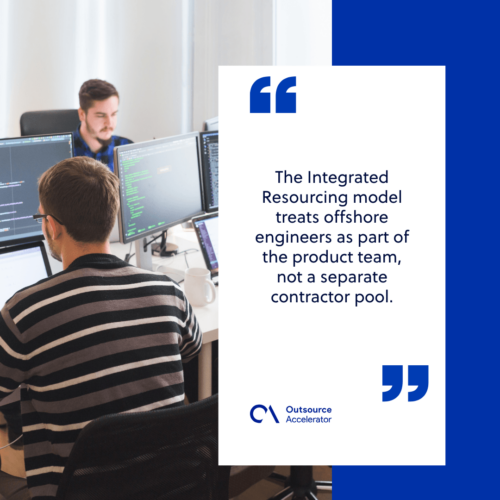
The Integrated Resourcing model treats offshore engineers as part of the product team, not a separate contractor pool. They attend ceremonies, participate in technical review, and operate with the same product context as their onshore counterparts.
The result is better technical decisions made faster, with fewer cycles of revision.
Common mistakes SaaS companies make when building offshore development teams
- Under-communicating product context before work begins — Sending a ticket backlog without explaining the product’s core problems and current priorities leaves the offshore team executing tasks with no basis for judgment on priority or edge cases.
- Treating the offshore team as a vendor rather than a team extension — This shows up in how retrospectives are run, who attends planning, and whether the offshore technical lead has authority to push back on poor decisions.
- Skipping an offshore technical lead — Without a technical counterpart on the offshore side, communication funnels through the onshore product lead, which creates a bottleneck and delays resolution of engineering-side issues.
- Expecting same-day turnaround across an 8-plus-hour time zone difference — Work that arrives late in the onshore workday cannot be completed and reviewed until the following day; planning that ignores this creates artificial urgency.
- Excluding the offshore team from retrospectives and planning — This is where context accumulates. A team kept at arm’s length from these ceremonies operates with steadily degrading product understanding over time.
Build your integrated offshore SaaS development team with ConnectOS
ConnectOS specializes in Integrated Resourcing, helping SaaS companies build dedicated offshore development teams that embed with their product workflow rather than operating as a separate vendor pool.
Each offshore engineer is sourced through a rigorous talent process, matched to the client’s technical stack and culture, and integrated into sprint ceremonies, code review workflows, and product planning from day one.
- Integrated Resourcing model — offshore engineers participate in planning, retrospectives, and architectural decisions, not just task execution
- Full-stack coverage across software engineering, QA, DevOps, product support, and technical roles in a wide range of languages and platforms
- Rigorous talent matching to the client’s technical stack and engineering culture, not generic CV screening
- Scalable team structures built to the actual requirements of the product, from a two-person QA function to a full cross-functional engineering team
Find out how ConnectOS can structure a dedicated offshore development team around your SaaS product.
Frequently Asked Questions
Common questions about building and managing an offshore development team for a SaaS product.
How many offshore developers do I need to start?
A functional offshore SaaS team typically starts with two to four people — at minimum one backend engineer, one frontend engineer, and one QA engineer.
Starting smaller than this creates artificial bottlenecks; starting with one developer and no QA almost always produces slower iteration than a slightly larger, more complete team from the start.
How do I maintain code quality with an offshore development team?
Establish code review standards upfront, integrate offshore engineers into the CI/CD pipeline, and maintain shared documentation standards from day one.
Quality monitoring should be built into the workflow through automated testing, mandatory peer review, and retrospectives — not added as a corrective measure after quality problems appear.
Can I offshore a full-stack SaaS team?
Yes. Full-stack offshore SaaS teams are common and can include frontend, backend, QA, DevOps, and design roles.
The critical success factors are communication structure and an offshore technical lead who has both the technical authority and the product context to keep the team moving between synchronous windows.
Key takeaways
- An offshore SaaS development team needs QA, DevOps, and an offshore technical lead from the start — not added later when structural problems have already compounded.
- Communication structure and product integration determine whether an offshore team accelerates or slows development, independent of individual technical skill.
- The Integrated Resourcing model — where offshore engineers participate in planning and retrospectives, not just task execution — produces consistently better outcomes than an isolated contractor arrangement.
- ConnectOS builds dedicated offshore SaaS development teams structured around the product workflow, with rigorous talent matching and an integrated engagement model from day one.






 Independent





