
A Chiang Mai-Based Outsourcing Firm with a Difference with Mikkel Schmidt of Azendo


Mikkel Schmidt, CEO and founder of Azendo, joins the Outsource Accelerator Podcast to explain how he built a deliberately small, higher-end staffing firm out of Chiang Mai, Thailand.
Danish by background and 17 years in Thailand, Mikkel makes the case that pricing on quality rather than on cost is what lets Azendo attract better talent, keep it for years, and weather the AI shake-up.
Azendo
Azendo places dedicated offshore teams in Thailand, weighted toward software development rather than customer service, from two offices: its Chiang Mai headquarters and a second location in Bangkok.
At roughly 100 employees, it is small by BPO standards, and that is by design.
“A lot of BPO companies have thousands of employees. We are roughly around 100 employees here. Our biggest service areas are more software development rather than customer service…
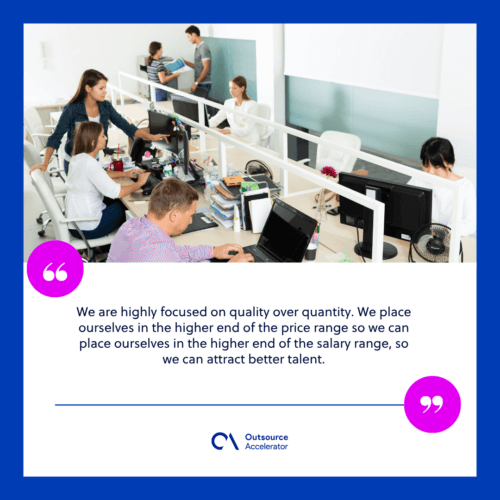
We are highly focused on quality over quantity. We place ourselves in the higher end of the price range so we can place ourselves in the higher end of the salary range, so we can attract better talent.”
From digital agency to staffing firm
Azendo did not start in staffing. It began as a digital agency, and the pivot happened gradually as European agencies started using the team as their extended production.
“Given our location, we had a lot of agencies in Europe who kind of used us as their extended production, like outsourcing, but on an hourly rate or project base.
And at some point the demand grew, so it was a time for a lot of them where it made more sense to have people on full-time rather keeping working on a project basis.”
Mikkel set a clear threshold for going all in, then acted on it.
“We later on made a goal that once the company was 70% dedicated outstaffed to partners, we would then change to only work with staffing. And that happened around 2021… we sold the agency part of the company.
We used to be named VSI Group, so at that time we rebranded to Azendo and then went fully in on the staffing business.”
Hiring globally, based in Thailand
Azendo’s most distinctive feature is that most of its talent is not local. Around 80 percent of its people are expats that it relocates to Chiang Mai, which lets it fill needs local hiring cannot.
“We usually say that we might be located in Thailand, but we are hiring globally. So we’re relocating a lot of people to Thailand.”
The cost advantage, Mikkel explains, comes from the gap in living costs rather than from cut-rate salaries.
“Of course, expats are still expecting a higher salary than most locals are, but they’re still also very aware that they’re relocating to a place where living cost is five times lower than at home.
So we are landing somewhere in the middle between a little bit above local salaries and below salaries in the country they’re from.”
A human-first approach to retention
Mikkel repeatedly calls Azendo a “human-first” company, and ties its benefits directly to keeping people for the long term, from two remote days a week to daily lunches. Retention runs at about 3.3 years for expats and four and a half years for locals, with some staff staying 12 to 15 years.
“We have a free lunch every day for our staff… Once a year, we also offer flight tickets for our expat staff, so they can go back home and visit family.
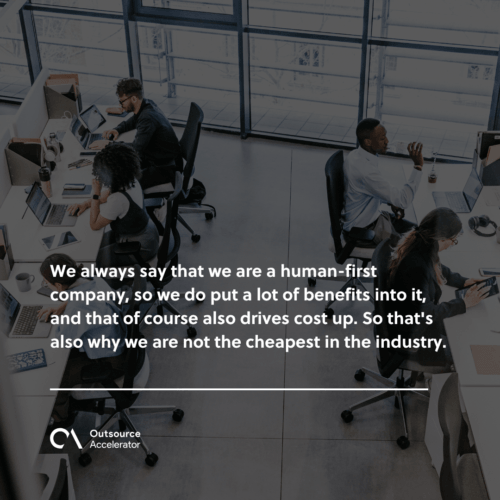
We always say that we are a human-first company, so we do put a lot of benefits into it, and that of course also drives cost up. So that’s also why we are not the cheapest in the industry.”
The same care extends to clients, who are flown out once a year to meet their teams in person.
What AI is doing to the staffing industry
Mikkel is candid that AI rattled the staffing industry early in the year, and that a few clients cut teams to replace people with AI. What has followed, though, is a swing back.
“If anyone is going to be replaced, it would be those people who do not know how to utilize AI. So we made sure that our staff here knows how to utilize AI and use it on a daily basis and create value by using it.”
He now sees demand returning as the running cost of AI climbs.
“There’s a lot of articles that started to surface around the topic that AI is becoming more expensive than people. So a lot of companies have been giving their staff free access to AI, and now they’re realizing that the amount of tokens they’re using is costing more than it would cost to hire a junior developer.
It’s been very heavy on the AI side, and now it’s kind of coming back into balance again.”
His broader view is that AI is a tool that scales output rather than shrinks headcount: given “superpowers,” companies tend to do more, not employ fewer people.
For Mikkel, the lesson of 17 years is that treating staffing as a human-first, quality-first business, not a race to the cheapest rate, is what builds a company that lasts.
To learn more about Azendo, visit azendo.co or connect with Mikkel Schmidt on LinkedIn. If you’d like to learn more about what we do in the outsourcing space, send us an email at [email protected].






 Independent





