
Outsourcing, AI & Human-in-the-Loop with King Alandy Dy of Expedock

King Alandy Dy, CEO and co-founder of Expedock, joins the Outsource Accelerator Podcast to explain how he built a deliberately different kind of BPO. Expedock started as a Silicon Valley software company and now sits at the centre of the AI boom.
With around 400 staff and a “human-in-the-loop” model, King makes the case that the BPOs merging people with AI fastest will pull ahead of the slower-moving incumbents.
Expedock
Founded by Filipino entrepreneurs but born in Silicon Valley, Expedock began as a pure software business automating logistics processes before pivoting to a human-in-the-loop model.
Today it serves logistics firms, shippers, real estate and healthcare companies, and — increasingly — AI companies, with around 400 staff.
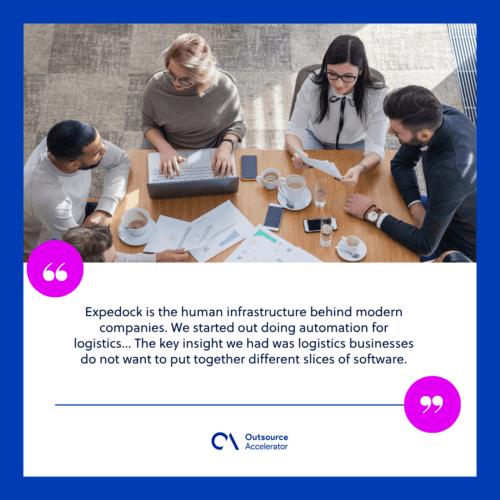
“Expedock is the human infrastructure behind modern companies. We started out doing automation for logistics… The key insight we had was logistics businesses do not want to put together different slices of software.
What they want is the job done — the entire end-to-end process finished. That’s what they’re willing to pay for.”
From logistics software to Human-in-the-Loop
King’s team tried to solve the problem with technology alone, then discovered the limits of pure automation — and leaned into a model that was still niche at the time.
“We tried to do this with just technology. Very quickly realized, especially at that time, this was not possible.
So we went the human-in-the-loop route. Human-in-the-loop, HITL, is now a very common acronym, but back in 2020, 2021, not as much.”
That pivot, backed by venture capital, set the template for everything that followed: technology to do the heavy lifting, people to make it actually work in messy, real-world processes.
Forcing the change: Lessons from Silicon Valley
A Stanford scholarship put King inside the Silicon Valley ecosystem, and the contrast with the BPO industry’s instincts left a mark.
“It was really interesting to be in an environment where everyone is chasing change. In the BPO industry… there’s that resistance to change.
Even the more legacy staff — there is resistance to use tooling. They will try to find reasons why it doesn’t work.”
His conclusion is blunt, and it drives how Expedock operates: “You just gotta force the change, because the technology is there.” He believes the impact of the latest models on the BPO industry is still understated.
Plugging AI-native people into old-school businesses
One of Expedock’s fastest-growing segments is modernising established businesses. It does this not by selling software, but by inserting people who already know how to wield AI tools.
“We’ll typically talk to the owner and ask, ‘Where’s your headache now? Where do you feel the work is really redundant?’
It tends to narrow into a few buckets… We can do sales really well. Executive assistants is another common bucket. Customer support is another.”
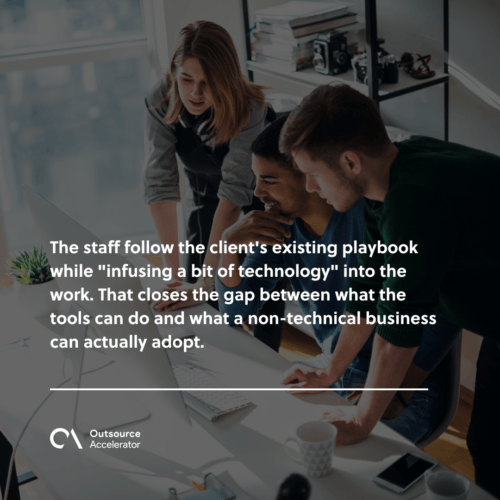
The staff follow the client’s existing playbook while “infusing a bit of technology” into the work. That closes the gap between what the tools can do and what a non-technical business can actually adopt.
Training the machines: The new annotation demand
The newest wave of demand comes from AI companies themselves, and it’s lucrative. King says specialised annotation — not commodity labelling — is where the value sits.
“Within the past month we’ve brought in seven figures in revenue from just AI-related work… Now a lot of them want doctors to train their models, people with med-tech backgrounds, psychologists to train their models.”
He rejects the idea that annotation is a race to the bottom, arguing the appetite for labelled data keeps expanding:
“It’s the same thing as when people started making sewing machines… instead of needing three shirts, I probably have 100 shirts. The appetite for labelled data continues to expand.”
Why Human-in-the-Loop isn’t going away
King is candid that AI cannibalises some headcount, but is equally clear that the work doesn’t collapse to zero. The real product, he says, is the orchestration of people and AI.
“You don’t want to see it as ‘I talked to this bot and it does everything.’ It’s a funnel… AI, then human, then AI, then human — multiple people passing around the work to make it actually work.”
Looking ahead, he expects the workforce itself to change shape:
“Instead of maybe having 400 humans, maybe I’ll have 400 humans and 1,000 AI employees.”
For King, the future isn’t AI replacing people but humans and AI working side by side — and the BPOs that merge the two fastest will define the industry’s next chapter.
To learn more about Expedock, visit expedock.com or connect with King Alandy Dy on LinkedIn.
If you’d like to learn more about what we do in the outsourcing space, send us an email at [email protected].






 Independent





