
Workplace productivity trends 2026: Benchmarks every leader should know


What are the top workplace productivity trends in 2026?
The top workplace productivity trends in 2026 show that output now depends on smart system design, protected focus time, and role-based work rhythms, not longer hours.
- Focus time is the new core benchmark for quality output.
- Work rhythms now vary sharply by role, team, and workstyle.
- Tool overload and shallow AI use quietly drain results.
Here is the quick view for busy leaders:
- Productivity in 2026 is a system design challenge, not a people problem
- Focus time is emerging as a core productivity benchmark
- Work rhythms now vary sharply by role, team, and workstyle
- Tool overload and AI misuse are quietly draining output
- 50+ hour workweeks signal capacity failure, not commitment
- The 2026 Global Trends and Benchmarks Report by Hubstaff gives role-level data leaders can benchmark against
If you lead a BPO, outsourcing, or distributed team, you have likely noticed something uncomfortable. People are busy, yet progress feels slower.
Meetings are everywhere. Meanwhile, tools keep multiplying. AI is “adopted,” but outcomes have not improved much. Still, burnout risk keeps rising.
That is exactly the problem explored in Hubstaff’s 2026 Global Trends and Benchmarks Report: How Work Gets Done. In short, it is a data-backed study of how modern teams really work across roles, regions, and workstyles.
This article highlights the most important workplace productivity trends for 2026. It focuses on BPO and global delivery leaders. Meanwhile, it leaves the deeper benchmarks where they belong, inside the full report.
Workplace productivity trends every leader should know in 2026
Here is a taste of what the report covers.
1. Diverging work rhythms by role, team, and workstyle
Microsoft’s Work Trend Index found that about half of all meetings fall between mid-morning and early afternoon. Unfortunately, that is when many people want to do focused work.
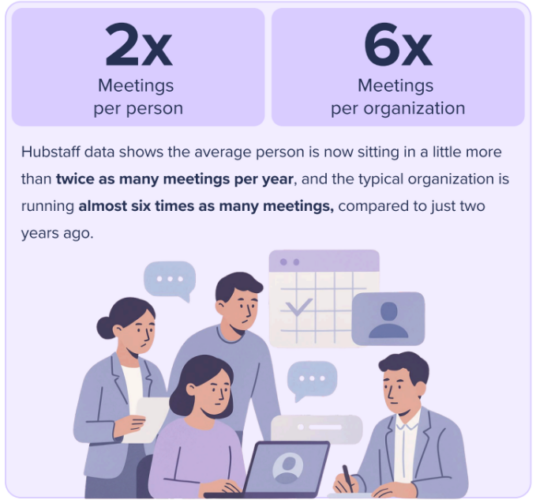
The idea that everyone should work the same way is now broken. That means the same hours, the same meeting load, and the same cadence for all.
In 2026, productivity rhythms diverge sharply:
- Managers coordinate
- Customer support reacts
- Analysts and engineers need long focus blocks
For BPOs, this matters a lot. For example, one set of rules across support, operations, QA, and leadership creates friction instead of efficiency.
Trend insight: High-performing teams now design role-based productivity guardrails, not one-size-fits-all targets.
2. Focus time as core
In knowledge and service work, attention is the bottleneck.
Hubstaff’s research shows that true focus time is now the most reliable signal of output quality. That means uninterrupted, meaningful work. So it is not hours logged, and not online presence.
For outsourcing leaders, this point is critical:
- Too many meetings reduce focus
- Constant messaging fragments attention
- Hybrid teams often suffer the worst focus erosion
Trend insight: Leading teams now treat focus time as a KPI. In practice, they track it at the team level, not on each person.
3. The triple-peak workday
One of the most striking 2026 patterns is the triple-peak workday:
- Morning work
- Afternoon work
- Evening work
This pattern is growing across global teams. For example, it appears in BPOs serving many time zones.
However, here is the catch:
- Intentional triple-peak days = flexibility
- Unspoken triple-peak days = burnout risk
When evening work becomes expected, not optional, boundaries disappear fast.
Trend insight: After-hours work must be explicitly designed, not silently assumed.
4. Productivity drains: Tool overload
More tools were supposed to help. Instead, many teams are drowning in them.
The average worker now touches dozens of apps daily. Meanwhile, every switch carries a mental cost. For BPO teams with CRMs, ticketing, QA tools, chat, and reporting, this adds up fast.
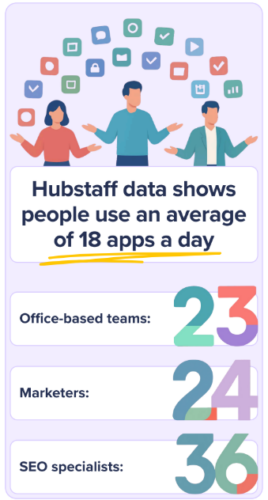
In fact, one study found that workers shifted between apps as many as 1,200 times a day.
Tool overload leads to:
- Lower focus
- Higher coordination time
- More “work about work”
Trend insight: Smart leaders do not cut tools blindly. Instead, they build a clear digital spine with defined “tool-for-what” rules.
5. AI at work: Adoption vs. impact
AI adoption numbers look impressive. But outcomes? Mixed.
As noted in the AI Productivity Shift, 67% of employees say they use AI at work. Yet it only accounted for 4% of tracked time.
So the gap is clear:
- AI adoption is high
- AI impact is uneven
In many teams, AI is still used for quick drafts, summaries, or one-off tasks. As a result, it is not yet built into workflows.
For BPOs, the opportunity is huge. For example, AI can help with:
- Ticket triage
- Call summaries
- QA reviews
- Reporting and analysis
Trend insight: AI delivers real gains only when it becomes a co-pilot inside standard processes, not a novelty tool.
6. The myth of the 50+ hour workweek
Long hours are often mistaken for dedication. However, the data tells a different story.
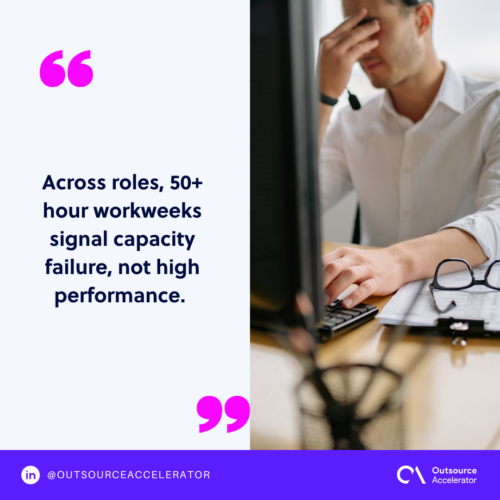
Across roles, 50+ hour workweeks signal capacity failure, not high performance. They are especially common in:
- Middle management
- Customer-facing roles
- Sales and operations
For outsourcing providers, chronic overwork also brings quality risk, attrition, and compliance issues across regions.
Trend insight: Sustainable output beats heroic effort every time.
Productivity signals leaders should watch in 2026
| Signal | What it indicates | Why it matters for BPOs |
| Focus time trends | Ability to do deep work | Direct link to service quality |
| Meeting distribution | Fragmentation vs. flow | Predicts burnout risk |
| App usage per day | Tool overload | Affects efficiency and onboarding |
| AI usage depth | Workflow maturity | Separates pilots from impact |
| 50+ hour weeks | Capacity failure | Early warning for attrition |
Benefits of workplace productivity trends for leaders in 2026
For BPO and outsourcing leaders, these trends unlock real advantages:
- Better service consistency across shifts and regions
- Lower burnout and attrition, especially in client-facing teams
- Stronger capacity planning without constant firefighting
- Smarter AI investments tied to outcomes, not hype
- Clearer conversations with clients about sustainable delivery
How can leaders use workplace productivity trends
The goal is not to copy other companies. Instead, it is to spot unhealthy patterns early.
So effective leaders use productivity trends to:
- Set role-appropriate guardrails
- Redesign meeting rhythms
- Simplify tool stacks
- Embed AI into core workflows
- Treat long hours as a review trigger, not a norm
Benchmarks are diagnostic tools, not performance quotas.
Go deeper with productivity benchmarks
This article only scratches the surface.
The Hubstaff 2026 Global Trends and Benchmarks Report goes deeper. For example, it covers:
- Role-level productivity benchmarks
- Workstyle comparisons (remote, hybrid, office)
- Global patterns across industries and regions
- Practical guidance for redesigning how work gets done
For BPO leaders managing distributed teams at scale, this data offers a practical blueprint, not theory.
Frequently Asked Questions (FAQs)
What are workplace productivity trends in 2026?
They reflect how focus, work rhythms, AI use, tools, and capacity planning reshape performance.
Why is focus time important for productivity?
Because output depends on attention, not activity. Without focus, both speed and quality suffer.
How does AI improve productivity in BPOs?
When it is built into workflows, AI cuts manual effort and cycle time. However, occasional use does little.
Are long work hours still a productivity signal?
No. In 2026, they are treated as an early warning sign of system failure.
Key takeaways
- Productivity is now designed, not demanded
- Focus time beats hours worked
- AI value depends on integration, not adoption
- Tool overload quietly kills efficiency
- Benchmarks help leaders act early, not react late
If you are serious about scaling BPO productivity in 2026 without burning out your teams, the next step is clear.
Download the Hubstaff 2026 Global Trends and Benchmarks Report and see how your teams compare by role, workstyle, and region.
The leaders who win in 2026 will not push harder. They will design work better.






 Independent





