
AI privacy and security in 2026


What is AI privacy, and why does it matter in 2026?
AI privacy is the practice of protecting personal and business data across the datasets, models, and infrastructure that power AI systems.
- AI privacy is now one of the defining business risks of 2026. The risk spans datasets, models, and infrastructure, so it sits high on every board agenda.
- Companies must rethink how AI systems collect, process, and safeguard data. As demand grows for AI consulting services, privacy and governance are no longer optional add-ons.
- Human oversight, privacy-by-design, and auditable controls help balance AI value with compliance. As a result, strong governance has become a core requirement, not a nice-to-have.
The growing importance of AI privacy for AI consulting services
In practice, AI models rely on large datasets, which often contain confidential information. So without strict privacy measures, AI systems can unintentionally:
- Leak private information from training data.
- Enable re-identification of anonymized data.
- Expose proprietary business insights or user details.
In some cases, privacy failures lead to regulatory fines, reputational damage, and security risks. As a result, experts now sort AI privacy risks across many layers. These range from dataset gaps to weak infrastructure. For this reason, firms increasingly treat strong data security practices as the baseline for any AI project.
For AI consultants advising enterprise clients, privacy risk is no longer theoretical. It shapes buying choices, vendor selection, and long-term AI strategy. So the stakes are high, and they keep rising.
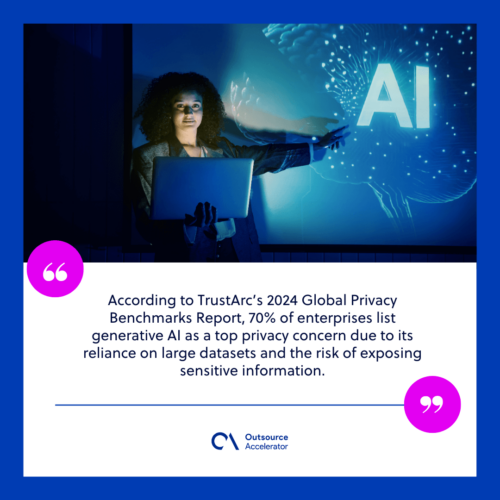
According to TrustArc’s 2024 Global Privacy Benchmarks Report, 70% of enterprises list generative AI as a top privacy concern. The worry comes from its heavy use of large datasets. In addition, generative AI tools can surface sensitive details in unexpected ways.
Key regulations that impact AI technology consulting
Meanwhile, organizations that seek AI consulting services must navigate a complex and growing set of rules.
| Aspect | GDPR (EU) | HIPAA (USA) |
| Scope | Personal data of EU residents | Protected Health Information (PHI) |
| Legal Basis | Consent / legitimate interest | Covered entity / BAA |
| Key Rights | Access, correction, erasure (data subject rights) | Right to privacy and security safeguards |
| AI Obligations | Explainability, documentation, risk assessments | Encryption, access controls, audit trails |
| Enforcement | Fines up to €20M or 4% of global revenue | Civil & criminal penalties |
| Notes | Focus on automated decisions & profiling | AI must not expose PHI to non-BAA-compliant tools |
How GDPR and HIPAA shape AI privacy compliance
GDPR compliance for AI
The General Data Protection Regulation (GDPR) remains the global benchmark for data privacy. It still shapes rules far beyond the EU.
GDPR requires:
- Lawful, fair, and clear processing of personal data.
- Data minimization and explicit consent.
- Rights such as access, correction, and deletion.
- Impact assessments for high-risk processing.
AI systems that train on personal data must follow GDPR principles. This includes new readings of automated decision-making and profiling. Because of this, teams must document how each model uses data.
Beyond Europe, GDPR continues to guide global policy. In Asia, for example, regulators are rolling out AI-specific laws. South Korea’s Basic2 AI Act is now in effect. It sets new duties around training-data records, risk tiers, and explainability. As a result, the region is moving fast toward AI-focused privacy rules.
For AI consultants running cross-border AI projects, mapping where these rules overlap is critical.
HIPAA compliance in AI deployments
In the U.S., the Health Insurance Portability and Accountability Act (HIPAA) governs how Protected Health Information (PHI) is collected, stored, and shared.
HIPAA compliance for AI deployments needs:
- Formal Business Associate Agreements (BAAs) with AI vendors.
- Encryption and strict access controls for PHI.
- Audit trails and clear incident response steps.
- Regular risk assessments and compliance reviews.
Failure to meet these standards can bring fines, legal liability, and lost patient trust. For this reason, many health firms pair HIPAA controls with wider cybersecurity best practices.
What AI consulting firms recommend to stay compliant
Today, AI privacy and security are board-level issues for any firm that uses artificial intelligence. So leaders cannot treat it as a side task.
Compliance is no longer about checking a box. Instead, it means building responsible data habits into every stage of the AI lifecycle. Leading AI consultants often recommend the steps below.
1. Design privacy into AI from day one
Importantly, privacy must be built into the product, not bolted on later. First, limit data collection to what you truly need. Next, apply anonymization so models cannot reveal sensitive details. Because of this, downstream compliance costs and risks fall.
2. Conduct regular impact assessments
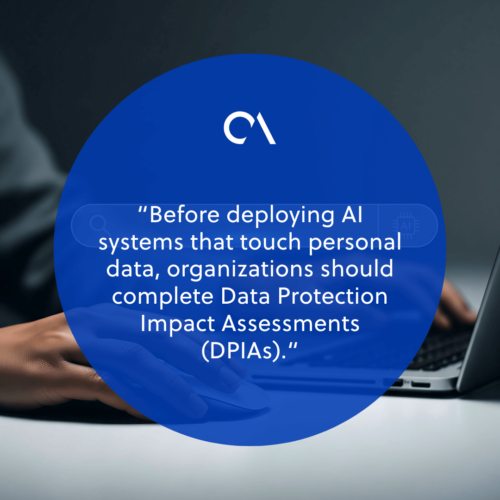
Before you deploy AI that touches personal data, run a Data Protection Impact Assessment (DPIA).
These checks flag privacy risks early. They also clarify the legal basis for processing and record how you plan to reduce harm. This matters most for high-risk or automated decisions.
3. Document and track data across its lifecycle
Above all, clear and auditable records are essential. So teams should keep full visibility into:
- Data sources
- Model training datasets
- Access controls
- Model updates and retraining cycles
Strong data governance supports audits and internal oversight. In addition, it makes handovers between teams far smoother.
4. Treat compliance as a continuous process
Privacy rules and AI tools both change fast. So staying compliant means watching for new rules, rechecking risks, and improving controls over time. Done well, this becomes a safeguard and a base for responsible AI and scalable AI adoption.
To put these practices in place, companies can use solutions like Acquire Intelligence.
How Acquire Intelligence helps balance data utility and AI privacy
In short, Acquire Intelligence helps firms turn AI compliance from a challenge into an edge. Through its AI strategy, implementation, and governance services, the team helps businesses:
- Embed privacy-aware controls into AI deployments from planning through execution.
- Monitor duties such as GDPR, HIPAA, and new AI-specific frameworks.
- Build governance, documentation, and oversight into daily AI operations.
- Align AI work with board-level risk management and compliance goals.
As analytics and AI consultants, the team helps firms balance innovation with responsible data use. As a result, leaders can unlock enterprise-grade AI value without taking on outsized privacy risk. It also gives boards and legal teams the assurance they need as rules shift.
Learn more about Acquire Intelligence’s AI solutions here.
Frequently asked questions (FAQs)
What are the main AI privacy risks in 2026?
AI privacy risks include re-identification of anonymized data and model inversion attacks that pull out training data. They also include unauthorized data use, shadow AI usage, and leaks through AI outputs. Because of this, firms now test models for these gaps before launch.
How do GDPR and HIPAA affect AI deployment?
GDPR covers personal data broadly and demands transparency and clear individual rights. HIPAA, by contrast, focuses on healthcare data and needs security measures and formal vendor agreements. As a result, both shape how AI consultants design data pipelines and deployment setups.
Can AI models be both effective and privacy-compliant?
Yes, but only with strong governance and privacy-preserving methods. These include differential privacy, encryption, and data minimization. So companies can still build AI that delivers value while meeting data protection laws.
Who owns AI privacy inside a company?
AI privacy is a shared duty, yet accountability sits at the top. Boards and senior leaders set the policy and tone. Meanwhile, data, legal, and security teams run the day-to-day controls. For this reason, clear ownership prevents gaps between departments.
Key takeaways
- AI privacy is a critical business risk in 2026
- GDPR, HIPAA, and emerging AI laws shape AI system design
- Compliance must be a continuous process, not a static milestone
- Responsible governance enables innovation without unnecessary risk
- Acquire Intelligence helps companies embed privacy controls and maintain compliance while unlocking AI value






 Independent






