
How high-growth companies hire remote employees


This article is a submission by Remote Latinos. Remote Latinos connects businesses with top talent from Latin America. Their platform facilitates the hiring of professionals from over 40 countries in Latin America.
Remote work has fundamentally changed how companies grow. What started as a flexibility benefit has become a core operating model across technology, marketing, real estate, professional services, and beyond.
As a result, leaders are increasingly asking a critical question: how do you hire remote employees without sacrificing performance, accountability, or culture?
The challenge is not access to talent. Global labor markets are deeper than ever. The real challenge is execution.
Research across hiring, onboarding, and workforce management shows that most remote hiring failures are not caused by location, but by unclear expectations, weak evaluation systems, and poor onboarding. Organizations that succeed approach remote hiring as a system rather than a reaction.
Why remote hiring requires a different mindset
Hiring remote employees requires leaders to rethink traditional assumptions about supervision and productivity. Visibility is replaced by outcomes. Informal alignment is replaced by documentation.
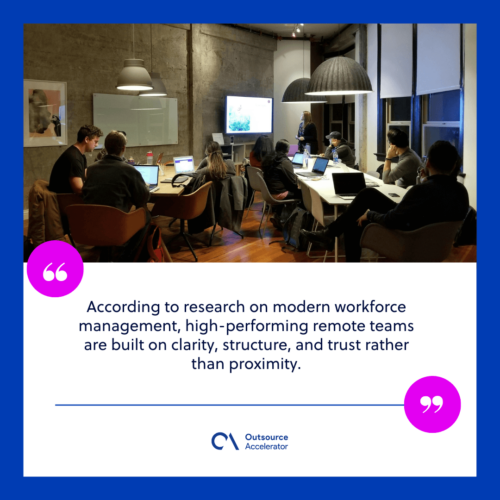
According to research on modern workforce management, high-performing remote teams are built on clarity, structure, and trust rather than proximity.
Companies that apply in-office hiring habits to remote roles often struggle. Those that design roles, evaluations, and management systems specifically for remote work consistently outperform peers.
What makes remote employees successful
Studies on retention and performance show that successful remote employees share several core traits.
They communicate clearly, manage priorities independently, and take ownership of results rather than tasks. They are comfortable working within systems and documenting their work for others to follow.
Just as important, remote employees thrive when expectations are explicit. Leaders who define success early and provide consistent feedback create environments where remote professionals can perform at a high level regardless of location.
Common hiring mistakes in remote work
Most remote hiring mistakes follow predictable patterns.
One is overreliance on resumes and informal interviews. Confidence and familiarity often outweigh evidence of execution. Another is urgency-driven hiring, where leaders rush decisions under workload pressure.
A third mistake is underestimating onboarding. Research on onboarding consistently shows that early confusion leads to disengagement, even among strong hires.
In remote environments, where context is not absorbed passively, onboarding becomes even more critical.
How to hire remote employees more effectively
1. Define outcomes before sourcing candidates
High-performing companies define what success looks like before posting a role. Instead of listing tasks, they outline outcomes: response times, project completion standards, quality benchmarks, or customer satisfaction goals.
This clarity filters applicants and aligns expectations from the start.
2. Use structured interviews and scenario testing
Unstructured interviews introduce bias and inconsistency. Structured interviews that ask the same questions of every candidate improve predictability.
Scenario-based questions reveal how candidates think, communicate, and prioritize in real situations. Short, paid test tasks often provide even stronger signals.

3. Verify skills and work habits
Remote hiring increases the importance of verification. Reviewing work samples, checking references, and validating claims reduces risk.
This step is especially important for roles involving autonomy and decision-making.
Onboarding determines whether remote hires succeed
Hiring does not end when an offer is accepted. Onboarding determines whether remote employees become contributors or disengaged observers. Effective onboarding focuses on clarity, connection, consistency, and culture.
Remote onboarding should include documentation, access to tools, defined expectations for the first 30-90 days, and regular check-ins. Organizations that invest in onboarding see faster ramp-up and stronger retention.
Managing and retaining remote employees
Remote management succeeds when leaders focus on outcomes rather than activity. Regular communication rhythms, documented workflows, and clear accountability replace micromanagement.
Research on modern leadership emphasizes that autonomy paired with structure produces the strongest results.
Retention also depends on growth. Remote employees who see long-term opportunities and feel trusted are more likely to stay engaged and contribute strategically.
Where companies are hiring remote employees
Companies hire remote employees through job boards, freelance marketplaces, internal referrals, and specialized remote hiring partners.
Each approach has trade-offs. Open platforms provide volume but require heavy screening. More structured approaches reduce hiring risk and time investment.
Many U.S. companies now work with remote hiring specialists to access professionals who are already familiar with remote collaboration and U.S. business expectations. This approach allows leaders to focus on fit and long-term alignment rather than initial screening.
FAQ
How do you hire remote employees successfully?
Successful remote hiring starts with clear role expectations, structured interviews, and intentional onboarding. Companies that treat hiring as a system rather than a quick fix consistently see better results.
Many organizations streamline this process by working with partners which help connect them with remote professionals accustomed to distributed work environments.
What roles are best suited for remote hiring?
Roles involving digital workflows, communication, analysis, operations, customer support, and coordination are well suited for remote hiring. These positions benefit most from outcome-based management rather than physical presence.
How long does it take to hire a remote employee?
A structured remote hiring process typically takes two to six weeks. Companies using specialized remote hiring partners often shorten this timeline by focusing on candidates who already meet baseline remote work standards.
How do you manage remote employees effectively?
Effective remote management prioritizes outcomes, documentation, and regular feedback. Leaders who avoid micromanagement and invest in systems create stronger performance and retention.
Is remote hiring cost-effective?
Remote hiring can reduce overhead and expand access to skilled talent, but long-term value depends on hiring accuracy and retention rather than hourly cost alone.
What tools support remote teams best?
Remote teams rely on communication platforms, project management tools, shared documentation systems, and secure access protocols. Tool effectiveness depends on how well workflows and expectations are defined.
Mastering the remote hiring standard
Learning how to hire remote employees effectively is now a leadership skill, not a temporary adjustment. Organizations that succeed replace intuition with structure, define outcomes clearly, and invest in onboarding and management systems.
Remote work does not reduce standards. It raises them. Companies that approach remote hiring thoughtfully build teams that are resilient, accountable, and capable of scaling without losing culture or control.
References
Herrenkohl, E. (2010). How to hire A-players: Finding the top people for your team, even if you don’t have a recruiting department. Wiley.
Johnson, K. (2022). How to recruit, hire and retain great people. G&D Media.
Kumler, E. (2020). How not to hire. HarperCollins Leadership.
Loper, N. (2014). Virtual assistant assistant. Bryck Media.
Painter, A. J., & Haire, B. A. (2022). The onboarding process: How to connect your new hire. Team Solution Series.
Rodriguez, R. (2007). Latino talent. Wiley.
Tulgan, B. (2022). Winning the talent wars. W. W. Norton & Company.
Wintrip, S. (2017). High-velocity hiring. McGraw-Hill Education.






 Independent





