
Why human-in-the-loop automation is the real key to outsourced process performance


This article is a submission by Alloyed. Alloyed is a premier global outsourcing partner providing scalable, high-quality solutions across media, tech, and finance by leveraging multi-shore expertise to drive efficiency and innovation.
For years, automation has been regarded as the magic bullet for achieving operational excellence. Faster processing. Lower costs. Fewer errors. Unlimited scale.
But if you spend any time in the real world of outsourced operations—finance, compliance, customer operations, media workflows—you quickly discover a truth many organizations eventually learn the hard way:
Automation on its own isn’t enough. Not for accuracy. Not for compliance. Not for resilience. Not for real business impact. Automation can be a very, very good thing. But on its own, it can be counterproductive.
This is why Human-in-the-Loop (HITL) has become the defining capability that separates BPO partners who deliver consistent business outcomes from those who simply add bots and hope for the best.
The problem isn’t automation. It’s over-automation.
Most automation failures can be traced back to a single belief: “If we automate more, the process will get better.”
In practice, the opposite is too often true.
Without effective human oversight at critical decision points, automation can:
- Amplify downstream errors
- Misinterpret non-standard data
- Apply outdated business rules
- Violate compliance without realizing it
- Break when customer behavior shifts
Gartner has repeatedly warned about silent RPA failures that go undetected until they escalate into operational or regulatory exposure. NIST’s AI Risk Management Framework flags the same pattern—automation without effective human supervision is inherently brittle.
MIT Sloan’s augmented intelligence research demonstrates that hybrid human/automation systems consistently outperform fully automated systems. If you’ve worked in ops for any length of time, you’ve likely lived this firsthand.
True process performance requires something more resilient.
HITL makes automation smarter, not slower
When people hear “Human-in-the-Loop,” they often assume it means slowing things down by inserting humans into automation.
That’s outdated thinking. Modern HITL isn’t about replacing or weakening automation—it’s about strengthening it.
Here’s what HITL actually accomplishes inside outsourced workflows:
- It prevents errors before they spread: A single misclassified invoice or incorrectly flagged KYC record can trigger a chain reaction downstream. Humans interpret these moments early, preventing cascading rework.
- It handles the exceptions automation will never solve: Every process has a messy middle. HITL is designed to absorb that unpredictability without derailing throughput.
- It improves the model or automation over time: Every intervention becomes training data, raising the automation’s accuracy ceiling.
- It protects your compliance posture: Regulated workflows (finance, healthcare, identity verification) require human oversight by design. HITL ensures that oversight is precise, documented, and auditable.
- It keeps your operations resilient as your business changes: New products, new customers, new formats—automation breaks when the world changes. Humans are the adaptive layer that keeps things running.
In other words: HITL isn’t a cost or a drag on efficiency. It’s the insurance policy that allows automation to scale safely and perform consistently.
Automation accelerates performance. Human-in-the-Loop protects it. Together, they transform it.
The future of automation and outsourcing is hybrid: The Human in the Loop is the differentiator in outsourced operations
The operations that thrive in this dawning era of AI won’t be the ones that automate everything. They’ll be the ones who master the hybrid orchestration of people plus automation. Indeed, that future will be people-first, not automation-led.
It will be the quality of the Human in the Loop that makes the real difference in automated and outsourced operations.
- Your business rules change faster than your automation can: HITL keeps operations aligned with shifting realities.
- Exceptions will increase, not decrease: more data will bring more variation and, quite likely, more regulatory scrutiny.
- AI introduces new risks that require oversight: bias, drift, hallucinations, and data quality gaps—HITL helps you mitigate them all (in fact, there is no mitigation without it).
- Trust will become a performance metric: HITL is the trust layer that ensures accuracy, consistency, and auditability.
Automation, whether RPA, intelligent process automation, or AI-based, without quality human judgment built into the process, is fast. Right up to the moment it fails. Automation with HITL is not just fast. It’s dependable, compliant, and continuous.
The future of automation-rich business process outsourcing is hybrid. And it’s already here.
3 things about human-in-the-loop automation you must understand before you can achieve hybrid processes
Not all Human-in-the-Loop (HITL) is the same
HITL blends automation with targeted human judgment. It ensures your critical outsourced processes remain accurate, compliant, and adaptable. There are five HITL models that matter to Hybrid Automation, each suited to a different workflow.
| HITL MODEL | DEFINITION | BENEFIT | BEST FOR | |
| 1. Upstream | People define the rules, thresholds, mapping, and training data ahead of automation. | Higher initial accuracy and fewer downstream exceptions |
| |
| 2. Mid-Stream | People intervene during execution when automation encounters uncertainty. | Real-time correction and reduced rework |
| |
| 3. Downstream | People perform validation, QA, or sampling after the automation is complete. | Safer outputs and data integrity for regulated workflows |
| |
| 4. Escalation- Triggered | Automation triggers a review by people only when confidence drops below a set threshold. | Maximum efficiency, minimal human workload |
| |
| 5. Continuous Collaborative | People and automation work together in real time. | Optimal blend of speed and expert judgment |
| |
Embracing HITL doesn’t mean you’re giving up on automation. You’re making it sustainable. Hybrid automation means fewer downstream errors, greater accuracy, stronger compliance, fewer exception resolutions, better cycle times, and scalable automation that evolves with your business.
The risks HITL helps prevent
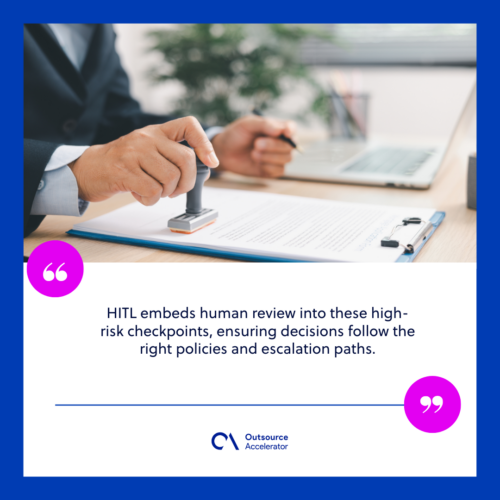
In regulated industries, mistakes in classification, reporting, or documentation can lead to significant exposure. HITL embeds human review into these high-risk checkpoints, ensuring decisions follow the right policies and escalation paths. It prevents automation from approving incorrect transactions, mislabeling data, or misinterpreting regulatory thresholds.
- Automation hallucinations & model drift
- Bias in automated decision-making
- Compliance violations
- Invisible errors in RPA
HITL strengthens audit trails, reduces remediation costs, and keeps outsourced operations defensible and reliable.
How to use HITL when outsourcing processes
Use HITL for steps where context, interpretation, or risk requires human judgment and ensure those steps are well-defined, measurable, and integrated with workflow data.
1. Use HITL for high-risk, high-context steps
- Regulated decisions (KYC, claims, financial adjustments)
- Ambiguous customer interactions
- Exception-heavy processing
2. Let your BPO own continuous operations
- Track exceptions
- Retrain models
- Optimize thresholds
- Manage escalation paths
3. Define decision rights and confidence thresholds
- Escalation rules
- Human approval boundaries
- Model auditability
4. Build HITL into SLAs, KPIs, and quality frameworks
- Exception rate
- Human intervention rate
- Accuracy improvement
- Automation drift
- End-to-end cycle time
Align early on goals, thresholds, exceptions, and decision rights, then let the partner manage the continuous improvement of the HITL system. Identify where judgment, variability, and risk exist. Moments of ambiguity become HITL touchpoints. Everything else becomes automation. Clear confidence thresholds and QA policies help determine when automation should defer to human expertise.
What to track and measure? Exception rates, resolution times, error patterns, confidence thresholds, rework, and downstream impacts on quality and customer service.






 Independent





