
Where to hire a virtual assistant with AI skills

This article is a submission by Remote Latinos. Remote Latinos connects businesses with top talent from Latin America. Their platform facilitates the hiring of professionals from over 40 countries in Latin America.
Where can you hire a virtual assistant with AI skills?
You can hire a virtual assistant with AI skills through pre-vetted talent networks, freelance marketplaces, or a strong hiring region like Latin America.
- Pre-vetted networks test real skills, not just resumes.
- Freelance sites offer scale but need careful checks.
- Latin America blends quality, cost, and time-zone overlap.
Many teams now want to hire a virtual assistant with AI skills who can turn AI tools into real results. AI has moved from a tech experiment to an everyday business tool. For example, it now helps with content, workflow automation, CRM work, and data analysis.
As adoption grows, founders face a fresh challenge. They must find people who can actually use AI well. So the search for skilled, AI-ready support keeps rising among startups and small firms.
AI does not replace people. Instead, it raises the value of workers who can run tools, read outputs, and stay accountable. Research on customer success and workforce management is clear. In short, tech creates value only when paired with human judgment and structure. Virtual assistants with AI experience sit right at that point.
Why AI-skilled virtual assistants are in demand
AI tools are easy to access, yet good use is uneven. Many teams adopt ChatGPT, Notion AI, or CRM automation with no clear workflow.
Meanwhile, studies on customer success and hybrid teams warn about this gap. Without human oversight, automation often adds complexity rather than cutting it.
Virtual assistants trained in AI close that gap. For example, they automate routine work, improve documentation, and manage prompts. In addition, they keep systems tidy.
So companies avoid the cost of hiring rare specialists. Instead, AI-literate assistants offer a practical, scalable fix that fits lean teams. Many firms weigh this against the cost of hiring a virtual assistant before they decide.
What does a virtual assistant with AI experience do?
A virtual assistant with AI experience extends traditional administrative or operational support. They fold automation and intelligence into daily work.
For example, typical tasks include AI-assisted content, automated reports, and cleaner CRM data. They also handle AI-powered customer messages and document AI-enhanced processes.
Their real job is not to “run AI.” Instead, they manage outcomes. Experts in virtual workforce design agree on one point. The best assistants treat AI as a productivity booster, not a stand-in for decisions.
So this mix of structure, judgment, and tool skill sets them apart. As a result, they beat general support that lacks AI fluency. Some teams also compare them with broader virtual assistant services before hiring.
Where to hire a virtual assistant with AI experience
Pre-vetted talent networks
One of the most reliable paths is a pre-vetted talent network. These networks test both technical and communication skills.
Hiring research is clear on this point. Fewer early screening errors lead to much better long-term results. So pre-vetted assistants get tested on real workflows, not just resumes. As a result, they can handle AI tasks from day one.
Freelance marketplaces
Global freelance platforms also offer AI-literate assistants. Still, they need more hands-on checks. Hiring research warns that self-reported AI skills can mislead.
So employers should use paid test projects and real scenarios. This proves true skill better than a list of tools or certificates.
Latin America as a strategic hiring region
Latin America has become a top region for AI-skilled virtual assistants. Workforce studies point to clear perks. For example, strong English, cultural fit with U.S. firms, time-zone overlap, and quick adaptability.
Workers in the region often keep learning new skills. This habit matters a lot in fast-moving AI settings. Plus, pay stays competitive. So Latin America gives a strong balance of quality, scale, and teamwork.
Skills that actually matter
Hiring for AI experience does not mean hiring an engineer. Research on strong remote teams is clear. Practical execution skills matter far more than theory.
So the best AI-capable assistants write clearly and stay organized. They also use data with care and improve systems over time.
Still, judgment matters just as much. AI outputs need context, checks, and ownership. For example, good assistants know when to automate and when to step in. As a result, they beat those who trust tools blindly. Many of these traits also define strong AI-powered virtual assistants.
How to evaluate AI experience during hiring
Good hiring frameworks focus on outcomes. So do not just ask if a candidate “knows AI.”
Instead, set real scenarios. For example, ask them to automate a report, improve a prompt, or document a workflow. Paid test projects remain the best sign of success.
Structured interviews also cut bias and reveal problem-solving. Candidates should explain why they used a tool, not just which tool. So this shows transferable skill rather than tool dependence.
Legal and compliance considerations
Hiring an AI-skilled virtual assistant is simple when done right. In addition, contracts should state worker classification, confidentiality, and data duties. They should also cover who owns AI-generated work.
Legal guidance on remote work stresses clarity and documentation. This matters most when staff handle customer data or private systems.
For long-term or full-time hires abroad, many firms use an Employer of Record. As a result, this service simplifies payroll, taxes, and compliance for both sides. To learn how it works, review the Employer of Record model.
Onboarding makes or breaks AI adoption
Onboarding decides whether AI helps or confuses. Research points to four pillars: clarity, connection, consistency, and culture.
For AI roles, this means clear rules. So define acceptable AI use, documentation standards, approval limits, and escalation paths.
Virtual assistants do best when expectations are clear and feedback is frequent. This matters most in the first 60 to 90 days. As a result, structured onboarding turns AI into a reliable operational asset. A simple remote employee onboarding checklist keeps this on track.
Cost considerations
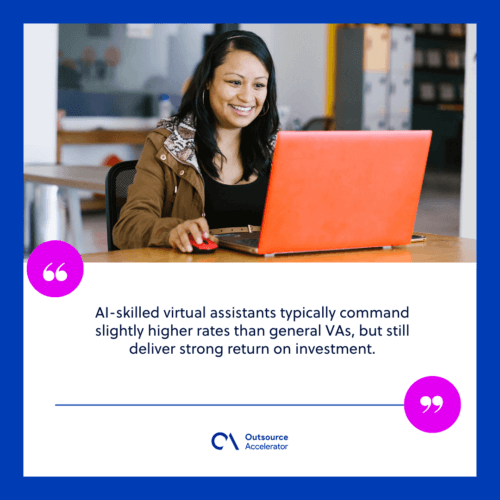
AI-skilled virtual assistants cost a bit more than general VAs. Still, they deliver strong return on investment. Meanwhile, pay varies by region and experience.
Latin America stays one of the most cost-efficient markets for quality AI support. Workforce research is clear on this point. Fair pay links directly to retention, performance, and accountability.
The specialized AI virtual assistant
Knowing where to hire a virtual assistant with AI experience is now a real advantage. It is a strategic choice, not just a tactical one.
AI tools keep changing fast. So firms that pair automation with strong human execution will win. Meanwhile, those that trust tech alone will fall behind.
Virtual assistants with AI experience offer a practical middle ground. In short, they are flexible, scalable, and focused on execution. So when hired with care and onboarded well, they help firms move from testing to steady gains.
Frequently asked questions (FAQs)
Do you need coding skills to hire an AI virtual assistant?
No. Instead, you need someone who can use AI tools well, not build them. So focus on judgment, clear writing, and execution.
How much does an AI-skilled virtual assistant cost?
They cost a bit more than general VAs. Still, the returns are strong. Meanwhile, Latin America remains one of the most cost-efficient regions.
What tasks can an AI virtual assistant handle?
For example, they manage content, reports, CRM data, and customer messages. They also document AI-enhanced processes. In short, they turn AI tools into daily results.
How do you test AI skills during hiring?
First, use paid test projects and real scenarios. For example, ask them to automate a report or improve a prompt. As a result, you prove true skill better than a tool list.
Key takeaways
- Hire a virtual assistant with AI skills through vetted networks, freelance sites, or Latin America.
- The best assistants manage outcomes and use AI as a productivity booster.
- Practical execution and judgment matter more than technical theory.
- Paid test projects are the strongest sign of real AI skill.
- Clear contracts and structured onboarding protect long-term success.
References
Docfield. (2024). Legal considerations in remote work employment agreements. Docfield.
Fahey, I. (2025). Legal considerations when hiring remote workers in LATAM. LATAM.Hire.
Herrenkohl, E. (2010). How to hire A-players. Wiley.
Johnson, K. (2022). How to recruit, hire and retain great people. G&D Media.
Loper, N. (2014). Virtual assistant assistant. Bryck Media.
Mar, J., & Armaly, P. (2024). Mastering customer success. Packt Publishing.
Madhwacharyula, C., & Ramdas, S. (2023). Scaling customer success. Apress.
Painter, A. J., & Haire, B. A. (2022). The onboarding process. Team Solution Series.
Rodriguez, R. (2007). Latino talent. Wiley.
Tulgan, B. (2022). Winning the talent wars. W. W. Norton & Company.
Wintrip, S. (2017). High-velocity hiring. McGraw-Hill Education.






 Independent





