
5 features to look for in a remote employee productivity monitoring software

5 features of a reliable remote employee productivity monitoring software
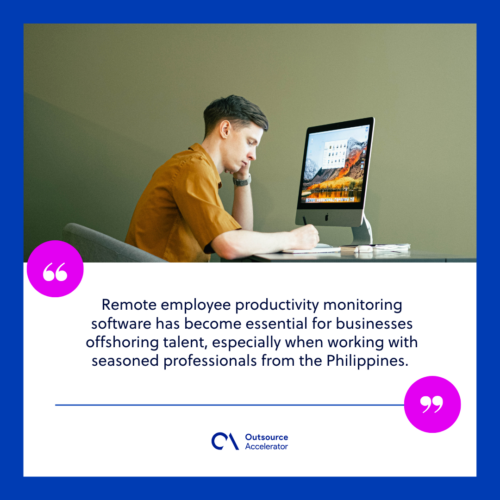
Remote employee productivity monitoring software has become essential for businesses offshoring talent, especially when working with seasoned professionals from the Philippines.
The country’s workforce offers a unique blend of technical expertise and cultural sensitivity, fostering smooth collaboration across borders. As Ruffy Galang, CEO of Remote Employee, says: “The Filipino workforce brings both technical skills and a unique cultural sensitivity that makes collaboration seamless.”
While having high-performing remote staff is a significant asset, successful offshoring demands more than just talent. It requires effective management practices and the right tools to track progress and optimize performance.
This is where reliable remote employee productivity monitoring software comes into play.
The right software empowers businesses to manage remote teams efficiently, ensuring productivity and alignment with company goals.
In this article, we’ll explore five essential features of an effective productivity monitoring software that every business should consider.
Table of Contents
Common challenges when hiring remote employees
5 characteristics of a reliable remote employee productivity monitoring software
FAQs
Remote Employee: Connecting firms with seasoned global professionals
Common challenges when hiring remote employees
Hiring remote employees offers a wealth of opportunities, but it also brings its share of challenges. While the flexibility of remote work is appealing, companies must navigate several obstacles to maintain high productivity and smooth team operations.
| Challenge | Why it Happens | Business Impact |
| Lack of visibility | No physical supervision; limited output insight | Hard to assess engagement and performance |
| Time management issues | Distractions at home; blurred work–life boundaries | Missed deadlines; decreased productivity |
| Communication barriers | Limited face-to-face interaction; remote isolation | Misunderstandings; slower collaboration |
| Weak team cohesion | Teams spread across time zones | Reduced morale and accountability |
Remote Employee | Empower Smarter Remote Teams
These challenges, especially when it comes to monitoring remote employee performance, can impact both individual and organizational success:
1. Lack of visibility into employee performance
One of the primary challenges in remote work is the limited visibility into employee performance. Unlike in-office environments, where managers can easily assess employee engagement and productivity, remote work requires digital tools for monitoring.
According to a recent report by Buffer, 16% of remote workers still cited “collaboration and communication” as a struggle, which often affects managers’ ability to track individual progress and outcomes.
Without the right monitoring tools, it can be difficult for managers to gauge whether employees are staying on task or becoming disengaged.
2. Managing distractions and time management
Remote employees often face a myriad of distractions at home, from family members to household chores. Without proper oversight, these distractions can hinder productivity.
A study by Gallup found that 45% of remote staff experience stress due to excessive distractions and insufficient time while working from home. These can lead to missed deadlines and decreased output.
Productivity monitoring software can help identify patterns of behavior and pinpoint when distractions are affecting work, allowing managers to address the issue promptly.
3. Communication barriers
Effective communication is essential for remote teams, but it can be harder to maintain without face-to-face interaction. A State of Remote Work report from Buffer revealed that 20% of remote professionals struggle with loneliness, which can affect communication and collaboration.
Remote employee productivity monitoring tools can facilitate clear communication by providing real-time feedback and performance updates. This ensures that remote workers remain engaged and informed throughout their workday.
4. Maintaining team cohesion
Building a cohesive team is challenging when employees are spread across different locations and time zones. A lack of camaraderie and team spirit can lead to disengagement, which impacts performance.
Remote monitoring tools that track team collaboration, project timelines, and progress help maintain alignment and accountability within a team, ultimately strengthening team dynamics.
Remote employee productivity monitoring software can address many of these challenges, helping businesses maintain high standards of performance, engagement, and collaboration.
Key takeaway:
Understanding the common struggles of remote employees helps companies choose monitoring tools that improve productivity, communication, and accountability.
5 characteristics of a reliable remote employee productivity monitoring software
Investing in the right remote employee productivity monitoring software can make a significant difference in effectively managing distributed teams.
| Key Feature | What It Does | Why It Matters |
| Real-time activity tracking | Shows tasks, active hours, and idle time | Identifies productivity trends instantly |
| Automated time logging | Tracks hours, breaks, and sessions automatically | Removes manual errors; improves accuracy |
| Comprehensive reporting | Converts data into dashboards & summaries | Supports decision-making |
| Privacy-respecting features | Blurred screenshots, access control | Builds trust while maintaining visibility |
| Integrations | Connects to PM tools, HRIS, and communication apps | Reduces manual work; improves workflow |
Choose tools that support people — not just data.
A reliable platform doesn’t just track time; it provides meaningful insights that help managers support productivity, identify obstacles, and enhance workflow.
Take a look at the five essential characteristics to look for when selecting the right solution:
1. Real-time activity tracking
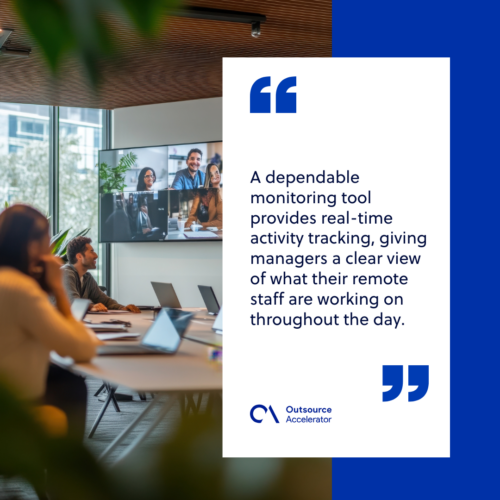
A dependable monitoring tool provides real-time activity tracking, giving managers a clear view of what their remote staff are working on throughout the day. This feature helps identify productive hours, idle time, and task engagement.
Real-time data allows teams to make quick decisions and course corrections, especially during time-sensitive projects.
Pro tip:
Use real-time insights to spot workflow issues before they escalate. Quick visibility empowers managers to support teams proactively rather than reactively.
2. Automated time logging
Manual timesheets are prone to errors and often waste valuable time. A robust remote employee productivity monitoring software automatically tracks clock-ins, breaks, and clock-outs, eliminating the need for constant staff input.
This function not only improves accuracy but also gives both employees and managers more time to focus on core tasks.
3. Comprehensive reporting and analytics
A reliable system doesn’t stop at data collection; it translates that data into actionable insights. High-quality software offers visual dashboards, productivity summaries, and detailed performance reports.
Accumulated reports help team leaders identify patterns, spot potential issues early, and make informed decisions that improve overall efficiency.
Pro tip:
Choose software that translates raw time logs into meaningful analytics. This saves managers hours of manual review and speeds up decision-making.
4. Privacy-respecting features
While transparency is important, a good platform respects employee privacy. Look for software that offers customizable settings, such as allowing blurred screenshots or data access controls.
These features promote trust while still offering managers the visibility they need to guide their teams.
5. Seamless integration capabilities
Effective remote employee productivity monitoring software integrates smoothly with other tools in your existing tech stack, such as project management platforms, communication apps, and HR systems.
Seamless integration helps reduce manual data entry and allows for better workflow coordination across departments.
Pro tip:
Choose platforms that offer pre-built integrations or an open API; this saves teams from costly custom development later. Prioritizing tools that “talk to each other” ensures cleaner data, faster onboarding, and fewer workflow bottlenecks.
Selecting a tool with these characteristics helps growing organizations manage remote teams with confidence. It promotes accountability, improves performance, and supports a healthy work culture, without disrupting productivity.
FAQs
Let’s answer some of the frequently asked questions about remote employee productivity monitoring software:
1. What is remote employee productivity monitoring software?
It is a tool that tracks activity, output, and engagement to help businesses manage distributed teams efficiently.
2. Why is productivity monitoring important?
It ensures visibility, improves accountability, and helps managers support staff more effectively.
3. Is monitoring invasive for remote employees?
Good tools include privacy controls like blurred screenshots and restricted access settings.
4. What features should companies prioritize?
Real-time tracking, automated logs, analytics, privacy settings, and integrations.
5. Does Remote Employee provide support with monitoring tools?
Yes. Remote Employee helps businesses streamline onboarding, integrate tools, and support performance management.
Remote Employee: Connecting firms with seasoned global professionals
Remote Employee helps companies scale faster by matching them with skilled, pre-vetted global talent, particularly top professionals from the Philippines. Businesses gain dedicated staff, streamlined support, and the tools needed for success.
Start building your high-performing remote team today with Remote Employee and experience offshore staffing that delivers results!






 Independent





