
The Philippines BPO advantage: Ensuring business continuity through extreme weather


How do BPO firms maintain business continuity during extreme weather?
BPO firms maintain business continuity in BPO by combining office-based work, resilient infrastructure, cloud tools, and clear communication so client service never stops.
- They get staff safely into well-equipped offices during storms.
- They rely on backup power, redundant internet, and cloud platforms.
- They lean on a resilient Filipino workforce and clear alerts.
The Philippines has long been a preferred destination for global business process outsourcing. So it draws firms with its large English-speaking workforce, cultural fit with Western markets, and competitive costs.
However, one part of doing business here is hard to avoid: exposure to extreme weather. For example, the monsoon season brings frequent flooding and typhoons. As a result, business continuity in BPO is both a challenge and a core skill for operators in the region.
In a recent chat on the 550th episode of the Outsource Accelerator Podcast, Dale Pearce shared firsthand insight. Dale is COO and co-owner of Platintel (formerly Platinum Outsourcing). In short, he explained how his firm stays stable even during severe weather in Metro Manila.
The challenge for BPO business continuity: Navigating the Philippines’s weather reality
Weather-related disruption is not rare in the Philippines.
For example, typhoons and monsoon flooding can derail firms without strong continuity plans. In addition, BPOs that run mission-critical work for global clients cannot afford downtime. So planning ahead matters, and it helps teams manage wider outsourcing risks too.
Dale noted that during the recording, Metro Manila was under heavy weather pressure: “We’re getting the first big weather event of the monsoon season. The whole of the National Capital Region is under an extreme flood advisory.”
He also pointed to the paradox of scale. Massive office parks host some of the world’s biggest outsourcing firms. Still, they sit in an environment prone to climate extremes.
“It’s amazing that you have a place like Manila that’s so exposed to natural disasters,” Dale noted, “and we have all of these huge office parks running support services for some of the largest companies in the world.”
Despite the risks, the industry keeps thriving. As a result, tested and refined continuity measures make the difference.
5 Proactive strategies for business continuity in BPO
BPO firms in the Philippines cannot take a reactive stance on weather. So effective business continuity planning (BCP) requires proactive, multi-layered strategies. For a fuller framework, see this guide to business continuity management.
Here are the key measures used by operators like Platintel:
1. Centralized office-based continuity
Instead of defaulting to remote work in bad weather, Platintel gets staff safely into the office. So people stay dry, keep power, and work from a safe space.
“We try to get people into the office,” says Dale. “We know that they’re going to have power, they’re going to be dry, and we’ve got the facilities for them to work from where it’s safe.” In fact, offices are often better equipped than homes in flood-prone areas.
2. Company-provided shuttle services
Transport becomes a major challenge during heavy flooding or typhoons. So Platintel runs private shuttles across strategic pickup points.
“We do collections from a variety of different points across Manila… with drivers and everything like that,” Dale shares. As a result, this cuts travel risk and keeps staffing steady.
3. Pre-scheduled shifts and early mobilization
In advance of extreme weather, many BPOs schedule shifts and office attendance early. So essential staff are already in place.
As a result, they avoid last-minute absences. In turn, they reduce the impact of transport suspensions or class cancellations.
4. Redundant power and internet backups
Most top-tier BPO buildings in Metro Manila have backup generators and redundant internet. BPOs do not run this infrastructure directly. Still, these partnerships are part of smart site selection. So firms treat them as a proactive continuity asset.
5. Flexible role-based work arrangements
Centralized work is preferred, but some roles can run remotely. However, that only works when conditions allow.
For example, a developer may work from home if the setup is secure. However, as Dale notes, many homes sit “in floodplains” and face brownouts or weak connections. So office setups stay the safer choice. To go deeper, see these remote work challenges in BPO.
Infrastructure and technology as enablers in BPO business continuity
Infrastructure and digital readiness shape whether BPO operations hold up in extreme weather.
Here is how leading firms use infrastructure and technology to support continuity. A sound enterprise risk management plan ties these choices together.
1. Strategic site selection
Platintel chose Alabang’s Filinvest Corporate City for its resilience. So the firm bet on strong infrastructure from the start.
“We’ve committed to Alabang as the home of our business… We’re now operating out of Asian Star building in Filinvest,” says Dale. In addition, this area offers flood-resistant design, reliable utilities, and secure transport routes.
2. Reliable office power and connectivity
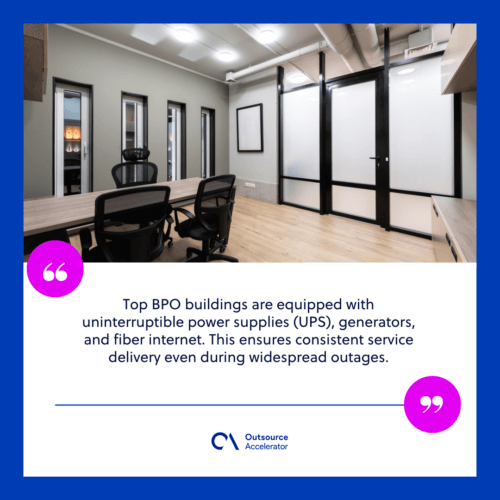
Top BPO buildings run uninterruptible power supplies (UPS), generators, and fiber internet. As a result, service stays consistent even during wide outages.
Meanwhile, these redundancies remove downtime from brownouts. In turn, residential areas that lose power during storms do not drag operations down.
3. Cloud-based operations
BPOs increasingly use cloud platforms for communication, tasks, and data. So teams switch between office and remote setups with ease. Still, they need the right hardware and connectivity to do so. In turn, strong data security in outsourcing keeps that shift safe.
4. AI-enhanced systems
AI is still evolving, but it now supports continuity too. For example, it helps most in customer support functions.
So intelligent routing and chatbot-assisted triage lighten the load on agents. As a result, teams cope better during short staffing from weather.
5. Real-time communication protocols
To stay aligned in emergencies, BPOs run internal alert systems. For example, they use SMS alerts, Slack updates, and email blasts.
So staff learn about transport, shift changes, and safety steps in real time. In turn, everyone stays informed and safe.
The human element of BPO business continuity
Technology and infrastructure matter, but people are the real backbone. In fact, Filipino BPO workers earn wide respect for their adaptability and resilience. So these qualities shine during hard conditions. Their steady remote and on-site presence keeps clients served.
Dale voices deep admiration for his team. “Just a shout-out to the Filipino staff that go through this every year. They’re so resilient. The fact that they turn up every day when these things are going on… I think it’s a testament to their work ethic.”
That dedication lets clients abroad feel little or no disruption. So work continues even when parts of Metro Manila are under water.
In short, planning, infrastructure, and human grit combine here. As a result, the Philippine BPO sector stays a reliable global partner, whatever the weather.
Despite the tough days, many outsourcing firms still give back. So stay tuned for the Outsourcing Impact Review 2025 and nominate your BPO now!
Frequently asked questions
What is business continuity in BPO?
It is the ability to keep services running through disruption. For example, floods, typhoons, and outages can all threaten work. So BPOs plan ahead to protect client operations.
Why is business continuity important for BPO firms?
Many BPOs run mission-critical work for global clients. As a result, even short downtime can be costly. So strong continuity protects both service and reputation.
How do BPOs keep working during typhoons?
They move staff into safe, well-equipped offices. In addition, they use shuttles, backup power, and cloud tools. So service continues even in severe weather.
What role does technology play in BPO continuity?
Cloud platforms, redundant internet, and AI tools all help. So teams switch between office and remote work fast. In turn, outages cause far less disruption.
Key takeaways
- Business continuity in BPO keeps client service running through extreme weather.
- Office-based work, shuttles, and early shifts protect staffing during storms.
- Backup power, redundant internet, and cloud tools remove most downtime.
- A resilient Filipino workforce is the real backbone of continuity.
- Clear, real-time communication keeps teams safe and aligned.






 Independent





