
How much is self-employment tax for business owners?


How much is self-employment tax?
Self-employment tax is 15.3% of your net earnings: 12.4% for Social Security and 2.9% for Medicare.
- You owe it once your net self-employment earnings top $400 in a year.
- Only 92.35% of your net earnings is taxed, and Social Security applies up to a yearly cap.
- You can deduct half of the tax, which lowers your income tax.
Self-employment tax matters a lot for business owners who do not get a normal paycheck. Because of this, you need to know how it applies to your work. It shapes your tax planning, your compliance, and your costs all year.
So how much is self-employment tax, and what can you do about it? This article explains what it is and how to manage it throughout the year.
What is self-employment tax?
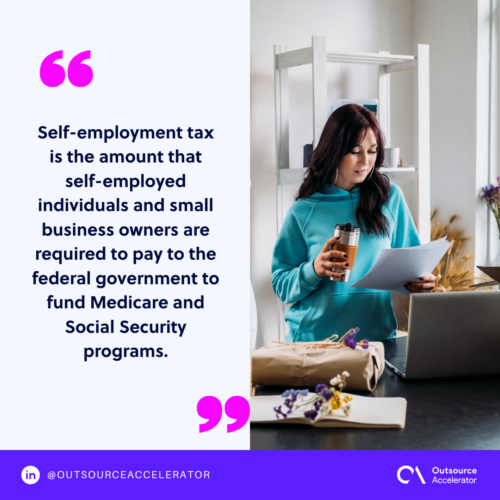
Self-employment tax is the amount that self-employed people and small business owners pay to the federal government. It funds Medicare and Social Security. In short, it replaces the part of the Federal Insurance Contributions Act (FICA) tax that an employer would normally pay for an employee.
This tax applies when your net earnings from self-employment top $400 in a year. It also applies if you earn $108.28 or more from a tax-exempt entity. Below these limits, you do not owe self-employment tax. It also helps to know how these earnings fit into your total taxable income for the year.
So how much is self-employment tax? The rate is 15.3%, split as follows:
- 12.4% for Social Security (covers old-age, survivors, and disability insurance)
- 2.9% for Medicare, which covers hospital insurance
How business owners can manage self-employment tax
You want to stay compliant and manage cash flow at the same time. So here are clear steps to handle self-employment tax with less stress.
1. Make estimated tax payments
The IRS asks business owners who expect to owe at least $1,000 in taxes to pay each quarter. As a result, these payments should cover both income tax and self-employment tax.
2. Deduct the employer portion of self-employment tax
When you are self-employed, you do not pay the tax on your full net earnings. Instead, the tax is figured on 92.35% of those earnings. This split reflects that you count as both the employer and the employee.
For example, say a business owner has net earnings of $200,000 in 2025. Then the taxable amount would be $184,700, which is 92.35% of $200,000. Because this amount tops the Social Security wage base limit of $176,100 for 2025, the Social Security part only applies up to that cap.
So how much is self-employment tax here? For 2025, it works out as follows:
- $176,100 × 12.4% (Social Security) = $21,836.40
- $184,700 × 2.9% (Medicare) = $5,356.30
- Total = $27,192.70
The cap changes each year. For 2026, the Social Security wage base rose to $184,500. So the same steps apply, just up to that higher cap this year.
When filing the income tax return, the owner may deduct half of the self-employment tax. In this case, that is $27,192.70 ÷ 2 = $13,596.35, taken as an above-the-line deduction. This deduction stands for the employer-equivalent share (7.65%) of the total. As a result, it lowers taxable income on the individual return. Still, it does not reduce the self-employment tax itself.
3. File the self-employment tax form
You must figure and report the tax on IRS Form 1040 Schedule SE. In most cases, you file this form with your Form 1040. You can also include it with your quarterly estimated tax payments.
4. Work with a qualified tax professional
Tax laws and limits often change, such as the Social Security wage base. So a tax professional keeps up with the rules and applies them the right way. As a result, you avoid errors and penalties. Working with an external provider for tax preparation is another way to stay compliant without straining your team. For a broader view, many owners also compare small business tax services before they decide.
How much is self-employment tax for LLCs?
So how much is self-employment tax for Limited Liability Companies (LLCs)? By default, single-member LLCs are taxed as sole proprietorships. Multi-member LLCs are taxed as partnerships. In both cases, each member usually pays the 15.3% tax on their share of the earnings. The one exception is when the LLC elects to be taxed as a corporation.
In fact, LLCs may elect S Corporation status to lower self-employment tax. Still, you must file this election with the IRS. It also helps to review the full LLC tax rate rules before you choose a structure.
How much is self-employment tax for partnerships?
So how much is self-employment tax for partnerships? Partnerships are pass-through entities. This means the business does not pay tax directly. Instead, each partner pays self-employment tax on the income they get from the partnership.
For general partners, this includes:
- Their distributive share of the partnership’s net earnings
- Any guaranteed payments for services or the use of capital
Both fall under the 15.3% self-employment tax rate for Social Security and Medicare. So how is it worked out? Here are the steps:
- Total subject to self-employment tax: $100,000 (share) + $20,000 (guaranteed payments) = $120,000
- Multiply by 92.35% for the taxable amount: $120,000 × 0.9235 = $110,820
- Apply the 15.3% rate: $110,820 × 0.153 = $16,958.55
So the partner would report and pay $16,958.55 as self-employment tax using Schedule SE.
How much is self-employment tax for S Corporations?
When you run an S Corporation, you count as both the employee and the employer. So S Corporation owners who work in the business pay self-employment tax only on their reasonable salary. That salary is subject to payroll taxes. Any extra profit taken as distributions is not subject to self-employment tax.
So how much is self-employment tax for S Corporations? For example, say you pay yourself a $70,000 reasonable salary. Then the 15.3% payroll tax is split evenly:
- 7.65% is withheld from your salary as the employee portion
- 7.65% is paid by the S Corporation as the employer portion
This is one reason owners weigh how a role is classified. For context, it helps to know the difference between a 1099 and a W-2 worker when you set pay.
Take control of your taxes by understanding self-employment tax
Knowing how much is self-employment tax for your business type helps you plan better. As a result, you make smarter money choices and avoid underpayment penalties. It also pays to track your small business tax deductions so you keep more of what you earn.
In the end, self-employment tax is not just a legal duty. It is a key part of keeping your business healthy.
Frequently asked questions
Who has to pay self-employment tax?
You pay it if your net self-employment earnings top $400 in a year. This covers sole proprietors, freelancers, and most partners. So even a small side business can owe it.
How is self-employment tax different from income tax?
Self-employment tax funds Social Security and Medicare. Income tax funds general government spending. As a result, you may owe both on the same earnings.
Can I lower my self-employment tax?
Yes, in some cases. For example, an S Corporation election can reduce it for active owners. In addition, tracking real business expenses lowers your net earnings, which lowers the tax.
When are self-employment taxes due?
Most owners pay in four quarterly estimates. You also settle up when you file your yearly return. So set money aside each quarter to avoid a large bill.
Do I still owe self-employment tax if I have a regular job too?
Yes. Your side income still counts once it tops $400. However, wages already taxed for Social Security count toward the yearly cap.






 Independent






