
Data scientist vs. Data analyst: Differences explained


What is the difference between a data scientist and a data analyst?
A data scientist builds models and predicts future outcomes from large, complex datasets, while a data analyst interprets existing data to guide day-to-day business decisions.
- Data scientists need advanced math, programming, and machine learning skills.
- Data analysts focus on cleaning data, building reports, and explaining trends in plain terms.
- The right hire depends on whether you face complex problems or daily decision support.
The rise of big data has raised the need for people who make sense of it. As a result, organizations now collect huge amounts of information. So they also need experts to read it well.
In fact, the U.S. Bureau of Labor Statistics predicted that data-related roles would grow fastest, at 36%, between 2021 and 2031. That pace shows how fast demand is climbing.
Two titles stand out in this field: data scientist and data analyst. In fact, people often use the terms as if they mean the same thing. Still, there are key differences between the two roles.
In this guide, we compare data scientist vs. data analyst. First, we look at their similarities and differences. Next, we cover which one an organization should hire.
What is a data scientist?
Data scientists are multidisciplinary experts. Basically, they use advanced methods and tools to pull insights from complex, large datasets.
For example, they spot patterns and trends in the data. In turn, they use these to build predictive models that improve business performance.
A data scientist needs strong skills in math, statistics, programming, and machine learning. Some of their main tasks include:
- Develop, test, and improve models. They use statistical models to analyze data, then tune those models for better results. Next, they test the models against the data to find patterns.
- Find new datasets. They source fresh datasets from third parties. As a result, they broaden what the business can analyze.
- Perform exploratory data analysis. They run deep statistical checks to surface trends that others may have missed.
- Write code. They write code to automate analysis. So the company can make data-driven choices faster.
Much of this work leans on machine learning and heavy computing power.
What is a data analyst?
Data analysts, meanwhile, focus on reading and interpreting data. So they find trends and patterns that guide business strategy.
Also, they work on datasets that are usually smaller than a data scientist’s. From these, they glean useful insights to aid decisions.
In practice, these experts use tools like Excel, SQL queries, and business intelligence (BI) software. Their key tasks include:
- Data cleansing. They clean and manage the data. For example, they remove duplicate, wrong, or missing records and keep things consistent.
- Developing dashboards and reports. They use BI software to build clear dashboards and reports.
- Conducting data analysis. They use statistical tools to find trends and see how choices affect outcomes.
- Communicating insights. They turn data into plain, useful language for the rest of the team.
To see how this pays off, read about the impact of data analysis on running a business.
Data scientist vs. Data analyst: Similarities and differences
The two roles share some ground. Still, data scientist vs. data analyst also brings some big differences.
Data scientist vs. Data analyst: Education and work experience
A data scientist usually needs advanced technical education. For example, that means a master’s or doctorate in computer science, math, or statistics.
In addition, data scientists are expected to have deep experience in analytics, machine learning, and AI.
Meanwhile, data analysts usually need a bachelor’s degree in computer science, statistics, or a related field. Often, experience in SQL database programming and data analysis is required too.
Data scientist vs. Data analyst: Skill comparison
To see how the skills differ, first look at the tools and methods each role uses.
| Data scientist | Data analyst | |
| Programming | Computer science Advanced object-oriented programming Proficiency in programming languages | Basic fluency in R, Python, SQL |
| Mathematics | Predictive analytics Advanced statistics | Foundational math Statistics |
| Software and tools | Hadoop MySQL TensorFlow Spark | SAS Excel Business intelligence software |
| Other skills | Machine learning Data modeling Economics Data visualization Data warehousing Data mining | Data mining Data warehousing Data visualization Analytical thinking Business intelligence |
Data scientist vs. Data analyst: Which should you hire?
Now you know the basics of data scientist vs. data analyst. So which one should you hire? The answer depends on your goals and needs.
Do you want to tackle complex problems? Then a data scientist may be the right choice. Data scientists uncover insights and chances that older methods often miss.
Do you need someone to read data for daily decisions? In that case, a data analyst may fit better.
In short, data scientists turn data into clear action. As a result, they give useful guidance to leaders across the organization.
Still, it is worth noting one thing. You can use people in both roles, but you must be applying the staff correctly.
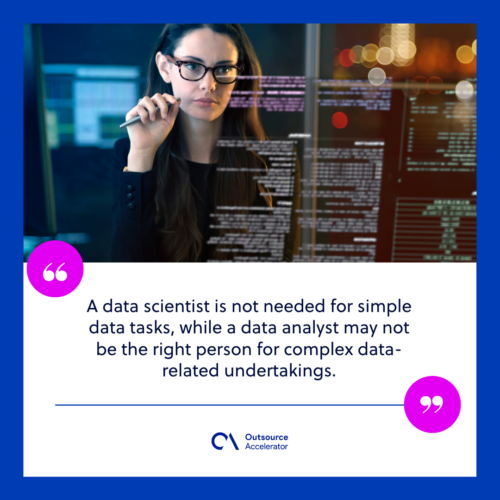
A data scientist is overkill for simple data tasks. Meanwhile, a data analyst may not be right for complex data work. Many firms solve this through data management outsourcing or by hiring offshore data analysts to fill gaps.
In the end, both roles are key to using data for business success. So if you hire one or the other, weigh the factors above to make the best call.
Finally, tapping a strong third-party provider can help you hire the right people. Whether you need a seasoned data analyst or data scientist, Outsourced can connect you with skilled professionals who meet your goals.
Frequently asked questions about data scientist vs. data analyst
Here are quick answers to common questions about the two roles.
Does a data scientist earn more than a data analyst?
Usually, yes. A data scientist needs deeper skills and often more education. As a result, the role tends to pay more than a data analyst role in most markets.
Can a data analyst become a data scientist?
Yes, and many do. First, they build stronger skills in programming, statistics, and machine learning. Over time, that path can lead into a data scientist role.
Which role does a small business need first?
Most small firms need a data analyst first. For example, they want clear reports and daily insights. Meanwhile, a data scientist makes more sense once the data and the problems grow complex.
Do the two roles use the same tools?
They overlap, but not fully. For example, both use SQL and data visualization. Meanwhile, data scientists add tools like Hadoop, Spark, and TensorFlow for heavier work.
Can you outsource data scientist and data analyst roles?
Yes. Many businesses hire these skills through offshore providers. Because of this, they access expert talent without the cost of a large in-house team. For complex needs, consider big data consulting support as well.






 Independent






