
Structured data vs. Unstructured data: What’s the difference?


What is the difference between structured data and unstructured data?
Structured data is neatly organized in rows and columns so computers can search it fast, while unstructured data has no set format and needs advanced tools to analyze.
- Structured data lives in tables, spreadsheets, and databases with a clear schema.
- Unstructured data includes text, images, video, emails, and social posts.
- Both hold business value, so the smartest firms use them together.
The amount of information made in today’s digital world is staggering. From customer transaction records to social media posts, data is collected and stored at a fast pace. However, not all data is created equal. Some information is neatly organized and easy to search. Other data sits in a messier, unorganized form. This article digs into structured data vs. unstructured data. We will look at their traits, their upsides, and how they affect business.
Structured data vs. Unstructured data: Definition of terms
First, here is a brief overview of each term.
What is structured data?
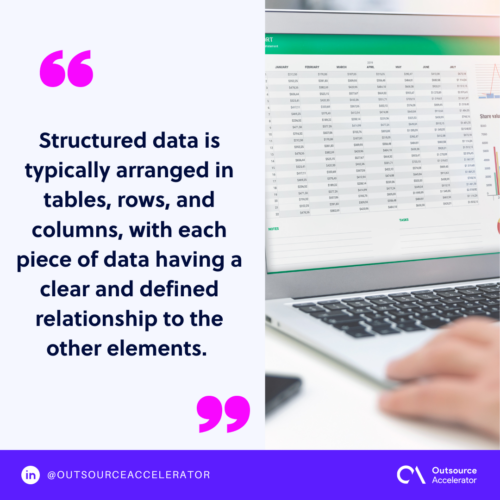
Structured data is any data that is highly organized and formatted to be easy to search in a computer system or database. In fact, this type of data shows up in a predictable way. It follows a consistent pattern, which makes it simple to store and access. Usually, it sits in tables, rows, and columns. Also, each piece of data has a clear, defined link to the other elements.
Because structured data is organized this way, computers can process and analyze it with algorithms. As a result, it is ideal for tasks that need large-scale data processing. It plays a key role across many industries too. For example, it supports data analysis, reporting, and the work of relational databases. Clean inputs matter here, so many firms run regular data quality checks.
What is unstructured data?
Unstructured data, on the other hand, is information that lacks a set data model or structure. Unlike structured data, it does not fit neatly into tables or rows. It also lacks a consistent pattern. Unstructured data can take many forms, such as:
- Text documents
- Images
- Videos
- Emails
- Social media posts
- Audio files
- Sensor data
Unstructured data is flexible and diverse. However, that same trait makes it harder to search, store, and analyze. To extract value, you need advanced methods. These include natural language processing, image recognition, and machine learning. Despite the challenge, unstructured data holds huge worth. It often carries valuable insights, sentiments, and context. In turn, this helps teams understand consumer behavior and trends.
Structured data vs. Unstructured data: Similarities and differences
This section compares structured data vs. unstructured data on what they share and where they split. First, let us look at the similarities. Then we will cover the differences.
Similarities of structured and unstructured data
Structured and unstructured data differ a lot in how they are organized. Still, they share some purposes.
Business value
For example, both types can give insights for businesses. Structured data offers clear, quantitative metrics. Meanwhile, unstructured data offers qualitative insights, sentiments, and context.
Decision-making
Both types can guide smart decisions based on patterns and trends. For instance, structured data can inform choices in sales, marketing, and finance. Unstructured data can inform choices in customer service and product development.
Analysis and processing
Both types can be analyzed and processed, though with different methods. In addition, modern analytics tools can handle each one. Structured data suits traditional relational queries and SQL operations. Unstructured data may need special tools, such as NLP for text or OCR for images. Overall, both data types play complementary roles. Together, they give insight into business operations and customer behavior. For scale, many teams turn to data management outsourcing.
Differences between structured and unstructured data
When you compare structured data vs. unstructured data, they differ in several key ways.
Organization
Structured data, as the name implies, is organized. It fits neatly into set formats with a predefined schema. These formats include databases, spreadsheets, or tables. It follows a clear structure with fields and relationships, so it is easier to analyze. Unstructured data, on the other hand, lacks a set structure. It does not fit into traditional tables or databases, and it is not organized in a predictable way.
Format
Structured data usually appears in a tabular format with clear rows and columns. For example, each column stands for a specific attribute. Each row is a distinct record. In contrast, unstructured data does not follow a fixed layout. It may show up as free-form text, multimedia files, or any other format without a set structure.
Flexibility
Structured data is rigid because it follows an organized schema. So any change to the structure needs changes to the schema. Unstructured data, however, is highly flexible. It can take many formats. Because it has no fixed schema, it allows for diverse and dynamic content.
Searchability and accessibility
Structured data is highly searchable. You can access it easily with database management systems. As a result, you can retrieve and analyze specific information against set criteria. Unstructured data is harder to search and analyze. You need advanced methods to pull out meaning and make it searchable.
Analysis complexity
Structured data is fairly easy to analyze. For example, common methods include aggregations, calculations, and reports. Unstructured data needs more complex methods. For example, teams use sentiment analysis, image recognition, and text mining to make sense of it.
Data types and examples
Structured data is mostly quantifiable and well-defined. It includes numerical values, dates, and categorical variables. Examples include:
- Databases
- Spreadsheets
- Tables
- Datasets with a clear organization
In contrast, unstructured data holds qualitative and subjective information. It includes data like:
- Social media posts
- Customer reviews
- Email communications
To keep both types usable, a clear data collection strategy and strong data standardization help a lot. Both reduce errors before analysis even begins.
Utilizing both structured and unstructured data
Rather than fixate on the differences, companies should see the value in using both. So treat these data types not as separate silos but as complementary resources.

By using the strengths of both, you gain a fuller view of your operations, customers, and market. The key is to adopt flexible data architectures and advanced analytics. It also helps to build a culture of innovation. For complex needs, big data consulting can speed the work. In the end, the firms that do this will be better positioned to adapt and thrive as more data fills the world.
Frequently asked questions about structured and unstructured data
Here are quick answers to common questions on this topic.
Is structured or unstructured data more common?
Unstructured data makes up the larger share of what most firms hold. Think emails, images, chats, and video. Structured data is smaller in volume, but it is faster to query.
What is semi-structured data?
Semi-structured data sits between the two. It has some tags or markers but no rigid schema. Common examples include JSON and XML files.
Which type is better for business decisions?
Neither one wins alone. For example, structured data gives clear metrics. Meanwhile, unstructured data adds context and sentiment. So the best decisions use both together.
Where is structured data stored?
For example, structured data usually sits in relational databases, spreadsheets, and data warehouses. These systems use a set schema, which keeps queries fast and reliable.
What tools analyze unstructured data?
For example, teams use natural language processing, image recognition, and machine learning. OCR also helps pull text from images. Together, these tools turn messy data into usable insight.






 Independent






