
Crucial customer retention statistics to know in 2026


Why do customer retention statistics matter?
Customer retention statistics matter because keeping existing customers is far cheaper than winning new ones, and loyal buyers drive most of a company’s revenue and growth.
- Repeat customers can make up around 65% of a company’s revenue.
- Most business leaders say retention costs less than new acquisition.
- A strong customer experience is the top driver of brand loyalty.
Today, customer retention stays a key goal for marketers everywhere. Beyond winning new clients, keeping current ones helps a business survive and grow. So it is not enough to attract new customers. You also need to keep them loyal to your products and services.
A strong customer retention strategy is a sure way to fuel growth. Happy customers do more than stay loyal. They also act as brand ambassadors. As a result, they promote your brand to their circles, so you reach new buyers at a much lower cost.
To put the value of loyalty in perspective, here are the customer retention statistics you should know in 2026.
Customer retention statistics across different industries
Statista’s research on customer retention revealed:
- Customers in media and professional services enjoy the highest retention rates, at 84%.
- Next come automotive and transport and insurance (83%), IT (81%), construction and engineering (80%), and finance and telecommunications (87%).
- Hospitality, travel, and restaurants see the lowest retention, at 55%.
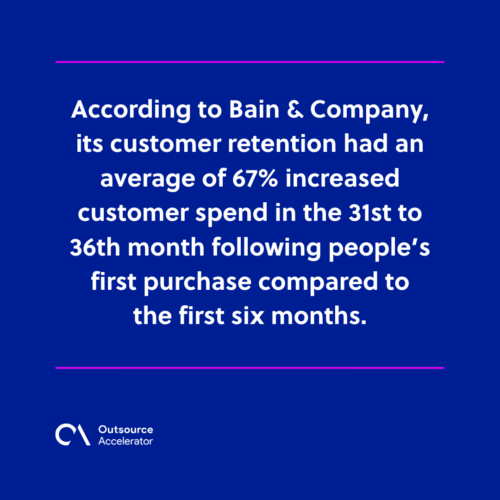
According to Bain & Company, retention led to an average of 67% increased customer spend in the 31st to 36th month after a first purchase, compared with the first six months. So loyalty clearly pays off over time.
A Gitnux study showed that in tech and electronics, Apple still has the most loyal customers. In fact, 92.6% of iPhone users plan to stay with the brand for their next phone. That is higher than Samsung users, at 74.6% brand loyalty.
Meanwhile, CustomerGauge found that across industries, about 44% of business does not track or compute their retention rates. So many firms fly blind on this metric.
In the software-as-a-service (SaaS) space, a net revenue churn of over 2% every month points to an internal fault. Often, that fault sits in the CX and delivery areas.
In addition, Grand View Research states that the loyalty management market is growing fast. It has a compound annual growth rate of 12.3% and is set to reach $17.65 billion by 2028.
How customer experience and opinion shape retention
Deloitte found that firms that focus on a good customer experience were 60% more profitable than their non-customer-centric rivals. So a positive experience should sit at the heart of the full value chain.
Meanwhile, PwC’s figures show that about three-fourths (73%) of clients link good customer experience (CX) to establishing brand loyalty.
Most firms underrate the cost of poor service. However, in the US, brand switching costs businesses about $75 billion to $1.6 trillion per year. According to Midlands Technical College, these losses stem from a few factors, such as:
- Cost-cutting strategies
- A gap in customer preferences
- Sacrificing CX for company growth
- Dehumanization of customer service
Below, we have gathered more customer retention statistics tied to customer experience:
- PR Newswire found that 68% of customers point to feeling unappreciated as the top reason to switch brands.
- A separate American Express study showed that 68% of customers see the service representative as a key part of a good experience.
- In a PwC survey, over half of respondents (54%) believe that companies need to do better at delivering quality customer experience.
- McKinsey’s study showed that a well-run CX strategy can lift customer satisfaction by 20%. It also drives a 15% sales boost, a 30% cut in cost-to-serve, and an extra 30% in employee engagement ratings.
- According to Gallup, engaged workers are more driven and keep better customer ties. Firms with highly engaged workers enjoy 20% higher sales. The same firms beat rivals by up to 147%.
- LiveAgent’s survey revealed that only 8% of customers agreed the brands gave excellent service. Yet 80% of those brands believed they delivered, which shows a disconnect between business and customer views.
- An Accenture survey showed that about 48% of customers left a company website and bought elsewhere because of a poor experience.
- In another PR Newswire study, 81% of companies see customer experience as a key competitive edge.
- As per Zippia, 60% of US customers returned to a brand after a positive experience. That is slightly lower than the 68% and 66% seen in earlier years.
Customer retention statistics: Brand loyalty
Take a look at these key customer retention statistics on brand loyalty:
- Smallbizgenius found that 65% of a company’s overall revenue comes from repeat customers. So retention efforts truly matter.
- 82% of business leaders believe customer retention is more cost-effective than winning new customers. This comes from Econsultancy’s market research.
- Bain & Company’s study also showed that a 5% increase in customer retention could drive profits up to 75%.
- Microsoft stressed that all firms rely on customer ties. A small 7% rise in loyalty can lift customer lifetime value (CLV) up to 85% or more. So your pressure to find new clients drops.
- In addition, a retail CX study showed that 77% of consumers stay loyal to favorite brands for ten years or more. This includes 60% of millennials.
- 37% of respondents believe loyalty forms when a customer purchases five times from the same brand, while 33% believe it takes three.
What makes customers loyal to a brand?
According to these customer retention statistics, buyers become loyal for the reasons below.
Online storefront
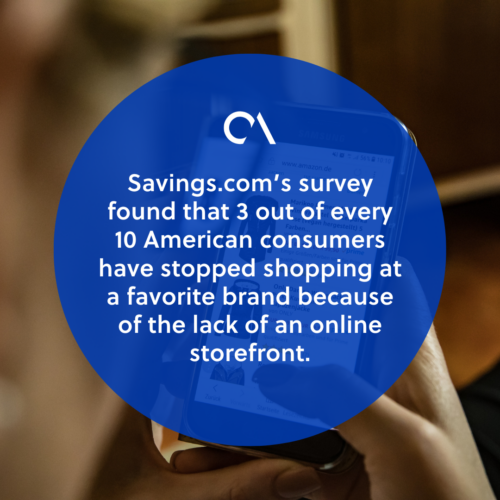
Savings.com found that 3 out of every 10 American consumers stopped shopping at a favorite brand due to no online storefront. Roughly the same number left because of poor online experience.
On average, firms have a 60% to 70% chance of reselling to an existing customer. That is far higher than selling to new ones, where success runs as low as 5% to 20%.
Excellent customer service
Firms with great service enjoy loyalty, even at slightly higher prices. American Express notes that US customers are willing to pay up to 17% more for a great customer experience.
Reward schemes
Similarly, over 70% of US consumers belong to at least one active reward scheme. So rewards clearly work and push repeat purchases. A separate Smallbizgenius study shows that three-fourths (75%) of people prefer companies with active reward programs.
Omnichannel customer experience
A marketing statistics report revealed that marketers with omnichannel reach can drive customer retention rates by 90% versus single-channel ones. As a result, outsourced omnichannel marketing is a growing trend in the BPO industry.
Customer retention and churn rates
Ideal churn rates should sit at 5% or below. Once churn tops 10%, you should rethink your retention strategy.
For example, Small Business says firms lose about 10 to 25% of their customer base each year. Churn is a natural part of any business. About half of customers normally churn within five years. However, only 1 out of 26 unhappy customers complain. The rest simply switch brands.
CallMiner reports that avoidable churn costs US businesses about $136 billion every year. The common reasons customers churn are below.
- Social media now helps control attrition. Gartner found that failing to answer social inquiries drove up to 15% churn rates.
- A Harvard Business Review study shows that short tutorials on product features can cut churn by up to 6%.
- Vonage found that after a poor experience, 58% of customers will not return to the same brand.
Leverage customer retention statistics for business growth
The customer retention statistics above span many industries and business sizes. So by weighing the best practices, you can give a better experience and build loyalty.
Loyal customers ensure a steady revenue stream. As a result, you gain a strong base for survival and growth. To help you start, here are some of the best customer retention strategies to consider.
To make the rollout smooth, Catalyst BPX‘s customer support team is ready to help you every step of the way.
Frequently asked questions
Why is customer retention cheaper than acquisition?
Winning a new customer takes more marketing and sales spend. Existing customers already trust you, so they cost less to sell to. In fact, 82% of leaders say retention is more cost-effective.
What is a good customer retention rate?
It varies by industry. Media and professional services top the list at around 84%, while hospitality sits near 55%. So compare your rate to your own sector.
What is a healthy churn rate?
An ideal churn rate is 5% or below. Once it tops 10%, you should review your retention strategy. So track churn month to month.
How much revenue comes from repeat customers?
Repeat customers can drive about 65% of a company’s total revenue. So loyal buyers matter far more than one-time sales.
What is the biggest driver of customer loyalty?
Customer experience is the top driver. About 73% of clients link good CX to loyalty. So a strong experience keeps people coming back.
Key takeaways
- Repeat customers can make up around 65% of total revenue.
- Most leaders agree retention costs less than winning new customers.
- A strong customer experience is the top driver of brand loyalty.
- Aim for a churn rate of 5% or below, and review it once it tops 10%.
- Reward schemes, great service, and omnichannel reach all boost retention.






 Independent





