
Impact of Artificial Intelligence (AI) on the Philippine outsourcing industry


What is the impact of artificial intelligence on the Philippine outsourcing industry?
Artificial intelligence is reshaping Philippine outsourcing by automating routine tasks, speeding up data work, and shifting skilled talent toward higher-value roles.
- AI handles repetitive work, so people can focus on complex, strategic tasks.
- Experienced talent still guides how new tools are set up and used.
- Roles are changing, but demand for great people remains strong.
The outsourcing industry has been a major driver of the Philippine economy for years. In 2020, the sector was reported to employ over 1.3 million people, which proved its huge role in the country. By 2025, that workforce had grown to about 1.9 million, with export revenue near USD 40 billion.
The industry has clearly moved forward over the years. One of the biggest recent shifts is the impact of artificial intelligence (AI).
In this article, we explore the impact of AI on the Philippine outsourcing industry. We also look at the role of skilled talent in digital transformation. In addition, we feature Inge Zwick, the Executive Director of Emapta Offshore Staffing.
Impact of AI on the outsourcing industry
AI has made a real mark on the BPO industry so far. For example, it can automate tasks once done by people. As a result, work gets faster and cheaper. AI has also improved the accuracy and speed of data processing, which matters a lot in outsourcing. To see the wider shift, read our guide to AI outsourcing.
In the 438th episode of the Outsource Accelerator Podcast, Emapta’s Executive Director shared her view on the topic.
According to Inge, some people worry that AI could replace human workers. However, she said skilled talent still plays a key role in setting up and improving these tools.
“But when we speak to our customers, we have the experience, and we’ve seen how new technologies are generally implemented in businesses, what the process is for…
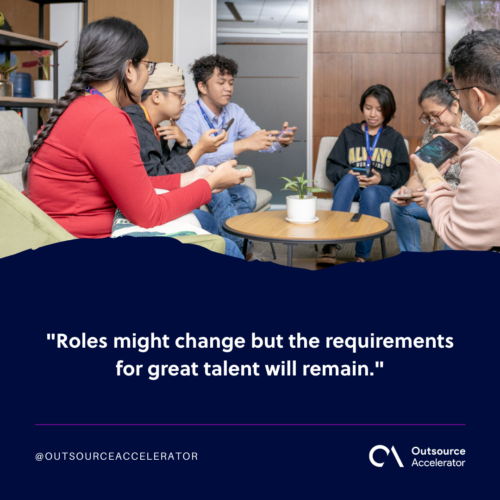
We’re not really worried, in the sense that roles might change, but the requirements for great talent will remain.”
Leveraging outsourcing for technology implementation
Using global staff to roll out new technology matters more than ever. Today’s business landscape moves fast. So firms need people who can put new tools to work quickly.
Inge’s podcast episode also touched on this need. New technologies must fit into existing processes across industries. Because of this, firms need people with the right expertise.
“That’s where I believe outsourcing does come in. With outsourcing, you can afford to have really great senior experienced resources, who can help with that implementation.
And then once the implementation of the technology has been achieved, these are still experts in their field who can then optimize other processes. So rather than a threat, it’s more of an evolution of the roles,” said the Emapta Executive Director.
By using outsourcing, firms can tap a pool of talented professionals. These experts bring the skills needed to drive successful technology projects. This is one reason many leaders now view AI-augmented BPO services as a growth lever rather than a cost.
The discussion also stressed the role of outsourcing in two areas. First, it helps firms set up new tools. Next, it helps them refine processes they already run.
Once the setup phase is done, these outsourced experts keep adding value. For example, they can optimize other processes inside the business. This evolution of roles shows the real power of outsourcing. It meets urgent needs and offers ongoing expertise for steady improvement.
Contrary to being a threat, outsourcing helps firms adapt as the landscape shifts. By partnering with providers, they gain experienced people with the knowledge needed for smooth technology adoption. Many firms pursue this as part of a wider AI transformation across their operations.
Collaborating AI and outsourced talent
AI keeps reshaping industries. So it helps to learn how to work alongside these tools. Done well, this teamwork can benefit the offshore outsourcing industry.
Inge highlighted the “unique” value that experienced Philippine talent brings to the table.
“Many of our candidates and team members have a unique ability to learn a new process, but also link it back to similar processes they’ve done before…
[They can] identify the best one and [suggest] which way would be most suitable for those companies…,” Inge noted.
Inge said that while “there is not yet a huge demand” for these professionals, it is “growing.”
She said firms open to this option are often early adopters. For example, they may be younger startups. They may also be organizations with a diverse workforce that have moved past worries about cultural differences.
“It’s really exciting to see it work, and to see it really succeed when you see them with the senior leadership providers…”
Overall impact of AI on the industry
With AI, routine and repetitive tasks can be automated. As a result, people are freed to focus on complex, strategic work. This lets outsourcing firms deliver faster turnaround and higher productivity. The broader benefits of automation reach almost every back-office function.
AI-powered chatbots and virtual assistants have also improved AI customer service. For example, they offer round-the-clock support and quick replies.
AI has also made it easier for spread-out teams to work together. With cloud platforms and AI communication tools, outsourcing staff can collaborate in real time. So geographical barriers shrink, and a global workforce can operate as one.
So far, AI has lifted efficiency, customer service, data analysis, innovation, and collaboration. As AI keeps advancing, the industry can seize the chances it brings. The Philippines, in particular, is well placed to benefit, as our look at the Philippine BPO industry shows.
To learn more about Inge Zwick and Emapta, visit their website at https://emapta.com/.
Frequently asked questions
Will AI replace outsourcing jobs in the Philippines?
Not on a large scale, based on current trends. AI automates routine tasks, so some roles change. However, demand for skilled people stays strong. In fact, workers who guide AI tools often become more valuable.
Which outsourcing tasks are easiest to automate with AI?
Repetitive, rules-based work is the easiest to automate. Examples include data entry, basic ticket routing, and first-line chat replies. Meanwhile, complex judgment and client relationships still need people.
How does AI help Philippine BPO firms compete?
AI boosts speed, accuracy, and round-the-clock coverage. As a result, firms can serve more clients at lower cost. Strong English skills and deep experience then add a human edge that pure automation cannot match.
What skills matter most in an AI-driven outsourcing industry?
Adaptability and process knowledge matter most. In addition, firms value people who can set up tools and refine workflows. Analytical and communication skills round out the list.






 Independent






