
Enabling Global Employment with EOR – Antoine Boquen of RemotePeople

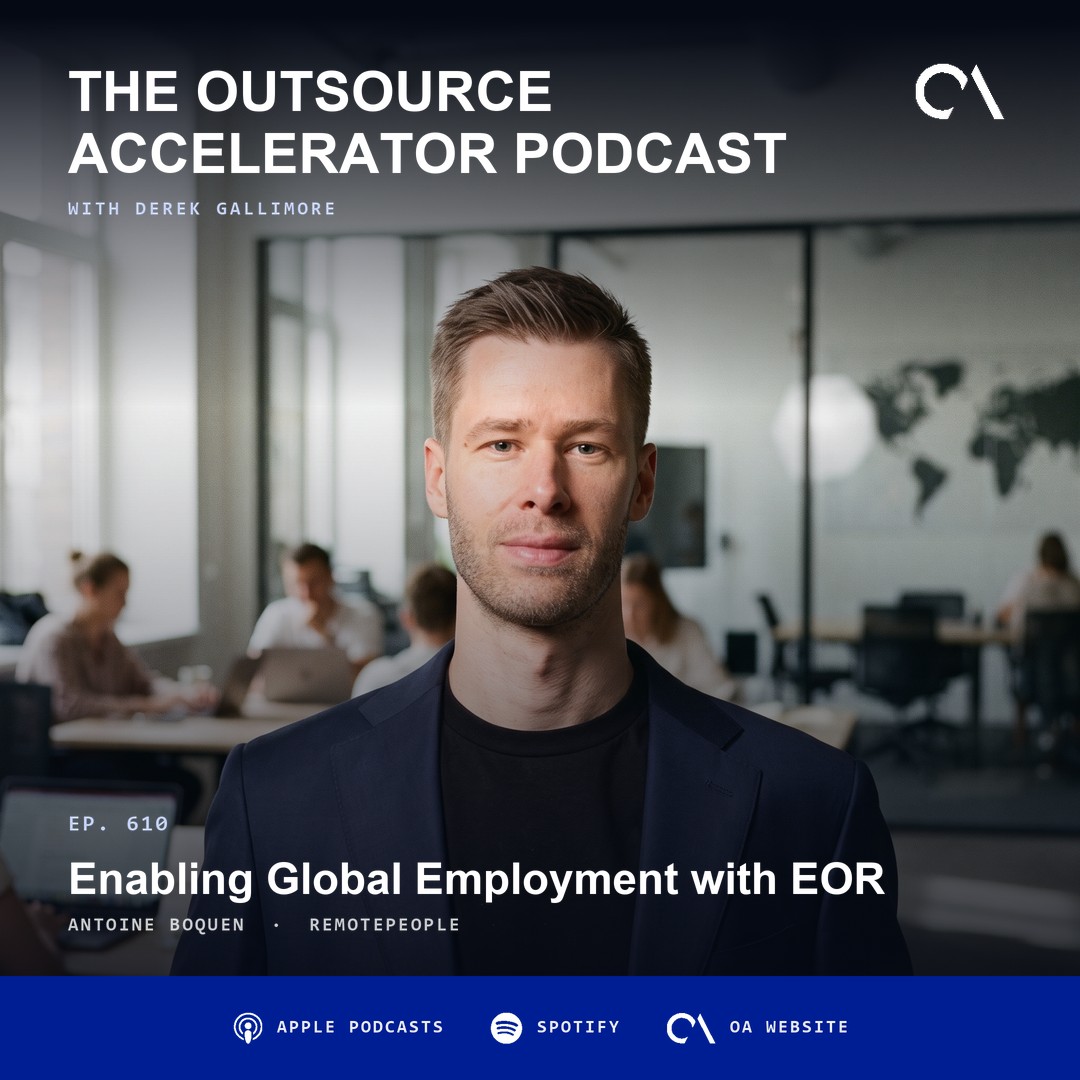
Antoine Boquen spent a lot of time traveling through Latin America, Africa and Southeast Asia, meeting skilled people who took whatever job their city offered. That gave him the idea for RemotePeople, which he started in 2018 to help companies hire the best talent wherever it lives.
As co-founder and CEO of RemotePeople, Antoine runs a global expansion company that manages close to 10,000 employees around the world for mostly American and Western European clients. He joins the Outsource Accelerator Podcast to talk about how employer of record (EOR) services fit into global hiring.
The conversation covers what clients still have to own once they hire abroad, how work norms change from one region to the next, and why the companies using AI the most are also hiring the most.
Inside RemotePeople
Antoine describes the business in simple terms.
“We are like a global expansion company, so we’re a company that tries to help businesses expand around the world.”
He keeps the offer narrow on purpose, built around three services.
“We really focus into recruitment, employment, and company incorporation. But what we do, we do it really, really, really well.”
From traveling to global hiring
The idea came from conversations on the road. Antoine kept meeting talented people who had settled for whatever work was nearby.
“A lot of people were actually applying for position just because that was the only thing available for them in their city, and not necessarily the thing they were the best at.”

Remote hiring was a harder sell before the pandemic, when most companies preferred people in the office. COVID changed that.
“But then COVID kind of reshuffled everything, so we felt like a big potential during COVID and after COVID, where organizations got used to work with people around the world.”
Measuring output, not office hours
The clients who do best with global teams, Antoine says, judge people on results rather than desk time.
“You’re able actually to measure the performance of people not based on their office presence, but their performance, like how do they deliver.”
Most of RemotePeople’s hiring happens in Asia, where the talent pools are deep.
“Our largest market for employment are India first, China second, and then countries like the Philippines, Vietnam, Indonesia.”
Compliance from the provider, management from the client
RemotePeople’s main job is HR, labor and payroll compliance. Antoine is clear that day-to-day people management stays with the client, especially once a team grows.
“You cannot outsource completely, you know, like the HR management of your team. People need support. They need speed.”
He sees the real complexity in running many countries at once.
“The most difficult is like when you have six or seven or 10 or more countries together and you want to try to align the policies, you know, that you have, the benefits that you have in, in a certain region versus others.”
A team of 400 people supports clients on benefits, contracts, onboarding, off-boarding and payroll. Getting the policy right is not a quick job.
“The implementation of, of this successful company policy takes on average 90 days to 180 days working with various of our teams to set up like the policy they want.”
Work norms depend on the city
Remote work looks different across regions. In Asia’s megacities, the commute alone makes working from home popular.
“If you live in a city like Shanghai, you would appreciate, you know, not to have to commute every day when the city is like 25 million people.”

In Europe’s smaller cities, clients often fund a co-working space or small office instead, with a flexible routine.
“The practice is often like three days a week, so you ask the team to come three days a week without commitment.”
Hiring for talent, not just cost
Antoine’s clients hire abroad first to find the best person. Lower costs come second.
“So we often see companies who intend to first hire one person, they end up, you know, hiring two people for the same budget. Not necessarily because they are cheaper, simply because they are better.”
He points to the US and China as the two markets where a single hire can cover the whole country.
“In those two countries, you can hire one person, one sales leader, and he or she will be able to sign contracts for your company and bring revenue by just speaking one language.”
When building a team, he advises choosing a main time zone and one secondary region rather than spreading across the globe.
“It’s impossible actually to run successfully a team with, like, all time zones at once.”
AI-native companies hire the most
Asked whether AI threatens demand for employment, Antoine sees the opposite trend among his clients.
“So the companies we work with that are using AI the most, or the, the, the ones that are AI native, are the ones hiring the most.”
The best people for AI work, in his view, are generalists who understand how the whole business runs.
“It’s almost like everybody should be a CEO, you know? It’s like you have 20 CEOs within one company with AI.”
For Antoine, global employment comes down to one idea: hire the best person for the job, wherever they live, and give them a compliant way to work.
To learn more about RemotePeople, visit remotepeople.com or reach Antoine Boquen directly at [email protected]. And if you would like to learn more about what we do in the outsourcing space, send us an email at [email protected].






 Independent






