
Strategic planning process

Definition
Strategic planning process
The strategic planning process is the step sequence an organisation follows to produce a plan: scan the environment, set objectives, choose a strategy, get it approved, then fix a cadence for reviewing it. The process ends at approval; delivery is separate work.
Treat it as a production line, not a philosophy. Each step has an input, an owner and a document that comes out the other end.
That distinction matters because planning collapses when the steps blur. A workshop that jumps straight from a market scan to a budget line usually produces numbers nobody can defend.
The sequence is also a brake — each gate forces a sign-off before the next step starts, which is what stops a plan being written backwards from a number the board already liked.
Strategic planning is the wider discipline. The process is the mechanics inside it — who meets, in what order, and what has to exist before the next meeting can happen.
Key takeaways
- The strategic planning process is a sequence of steps, each with an owner and an output.
- It runs scan, objectives, formulation, approval, then review cadence.
- Approval is the finish line for the process, not for the strategy.
- A fixed review rhythm is what separates a plan from a filed document.
How it works
The process runs in five steps: scan the operating environment, set objectives, formulate options and pick one, take the plan through approval, then set a review cadence. Each step closes with a document, which is what makes the next step possible.
Step one is evidence gathering. Market data, customer feedback and capability gaps all land here, alongside the external factors nobody controls but everybody has to plan around.
Objectives come next, and they have to be measurable. Many organisations express them as objectives and key results, with the mission statement already settled through mission statement development.
| Step | Output | Typical owner |
|---|---|---|
| Environmental scan | Evidence pack, external risk list | Strategy or insight team |
| Set objectives | Measurable goals with targets | Executive team |
| Formulate strategy | Shortlisted options, chosen approach | Executive team |
| Approve | Signed plan and funded budget | Board or minister |
| Set review cadence | Review calendar and reporting pack | Chief operating officer |
Formulation is the step most often rushed. Picking a strategy means rejecting options in writing — and a plan that never names what the organisation decided not to do is a wish list with a cover page.
Statute shows the same sequence in public bodies. Under US law, an agency strategic plan must carry a mission statement, outcome-oriented goals, the resources needed, and key external factors beyond the agency’s control, covering at least four years ahead.
Private firms rarely write the sequence into policy, but the better ones publish a planning calendar instead. Fixed dates for the scan, the objective-setting workshop and the approval meeting do the same job as a statutory deadline.
The review step is the one most often skipped. The GPRA Modernization Act of 2010 requires agency leaders to review progress on priority goals at least quarterly, which is a useful benchmark for any planning calendar.
Examples
The same five steps appear in a federal agency, a mid-sized outsourcing provider and a single business unit. What changes is the horizon, the approval body and how much of the sequence is written into law.
US federal agencies run the most documented version. Their plans must cover at least four years, be published after a presidential term begins, and be built with consultation of congressional committees at least once every two years.
A business process outsourcing provider usually runs an annual cycle with a three-year horizon. The scan lands in August, objectives in September, approval in November, and the first review falls in the following March.
A single business unit compresses it to about six weeks. It inherits the corporate objectives, formulates only at the service-line level, and takes approval from a divisional head rather than a board.
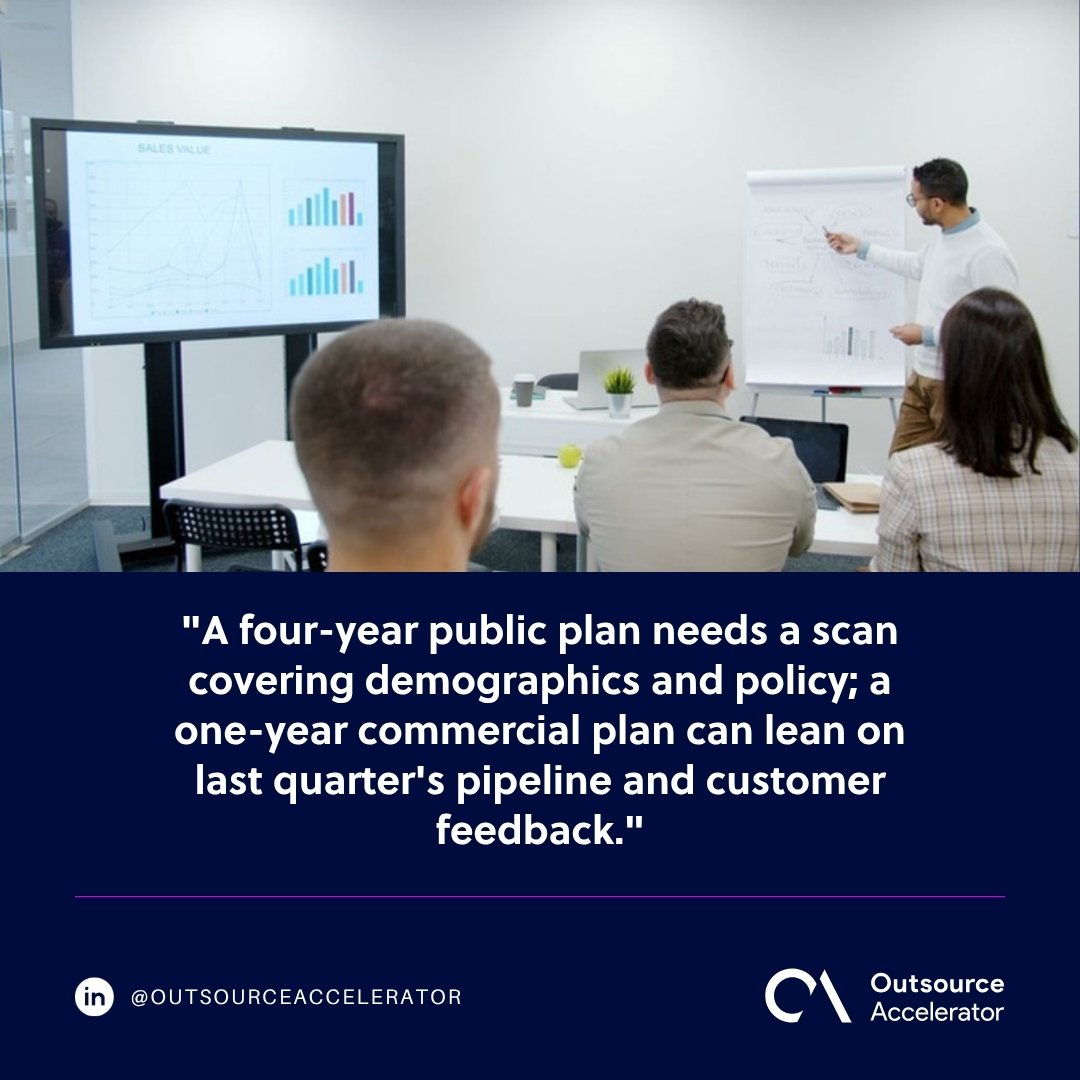
Horizon length drives everything else. A four-year public plan needs a scan covering demographics and policy; a one-year commercial plan can lean on last quarter’s pipeline and customer feedback.
Reviews then compare plan to actual. Budget variance analysis usually sits at the centre of that conversation, because money is the first place a stale plan shows up.
Related terms
Five terms sit around the process: the discipline it belongs to, the goals it produces, the statement it starts from, the money it commits, and the variance analysis that tells you whether the plan survived contact.
- Strategic Planning: the wider discipline the step sequence belongs to.
- Mission Statement Development: produces the purpose statement every plan is anchored to.
- Objectives And Key Results: a common format for the measurable goals the process sets.
- Budget: funds the approved plan and makes the choices real.
- Budget Variance Analysis: compares planned to actual spend at each review point.
FAQ
Six questions cover most of what teams ask: what the steps are, how long the process takes, who should be involved, how often plans are refreshed, why the process fails, and how it differs from account planning.
What are the steps in the strategic planning process?
Environmental scan, set objectives, formulate strategy, approval, then set the review cadence. Each step produces a document that the next step depends on.
How long does the process take?
Six weeks for a business unit, three to six months for a whole organisation. Public bodies take longer because consultation and publication are mandated.
Who should be involved?
An insight team for the scan, the executive team for objectives and formulation, and the board for approval. Delivery leads join early enough to flag what is not feasible.
How often should a strategic plan be refreshed?
Annually for objectives and every three to four years for the full plan. US federal agencies work to a minimum four-year horizon by statute.
What makes the process fail?
Skipping the review step. A plan with no scheduled review becomes a filed document rather than a decision tool — and nobody notices until the numbers drift.
How is this different from the account planning process?
The account planning process plans one customer relationship. The strategic planning process plans the whole organisation, and sets the objectives account plans then serve.
Work out where outsourcing fits in next year’s plan with the research and provider coverage at Outsource Accelerator.






 Independent






