
Stand-up meeting

Definition
Stand-up meeting
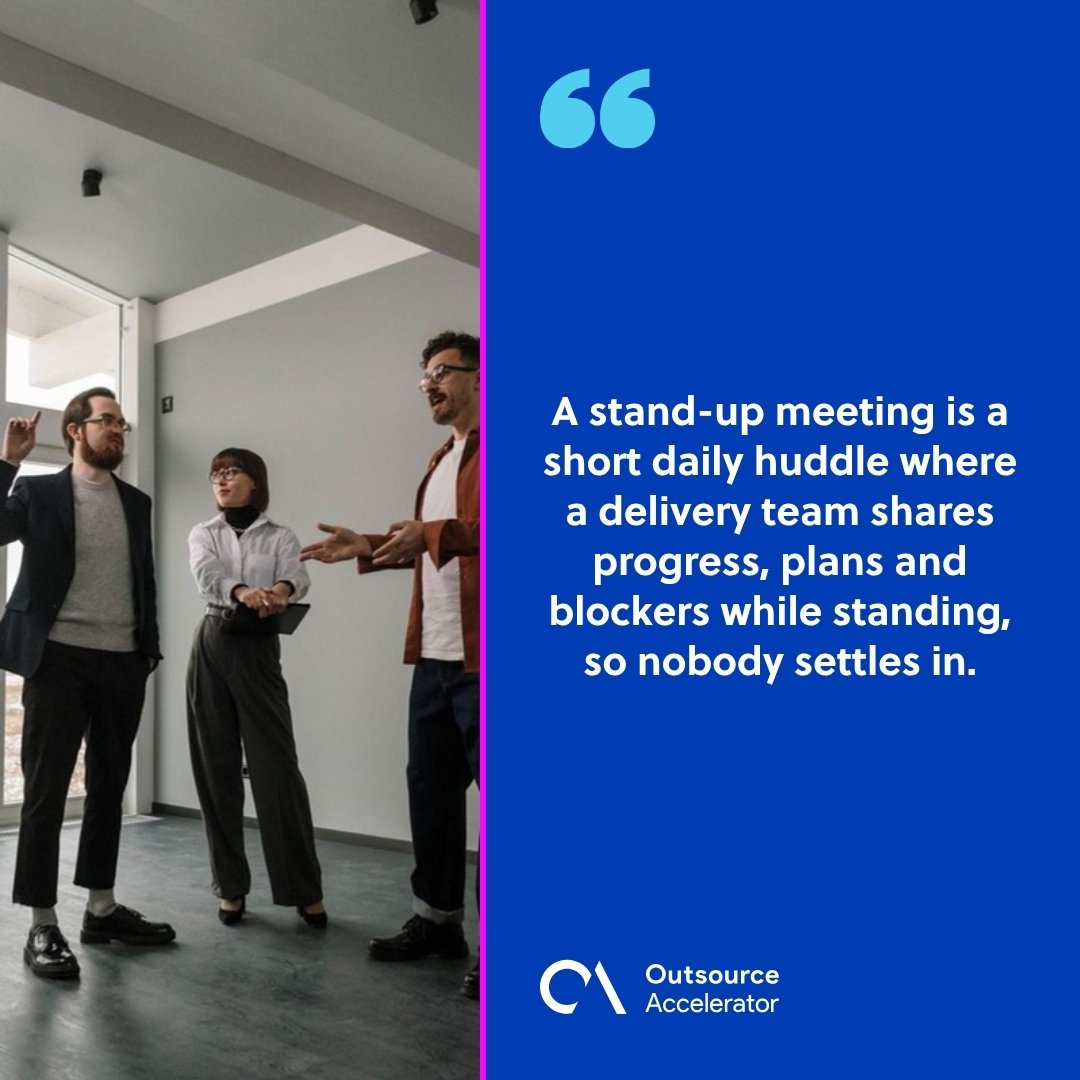
A stand-up meeting is a short daily huddle where a delivery team shares progress, plans and blockers while standing, so nobody settles in. Fifteen minutes is the usual ceiling, and the aim is coordination rather than a status report for an absent manager.
The format is older than agile — agile simply made it standard. Scrum calls it the Daily Scrum, and keeps the rules tight on purpose.
Three questions still do most of the work: what did I finish, what am I on next, and what is in my way. The third matters most, because blockers are the only item the group can clear on the spot.
Who runs it matters less than who speaks. The team talks to each other and anyone senior listens without steering — the moment every update is aimed at one chair, it has stopped being a stand-up.
Stand-ups fail in predictable ways. They turn into serial reporting to the most senior person present, they drift past twenty minutes, or they become a design debate that three people care about.
Introducing them across dozens of teams is a programme in its own right, which is why they usually arrive as part of an agile transformation rather than on their own.
Key takeaways
- A stand-up is a daily coordination slot, not a status meeting for managers.
- Fifteen minutes is the working limit; detail moves to a follow-up conversation.
- Blockers are the valuable output, so raise them before progress updates.
- Distributed teams need an agreed overlap hour more than they need a fixed script.
How it works
Stand-ups run at the same time and place every working day, with the delivery team speaking and anyone else listening quietly. Each person covers progress, next step and blockers in under a minute, and longer debates move to a separate session afterwards.

The Scrum Guide is specific about the shape. It defines the Daily Scrum as a 15-minute event for the Developers of the Scrum Team, held at the same time and place each day to reduce complexity.
The reasoning behind daily contact is older than Scrum. The principles behind the Agile Manifesto state that business people and developers must work together daily throughout a project.
| Element | Common practice | Failure signal |
|---|---|---|
| Length | 15 minutes, hard stop | Runs to 25 minutes, people drift off |
| Attendance | Team speaks, others observe | Managers ask round-the-table questions |
| Focus | Blockers first, then progress | Everyone reports to one person |
| Follow-up | Parking lot straight afterwards | Design debate inside the stand-up |
Two habits keep it to time. Park anything needing more than a sentence for a follow-up conversation, and let whoever is blocked name the person they need instead of waiting for a manager to assign it.
Sprint planning sets what the team committed to; the stand-up only checks whether that commitment still looks realistic today. Teams that blur the two end up replanning every morning.
Examples
Stand-up practice varies with distance. A co-located squad can stand at a board, a distributed team needs a call and a shared screen, and an offshore team needs an overlap window both sides have genuinely agreed to.
Scrum teams run the strictest version. The 15-minute limit has been fixed since the 2020 Scrum Guide, and who speaks is set by the scrum team roles the framework defines.
Scaled programmes add a second tier. Inside an agile release train, team stand-ups feed a cross-team sync where only blockers crossing team boundaries get raised.
Offshore delivery leans on the clock. A Manila team working with a London client often takes the 4pm Manila slot, which is 9am in London — one overlap hour that protects both working days.
Some distributed teams write the stand-up instead. Each person posts progress, next step and blockers to a channel before their day starts, and the group meets live only twice a week — a pattern that suits an overlap window under two hours.
A scrum master offshore usually owns that slot, because somebody has to defend it when either side wants the hour back.
Related terms
Five terms sit around the daily stand-up: the role that protects it, the session that feeds it, the roster that decides who speaks, the delivery model that stretches it across borders, and the programme that introduces it.
- Scrum Master Offshore: the role that keeps a remote team’s stand-up short and unblocked.
- Sprint Planning: the session that sets the commitment a stand-up checks each day.
- Scrum Team Roles: defines who speaks at the Daily Scrum and who only listens.
- Agile Outsourcing: the delivery model that spreads one stand-up across two countries.
- Agile Transformation: the change programme that introduces daily stand-ups at scale.
FAQ
Six questions cover most of what teams ask before their first stand-up: how long it runs, who attends, whether standing is required, how it survives time zones, what to do when it overruns, and how it differs from a status meeting.
How long should a stand-up meeting be?
Fifteen minutes is the standard ceiling and the limit the Scrum Guide sets for the Daily Scrum. Anything longer usually means detail that belongs in a follow-up.
Who should attend a stand-up?
The people doing the work speak; everyone else may listen. Managers who attend should hold their questions until the meeting has closed.
Do people actually have to stand?
Standing is a timer, not a rule. Remote teams get the same effect from a hard stop and a visible countdown.
How do stand-ups work across time zones?
Pick one overlap hour and protect it. Teams split across Manila and London or Manila and Sydney normally fix the slot once and treat it as immovable.
What should you do when a stand-up keeps overrunning?
Cut the scope, not the meeting. Move design debate to a parking lot, hold each person to a minute, and check whether the team has simply grown too large to coordinate in one slot.
How is a stand-up different from a status meeting?
A status meeting reports upward to one person. A stand-up coordinates sideways between people who need each other today, which is why blockers lead.
See how agile outsourcing teams are structured, then compare providers in the Outsource Accelerator directory.






 Independent






