
Conversation Designer

Definition
Conversation Designer
A conversation designer writes the dialogue a chatbot, voice assistant or help widget speaks, and decides what it says when it fails to understand. The craft is writing and user experience work, not engineering. Flows, sample dialogues and fallback rules are the job.
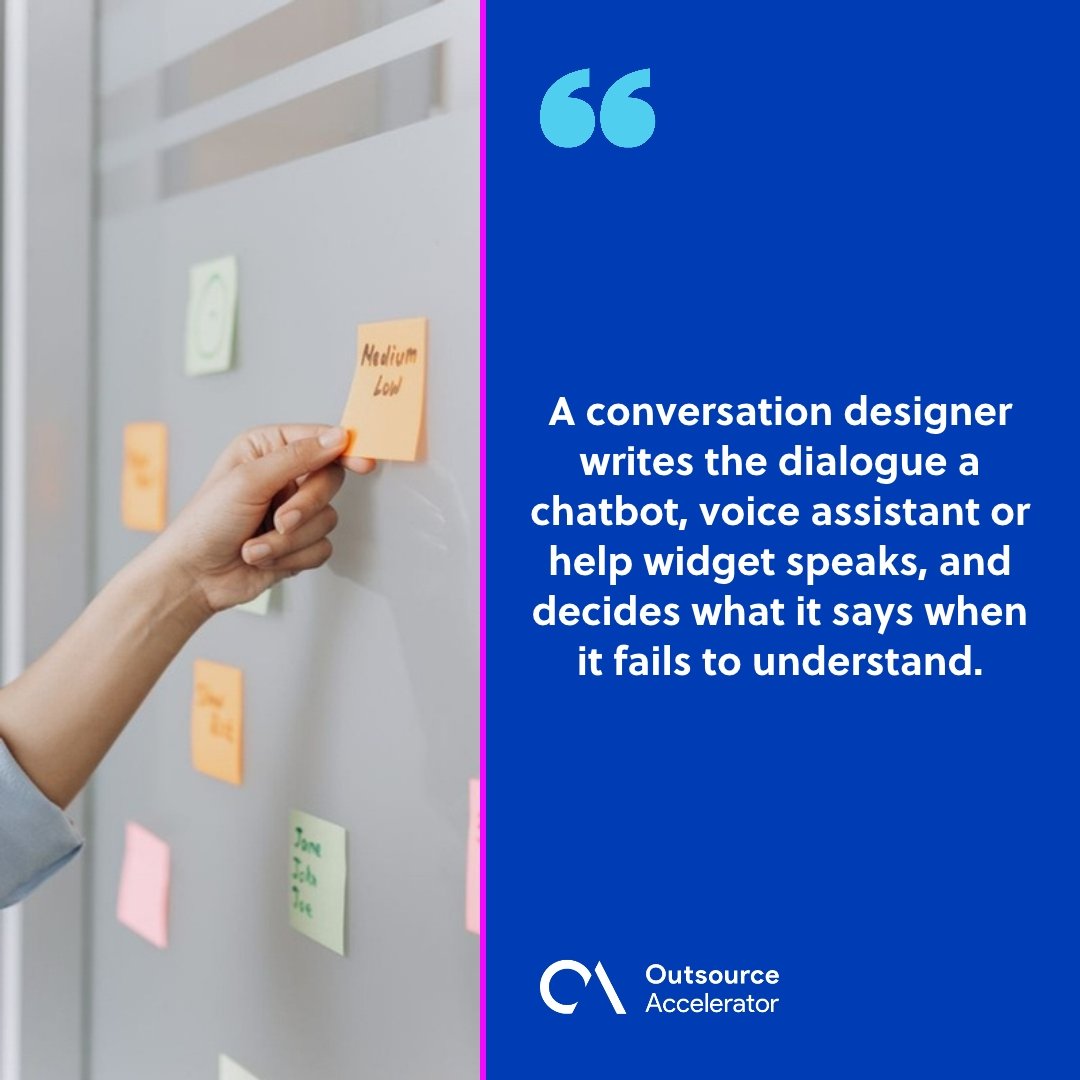
Think of them as the scriptwriter for a product that talks back. They choose the words, the order of the questions, and the moment the bot admits defeat — and fetches a human.
Most of the job happens in documents rather than code. A flow diagram, sample dialogues, an intent list with example phrasings, a persona guide and an error taxonomy — that pack is what gets handed to developers.
The rest of the week goes on transcripts. Reading what real users actually typed is the only reliable way to find the gaps between the script and the conversation people are having.
Key takeaways
- A conversation designer owns dialogue flows, sample dialogues, intent design, persona and error handling.
- The role is a writing and user experience discipline, distinct from the engineers who train and deploy the model.
- Fallback design matters more than happy-path design, because users leave when a bot loops.
- Transcript review is the core weekly habit, not a quarterly audit.
How it works
Conversation design runs in a loop: write a sample dialogue first, turn it into a flow, define the intents and example phrasings behind each branch, build a fallback ladder, then rewrite all of it against real transcripts once the bot is live.
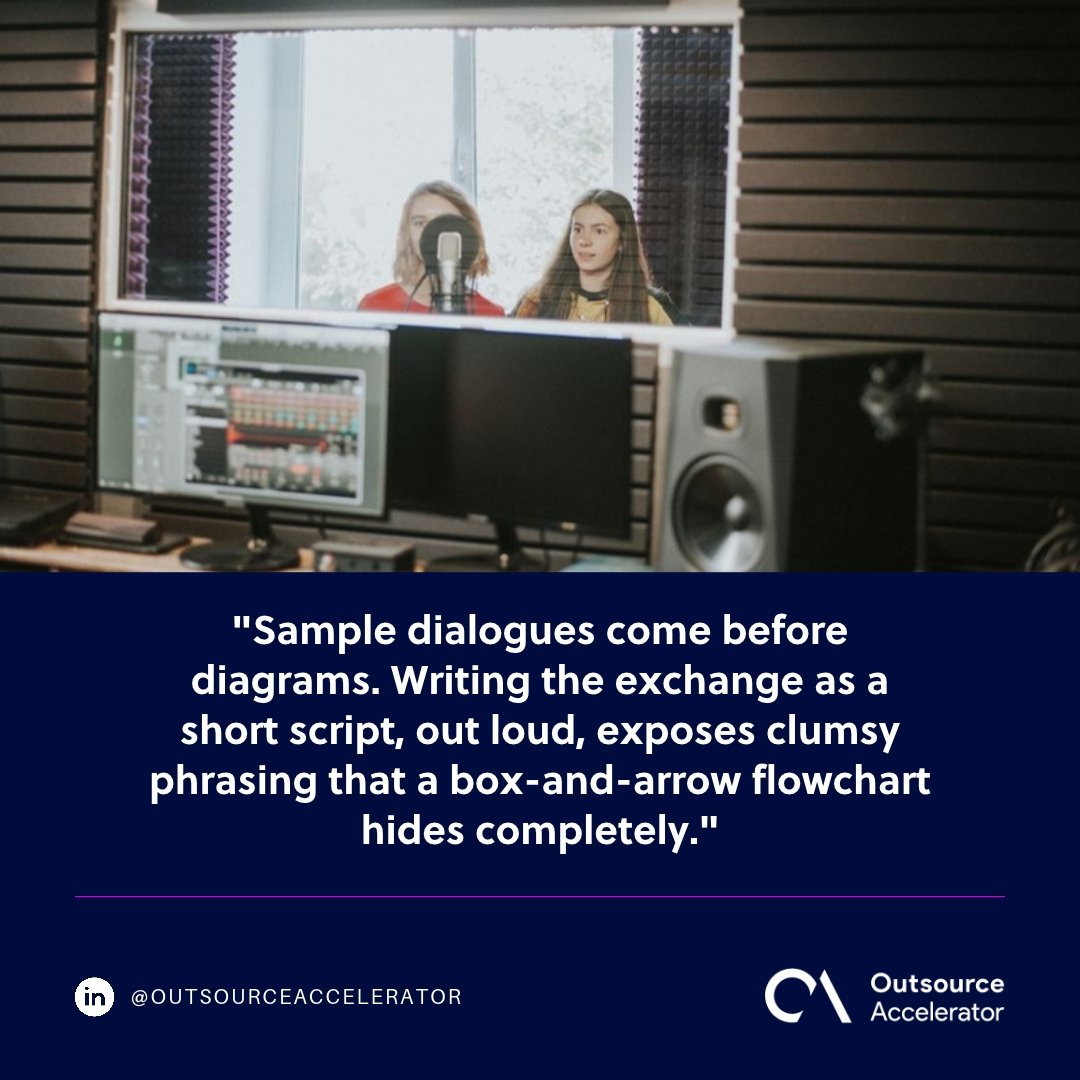
Sample dialogues come before diagrams. Writing the exchange as a short script, out loud, exposes clumsy phrasing that a box-and-arrow flowchart hides completely.
Intents and utterances follow. An intent is the thing a user wants; utterances are the many ways real people ask for it, including the typos and the three-word fragments.
| Artefact | What it answers | Who consumes it |
|---|---|---|
| Sample dialogue | How should this exchange sound? | Product, stakeholders |
| Dialogue flow | Where does each answer lead? | Developers, QA |
| Intent and utterance list | What phrasings map to this branch? | Natural language engineers |
| Persona and tone guide | What voice does the assistant use? | Writers, localisation |
| Error and fallback ladder | What happens on the second failure? | Support operations |
Scope is a design decision too. A bot that promises to answer anything will disappoint on the second question, so good designers argue for a narrow task set and say plainly what the assistant cannot do.
The fallback ladder is the part that separates a good designer from an average one. First miss, reprompt with a narrower question. Second miss, offer choices. Third miss, hand off to a person with the conversation history attached.
Tone decisions are design decisions. The GOV.UK service manual tells writers to keep validation errors blunt, preferring “Wrong password” to a longer apology, and warns against humour because people often use services under stress.
Testing closes the loop. Designers run unmoderated tests on the script before a line of code exists — then read live transcripts weekly and rewrite the prompts behind the most abandoned sessions.
Examples
Three sources show the craft in practice: public sector interface-writing standards, usability research on where bots break, and the named banking assistants that pushed conversation design into mainstream product teams.
The United Kingdom’s Government Digital Service publishes the clearest public standard. Its service manual asks writers to cut help text unless user research proves it is needed, use one idea per sentence, and write link text that still makes sense out of context.
Nielsen Norman Group’s chatbot usability study, published in November 2018, remains a widely cited diagnosis of why bots fail. Its researchers found that bots could not recover from unexpected input and forced users to restart the flow.
That 2018 study is old enough to read as history on specific products, but its structural finding holds — recovery design, not understanding, is where most assistants lose the user.
Capital One’s Eno assistant, one of the bots in that study, is a standard teaching case. A narrow task set, a declared bot identity and a short handoff path beat a broad assistant that tries to answer anything.
Localisation doubles the work. A script translated word for word stops working, because politeness markers, question order and the length people will tolerate all shift by market.
Contact centres hire the role for deflection work. A chatbot that resolves password resets and order status cleanly removes the two highest-volume tickets, and the design of the handoff decides whether the rest arrive at an agent warm or furious.
Related terms
Conversation design sits between the writing disciplines and the speech and language technologies that execute the script. These neighbouring terms cover the systems a designer writes for and the specialists they hand work to.
- Conversational AI: the technology stack that interprets and generates human-like dialogue.
- Intent Recognition: the classification step that maps an utterance to a user goal.
- Automatic Speech Recognition: the conversion of spoken audio into text a system can parse.
- Interactive Voice Response (IVR): the menu-driven phone system conversation designers increasingly replace.
- UX Designer: the broader practitioner responsible for how a product feels to use.
FAQ
What does a conversation designer do day to day?
They write sample dialogues, map flows, define intents and example phrasings, set the persona and tone, and read live transcripts to find where the script fails.
Is a conversation designer a developer?
No. The role is a writing and user experience discipline; developers and natural language processing specialists build and train the systems the script runs on.
What skills does a conversation designer need?
Plain-language writing, interviewing and transcript analysis, basic information architecture, and enough familiarity with intent models to know what a branch can realistically detect.
How is conversation design different from copywriting?
Copywriting persuades in one direction. Conversation design handles turn-taking, memory between turns, and the branching that happens when a user answers something unexpected.
Can the role be hired offshore?
Yes, and Philippine and Indian teams often pair a designer with the AI trainer who labels the transcripts.
Search the Outsource Accelerator provider directory to compare firms offering conversation design and chatbot support teams.






 Independent






