
Why you should try cloud staffing

Why should you try cloud staffing?
You should try cloud staffing because it lets you build a full remote team quickly, tap global talent, and cut costs without new office space.
- It gives you flexibility, much like cloud computing.
- It brings trained experts without a long onboarding process.
- It scales up or down as your needs change.
Cloud staffing, along with remote working, has grown fast in recent years. So what does it mean for the traditional office?
We all know how remote work is going to take industries by storm. Today, the talent pool keeps growing fast. From new learners to seasoned pros, people are moving toward work models that fit their lives.
When it comes to cloud staffing, a few big names already lead the field. These providers stay on top of the remote hiring trend. Soon, cloud staffing will be the next big step for many firms too. The latest remote work statistics back up this shift.
What is cloud staffing?
The term was coined by CEO Lloyd Ernst of Cloudstaff back in 2005.
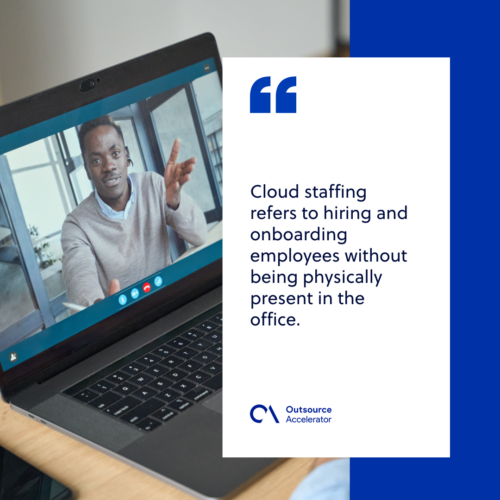
It means hiring and onboarding staff without them being in your office. In most cases of cloud staffing, more than half your team works offshore. So you deal with different time zones, cultures, and work habits. These are not bad things. Still, they can bring fresh challenges for everyone.
Much like cloud computing, cloud staffing gives you flexibility. You get a full team and its benefits without the heavy setup. For many firms, this is where offshore staffing can boost operations.
Advantages of cloud staffing
In cloud staffing, there are two distinct advantages. Much like working from home, the model has drawn many people who want to work outside the office. Today, many leading distributed workforce companies run fully on this model.
Productivity. Several studies show that remote work can help employees be more productive. Without a daily commute, workers often feel ready to tackle their tasks.
Any dips in output usually come from extra errands at home, not the remote setup itself. Beyond that, there are few negative reports about cloud employees. Strong remote work adoption habits help close that gap.
Cost-effectiveness. Imagine growing without using up too many resources. With cloud staffing, you can have a whole remote team ready to work. You hire trained experts and expand fast. Best of all, you skip the extra office space, desks, and long onboarding.
Scalability. Cloud staffing also flexes with demand. For example, you can add people for a busy season and scale back later. So you keep costs in line while your output stays strong.
Access to global talent. Cloud staffing opens the door to skilled people worldwide. So you are not limited to your local market. For example, you can hire specialists who are hard to find at home. As a result, your team gains fresh skills and new ideas.

How Cloudstaff can help
As noted above, Ernst has worked in cloud staffing for a long time. For a firm to lead for about two decades, Cloudstaff clearly did things right.
In 2010, Cloudstaff set its roots in Philippine soil. The company builds its model around what the market needs. Since then, it has grown to thousands of employees across several locations.
Cloudstaff is a leading outsourcing company today. From real estate to quality assurance, it covers front-facing roles and back-office support. As noted above, cloud staffing is not just another outsourcing gig. Instead, it offers scalable, personal, and cost-effective support.
So cloud staffing is a reliable business model. In fact, it can save resources even in tough times. Firms that want local know-how can also explore offshore staffing in the Philippines.
What to look for in a cloud staffing provider
Not every provider is the same. So it pays to choose with care. First, check their track record and client reviews. A strong history often points to steady, reliable service.
Next, look at how they hire and train staff. The best providers screen for both skills and fit. As a result, you get people who are ready to work from day one.
You should also review their tools and security. For example, ask about data protection, time tracking, and reporting. In addition, clear reports help you stay in control of remote work.
Finally, weigh their pricing and flexibility. Good partners let you scale the team as needs change. So you only pay for the support you truly use.
Frequently asked questions
What is cloud staffing in simple terms?
Cloud staffing means hiring a remote team through a provider. The staff work offshore, often in another country. You get trained experts without extra office space. So it works much like cloud computing, but for people.
How is cloud staffing different from freelancing?
Freelancers work on their own and juggle many clients. Cloud staff work as a dedicated team for you. A provider also handles payroll, tools, and onboarding. As a result, you get more control and steadier output.
Is cloud staffing cost-effective for small businesses?
Yes. Small firms often save the most, since they skip office and setup costs. You can also scale the team up or down as needs change. So you pay for the support you actually use.
What roles can you fill with cloud staffing?
You can fill many roles, from customer service to IT and design. Back-office tasks like data entry and accounting work well too. In short, most desk-based roles can move to a cloud team.






 Independent






