
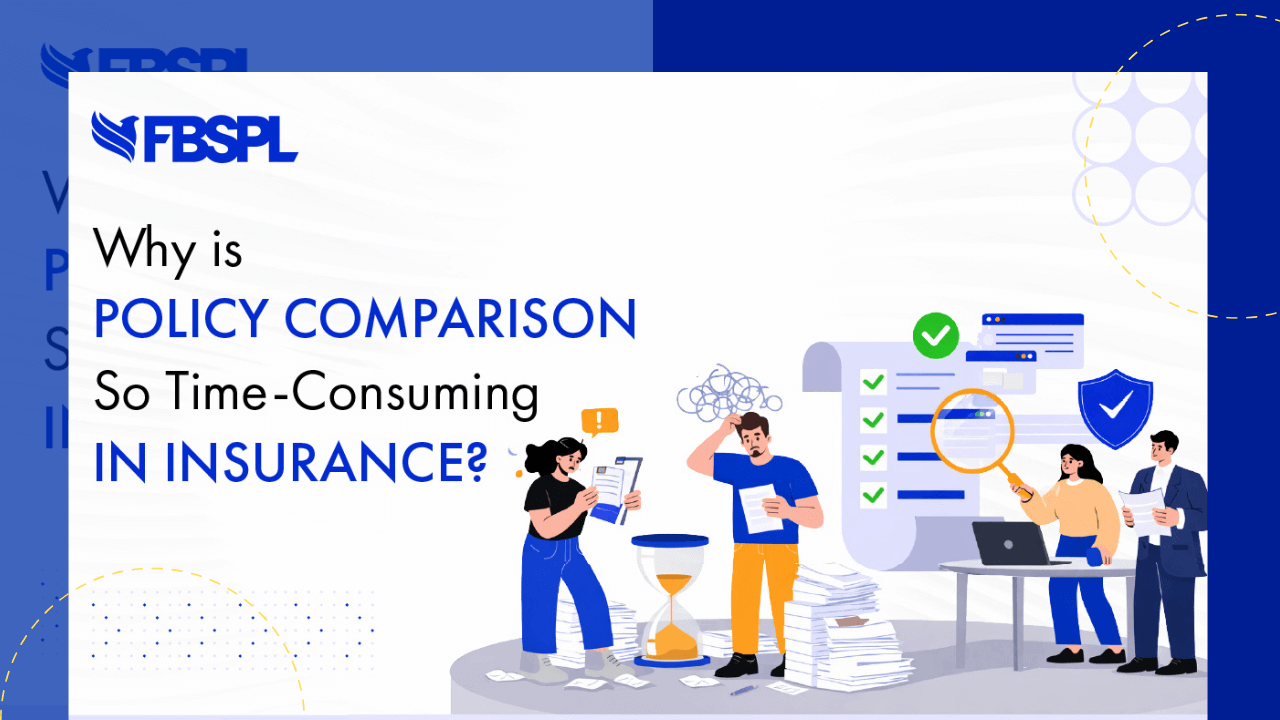
Why is policy comparison so time-consuming in insurance?
This article is a submission by Fusion Business Solution (P) Ltd.-FBSPL. Fusion Business Solution (P) Ltd. (FBSPL) is a Udaipur, India-based company providing Business Process Outsourcing, management, consulting, and IT services, with operations in New York, USA.
Have you ever wondered why something as straightforward as comparing two insurance policies can take so much time?
In theory, policy comparison should be simple: line up coverage details, check limits, confirm endorsements, and move forward.
But in reality, insurance professionals often spend 30 to 60 minutes per policy just reviewing documents. Multiply across renewals, endorsements, and new business, and the hours quickly add up.
The challenge isn’t a lack of expertise. It’s the volume, complexity, and format of insurance documents.
From binders and applications to quotes and ACORD forms, data lives in multiple places and rarely follows a single structure. That’s why even online insurance comparison processes often fall short when deeper policy-level checks are required.
In this post, we’ll break down why policy comparison is so time-consuming, explore the role of document processing and data extraction, and show how agencies can automate insurance policy comparison to transform their quoting process and policy review workflows.
What is policy comparison in insurance?
Policy comparison is the process of reviewing and matching insurance policy details across multiple documents to ensure accuracy, consistency, and completeness.
It verifies coverage terms, limits, deductibles, forms, endorsements, exclusions, and insured information across quotes, binders, applications, prior policies, and issued documents.
It plays a crucial role in:
- New business onboarding
- Policy issuance
- Renewals
- Endorsement processing
- E&O risk reduction
Despite its importance, it remains one of the most manual and time-intensive tasks in insurance operations.
Why is policy comparison so time-consuming?
At first glance, comparing two policies may seem like a simple side-by-side review. In reality, it involves digging through multiple documents, verifying scattered data points, and ensuring every detail aligns perfectly across forms, endorsements, and system records.
1. Information is scattered across multiple documents
A single commercial policy may involve:
- Application forms
- Binders
- Quotes from multiple carriers
- Prior policy documents
- Endorsements
- ACORD forms
Each document contains overlapping yet slightly different data. Reviewers must manually cross-check names, dates, coverage limits, classifications, and forms.
Even online insurance comparison tools often stop at premium and coverage summaries, leaving detailed verification to humans.
2. Insurance documents are largely unstructured
Insurance policies are not clean spreadsheets. They are:
- PDFs with dense legal language
- Scanned forms
- Multi-page endorsements
- Schedules buried deep in attachments
This makes document processing and data extraction difficult without automation. Humans must read line by line, increasing fatigue and the risk of oversight.
3. Every reviewer has a different method
Without a standardized checklist, policy comparison depends on individual experience. One team member may focus on limits, another on forms, another on named insured details.
This inconsistency leads to:
- Missed endorsements
- Incorrect limits
- Overlooked exclusions
Inconsistent reviews increase Errors & Omissions (E&O) exposure and rework.
4. Manual comparison slows the quoting process
The quoting process doesn’t end when a carrier sends a quote. Agencies must:
- Compare quote vs. application
- Compare quote vs. prior policy
- Confirm endorsements and forms
- Validate data before binding
These extra validation steps delay turnaround time, impacting both agents and clients.
5. High risk of human error
Humans are not built for repetitive, detail-heavy comparison. After reviewing multiple policies in a day:
- Attention drops
- Details blur together
- Small discrepancies go unnoticed
Industry studies suggest that manual data handling error rates can range from 1% to 5%, which is significant in high-volume insurance operations.
The hidden costs of slow policy comparison
Time-consuming policy comparison doesn’t just affect operations; it impacts the entire agency.
| Impact Area | How Delays Hurt |
| Operations | Backlogs build during renewals |
| Compliance | Higher E&O exposure from missed errors |
| Client Experience | Slower policy issuance and corrections |
| Team Morale | Staff burnout from repetitive reviews |
| Growth | More business requires more headcount |
Clearly, traditional online insurance comparison methods are not enough when agencies scale.
Why traditional online insurance comparison falls short
Most online insurance comparison platforms focus on:
- Premium differences
- Coverage highlights
- Basic feature comparisons
But they rarely perform deep, document-level validation. They don’t:
- Extract 900+ data points from raw documents
- Cross-check information across all files
- Compare policy data with agency management system (AMS) entries
This is where automated insurance policy comparison becomes critical.
Why agencies need to automate insurance policy comparison
As policy documents become longer and more complex, manual review processes struggle to keep pace. Agencies need ways to maintain accuracy and speed without overloading their teams.
Here’s why:
Document complexity is increasing
Modern insurance policies often include numerous endorsements, schedules, and layered coverages. Reviewing these manually requires navigating multiple document versions and formats.
Automation helps manage this complexity by organizing and structuring information for easier comparison.
Standardization improves consistency
Different reviewers often have different approaches. Automation introduces structured workflows that ensure every policy is reviewed using the same validation logic.
This reduces variability and improves overall quality control.
Data validation across systems is critical
Policy data doesn’t live in just one place; it exists in applications, quotes, binders, policies, and agency systems. Automated comparison tools can cross-check information across all sources, helping agencies catch discrepancies early in the quoting process and policy lifecycle.
Speed and accuracy must coexist
Agencies are under pressure to respond faster while maintaining compliance. Manual processes force a tradeoff between speed and thoroughness.
Automation helps deliver both by reducing manual workload while maintaining high validation standards.
How AI improves the quoting process and policy checks
AI removes the manual burden of reviewing dense policy documents by instantly extracting, comparing, and validating critical data points. This allows insurance teams to move faster, reduce errors, and make more confident decisions without getting stuck in repetitive document checks.
- Faster operations – Policies are validated quickly, reducing issuance delays and backlogs.
- Better compliance – Standardized policy comparison lowers E&O exposure.
- Improved client experience – Fewer corrections and faster turnaround build trust.
- Higher team efficiency – Staff move from paperwork to advisory and relationship tasks.
- Scalability without more hiring – Automation supports growing volumes without increasing headcount.
Benefits of automating policy comparison
Automation improves policy comparison across operations, compliance, and client service.
- Faster review cycles – Automated document processing and data extraction reduce the time needed to locate and validate information, easing bottlenecks during renewals and new business periods.
- Improved accuracy – System-driven validation helps catch mismatched limits, missing endorsements, and data inconsistencies; lowering compliance risks and E&O exposure.
- Consistent review standards – Automation applies the same rules to every file, improving quality control and reducing dependence on individual reviewer methods.
- Better use of staff time – With fewer repetitive checks, teams can focus on client communication, advisory work, and relationship-building.
- Scalable operations – As volumes grow, automated systems handle increased workloads without requiring proportional staff expansion.
As insurance documents become more complex and volumes continue to rise, relying solely on manual policy comparison is no longer sustainable.
Automation helps agencies work faster, reduce risk, and maintain consistency; creating a stronger operational foundation for growth while improving the overall client experience.
The future of policy comparison is automated
Traditional policy comparison is slow because insurance data is scattered, unstructured, and manually reviewed. While online insurance comparison tools help at a surface level, they don’t address deep document validation.
By combining document processing and data extraction with ai-driven validation, agencies can automate insurance policy comparison, speed up the quoting process, reduce errors, and improve client service.
As insurance operations grow more complex, automation is becoming less of an advantage and more of a necessity for agencies that want to scale efficiently while maintaining accuracy and compliance.






 Independent





