
5 web development strategies you should embrace in 2026


- A web development strategy provides a structured plan for building secure, scalable, and engaging websites that align with business objectives.
- Key strategies for 2026 include user-centric design, AI integration, security-first approaches, scalable architecture, and data-driven development.
- Effective strategies improve user experience, site performance, and adaptability, while reducing errors and maintenance costs.
- Partnering with dedicated offshore specialists through Outsourced Global accelerates projects, delivers high-quality solutions, and supports digital growth.
A web development strategy is a structured plan that guides how a business designs, builds, and maintains its website and digital applications.
It outlines essential elements, including the technology stack, coding standards, user experience design, performance optimization, and security protocols.
Ineffective strategies can lead to slow load times, frequent downtime, poor user engagement, and increased maintenance costs, ultimately affecting brand reputation and revenue. Without a clear roadmap, development teams risk misalignment, redundant work, and missed opportunities for innovation.
This article highlights seven essential web development strategies that businesses should adopt in 2026 to stay competitive, improve efficiency, and leverage top-tier talent.
Importance of having an effective web development strategy
A well-planned web development strategy provides a roadmap for building websites and digital platforms that perform efficiently, engage users, and support business objectives.
It helps organizations avoid costly mistakes, streamline workflows, and maintain consistency across projects:
Enhances first impressions
Web design shapes how users perceive a brand. According to Hostinger, 94% of all first impressions are influenced by web design. A clear strategy guides design decisions, ensuring websites look professional, align with brand identity, and capture visitor attention from the start.

Improves user experience
Effective strategies prioritize navigation, accessibility, and performance. Smooth user journeys increase engagement, reduce bounce rates, and encourage repeat visits.
Teams that plan interactions in advance can anticipate user needs and create intuitive interfaces that boost satisfaction.
Drives business growth
Web development is a significant segment of the IT services market. As per Statista’s report, it is projected to reach US$1.57 trillion by 2026, growing at a CAGR of 3.81%. Strong strategies support scalable platforms, integrate marketing and analytics tools, and enable faster launch of features, helping companies capture market opportunities and stay competitive.
Reduces costs and risks
Structured planning minimizes redundant coding, technical debt, and post-launch errors. Anticipating challenges during development lowers maintenance costs and avoids unexpected downtime, protecting brand reputation and long-term investments.
An effective web development strategy aligns design, technology, and business goals, forming the foundation for high-performing, scalable, and engaging digital platforms.
5 web development strategies to adapt in 2026
Websites are no longer just digital brochures, as they are interactive platforms that represent a brand, engage users, and drive business results.
Businesses that adopt forward-thinking web development strategies gain a competitive edge, improve user satisfaction, and reduce costly errors.
| Strategy | |
| User-centric (UX/UI) design | Create intuitive, accessible interfaces that simplify navigation |
| AI integration | Leverage AI tools to automate tasks, personalize experiences, and optimize performance |
| Security first | Implement updates, SSL, and secure coding to protect data and trust |
| Scalable architecture | Use scalable frameworks, microservices, and load balancers for growth |
| Data-driven development | Leverage analytics, heatmaps, and A/B testing for informed decisions |
The following strategies highlight key approaches companies should embrace in 2026:
1. User-centric (UX/UI) design
Focusing on the user experience improves engagement and retention. Navigation should allow users to reach important pages within three clicks. Consistent layouts, readable fonts, and accessible design elements make websites easier to use and more appealing.
Prioritizing UX/UI reduces frustration, increases conversions, and reinforces brand credibility.
2. AI integration
Artificial intelligence enhances web functionality and personalization. AI tools can automate repetitive tasks, provide predictive recommendations, and tailor content based on user behavior.
Integrating AI improves efficiency, increases engagement, and helps businesses deliver smarter, more adaptive digital experiences.
3. Security first
Cybersecurity remains a top priority. Regular software updates, SSL certificates, and secure coding practices protect sensitive data and maintain user trust. Security-focused strategies prevent breaches, preserve reputation, and comply with regulatory requirements.
4. Scalable architecture
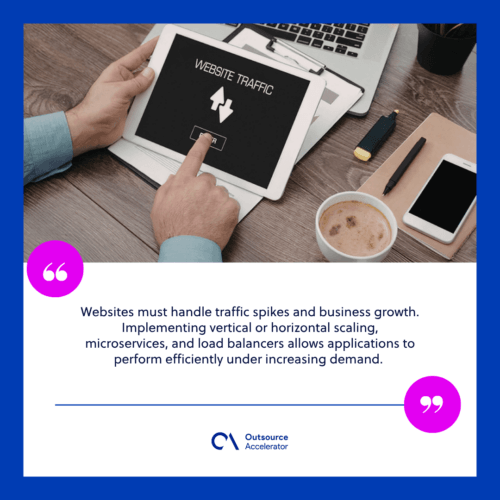
Websites must handle traffic spikes and business growth. Implementing vertical or horizontal scaling, microservices, and load balancers allows applications to perform efficiently under increasing demand. Scalable architecture reduces downtime, improves performance, and supports long-term expansion.
5. Data-driven development
Analytics and testing guide smarter development decisions. Tools like heatmaps and A/B testing provide insights into user behavior and content performance.
Data-driven approaches help prioritize improvements, refine features, and enhance the overall user experience, replacing guesswork with measurable results.
Adopting these strategies positions businesses for success in 2026, enabling secure, scalable, user-friendly websites optimized for performance and growth.
Best in-line IT and development specialists through Outsourced Global
Global businesses can accelerate web development projects by partnering with Outsourced Global. As a reputable third-party services company, it provides skilled IT and development specialists who integrate seamlessly into teams and deliver high-quality solutions.
Connect with Outsourced Global to access dedicated talent and drive digital growth!
Frequently Asked Questions (FAQs)
Many businesses have additional questions when planning web development projects. Here are answers to common concerns about strategy, talent, and implementation:
How long does it take to implement a full web development strategy?
Implementation depends on project complexity, team size, and technology stack. Small websites can take a few weeks, while large enterprise platforms may require several months, including design, coding, testing, and deployment.
Can offshore web development specialists maintain the same quality as in-house teams?
Offshore specialists from reputable providers like Outsourced Global follow industry standards, coding best practices, and collaborative workflows.
They integrate with existing teams, delivering high-quality code and meeting deadlines on par with in-house developers.
How often should a web development strategy be updated?
Web development strategies should be reviewed at least annually or after major business or technology changes. Frequent updates keep websites secure, optimize performance, and adapt to evolving user expectations and market trends.
Key takeaways
A strong web development strategy aligns technology, design, and business goals to create secure, scalable, and user-friendly websites. Adopting strategies like UX-focused design, AI integration, scalable architecture, and data-driven development helps businesses stay competitive.






 Independent





