
7 software development models: Which is best for you?

- Software development models provide structured frameworks that guide teams in planning, building, testing, and delivering software projects efficiently.
- Choosing the right model depends on factors such as project scope, timeline, budget, team size, and collaboration style.
- Businesses can accelerate development by partnering with offshore specialists like ConnectOS that align with the chosen development methodology.
Businesses rely on software that aligns closely with their operational needs and long-term goals. Purpose-built digital solutions streamline workflows, improve collaboration, and support faster innovation across teams.
Demand for these solutions continues to rise as companies accelerate digital transformation worldwide. According to Statista, revenue in the global software market is projected to grow at a steady annual rate of 4.67% between 2026 and 2030, reaching an estimated US$937.39 billion in market volume by 2030.
Rapid market expansion pushes organizations to plan development initiatives carefully and adopt structured approaches. Knowing different software development models helps decision-makers choose methods that align with project scope, timelines, and resources.
This article explores widely used models and how businesses can select the best approach for their projects.
How to choose among the software development models?
Software development models are structured methodologies that guide how teams plan, build, test, and maintain software products. Organizations should evaluate these factors before deciding which framework fits their project best:
- Client–developer collaboration model. Communication style between the vendor and the client influences workflow, reporting, and decision-making throughout the project lifecycle.
- Project goals and technical requirements. Purpose, complexity, and the intended application of the software shape the development strategy and influence which model works best.
- Target market or product focus. Software designed for B2B environments may require different planning and iteration processes compared to B2C products that demand rapid updates.
- Development stage. Some organizations begin with a detailed roadmap, while others prefer to collaborate with a development partner to refine requirements during the process.
- Delivery priorities. Some teams prioritize launching quickly and improving later, while others focus on building a fully defined product before release.
- Timeline expectations. Development speed and deadlines determine whether a structured or flexible methodology is more appropriate.
- Team size and project scale. Larger initiatives with multiple specialists often benefit from clearly structured models that organize tasks and responsibilities.
- Budget constraints. Early planning and design adjustments usually cost less than major changes during later development stages.
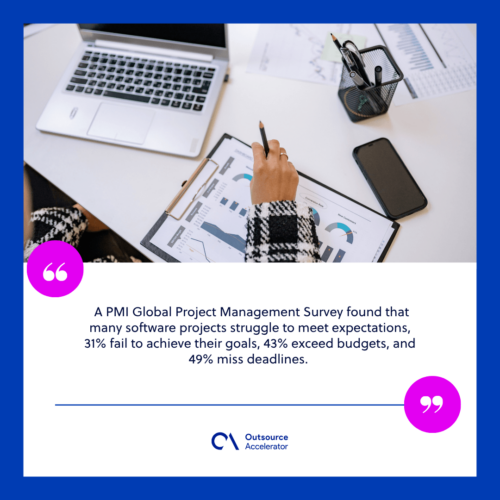
Selecting the right approach highly impacts project outcomes. A PMI Global Project Management Survey found that many software projects struggle to meet expectations, 31% fail to achieve their goals, 43% exceed budgets, and 49% miss deadlines.
Choosing a suitable development model helps reduce these risks and sets a realistic pace for execution and communication.
7 software development models to use for your projects
Software projects rarely follow a single path to completion. Different teams operate under varying timelines, budgets, and product goals, which makes a one-size-fits-all approach unrealistic.
Development models provide structured workflows that help teams organize tasks, manage risks, and deliver reliable software.
| Software development model | Advantage |
| Waterfall | Structured and predictable workflow |
| Agile | Flexibility and rapid iteration |
| Iterative | Continuous refinement |
| Spiral | Strong risk management |
| V-Model | Rigorous testing at every stage |
| DevOps | Faster deployment cycles |
| Rapid Application Development (RAD) | Accelerated prototyping |
Each method offers unique strengths, making it suitable for specific project environments:
1. Waterfall model
The Waterfall model follows a linear sequence of stages, such as planning, design, development, testing, and deployment. Teams complete each phase before moving to the next.
Clear documentation and defined milestones make this model ideal for projects that have stable requirements and minimal expected changes.
2. Agile model
Agile focuses on flexibility and collaboration. Development occurs in short cycles called sprints, allowing teams to release incremental improvements frequently.
Regular feedback from stakeholders helps refine the product as the project progresses. Organizations that operate in fast-changing markets often prefer this approach.
3. Iterative model
The Iterative model builds software through repeated cycles of development and evaluation. Teams release an initial version early, then add features or improvements through successive iterations. This method helps organizations adjust functionality based on user feedback.
4. Spiral model
The Spiral model combines structured development stages with detailed risk analysis. Software developer teams evaluate potential risks at each cycle before proceeding to the next phase. Complex projects that involve new technologies often benefit from this risk-focused strategy.
5. V-Model
The V-Model emphasizes testing and validation throughout development. Each design stage corresponds to a testing phase. Strong quality control makes this model suitable for industries that require strict compliance or reliability.
6. DevOps model
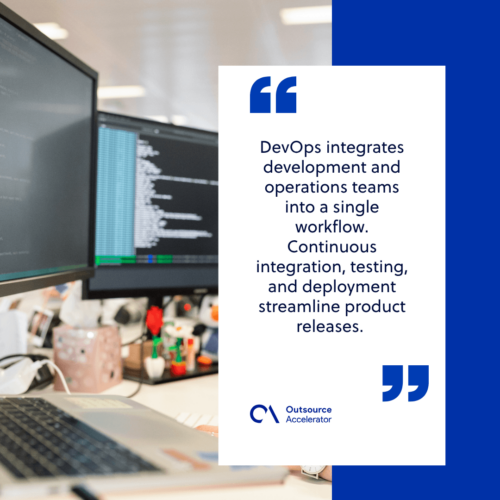
DevOps integrates development and operations teams into a single workflow. Continuous integration, testing, and deployment streamline product releases. Organizations that require frequent updates and stable infrastructure often adopt this approach.
7. Rapid Application Development (RAD)
RAD prioritizes speed through rapid prototyping and user feedback. Teams build functional prototypes quickly, refine them based on stakeholder input, and accelerate product launches. Businesses that want to release solutions quickly often choose this model.
High-performing offshore development specialists from ConnectOS
Access to skilled developers can transform how companies build and scale digital products. ConnectOS connects global businesses with seasoned offshore specialists through its Integrated Resourcing model.
ConnectOS manages recruitment, compliance, HR, and IT, allowing organizations to focus on innovation and long-term growth.
Frequently Asked Questions (FAQs)
This section addresses common questions businesses often ask when evaluating development frameworks for software projects:
Can a company switch software development models during a project?
Yes, teams can transition to another model if project requirements change. However, the shift may require workflow adjustments, updated timelines, and revised documentation. Careful planning helps maintain productivity and reduces disruption during the transition.
Do offshore development teams follow the same software development models?
Offshore teams commonly use the same industry-standard frameworks such as Agile, DevOps, and Waterfall. Experienced providers align their processes with the client’s preferred methodology, allowing seamless collaboration, consistent reporting, and efficient delivery.
Which software development model works best for startups?
Startups often prefer flexible approaches such as Agile or RAD because they support rapid iterations and quick product launches. Early releases allow founders to collect user feedback, refine features, and adjust product direction as market needs evolve.
Key takeaways
Software development models guide how teams plan, build, test, and deliver digital solutions while aligning workflows, timelines, and collaboration.
Careful evaluation of project goals, resources, and timelines helps businesses choose the model that supports efficient development and long-term product success.






 Independent





