
5 signs your in-house accounting team is at capacity and needs nearshore support


At a glance
- Accounting capacity problems show up as process breakdowns before they appear in a staffing report: close cycles lengthen, error rates climb, and senior staff absorb work that should belong to someone else.
- The underlying pressure is structural. Demand for accounting professionals is high and replacement hires take time, so a team that loses one person or absorbs new volume has nowhere to put the gap.
- Nearshore accounting support adds bandwidth for specific functions without requiring a full domestic recruitment cycle, letting the in-house team focus on work that needs judgment and business context.
- Connext provides dedicated nearshore accounting teams in Latin America covering bookkeeping, accounts payable and receivable, financial analysis, and controller functions, working in US time zones.
Most accounting teams don’t announce when they hit capacity. There’s no meeting where someone says the function is stretched. The signals come through the work itself.
The U.S. Bureau of Labor Statistics projects about 115,300 openings for accountants and auditors each year over the next decade. Most of those openings are replacements, not growth.
When a team loses someone or absorbs new volume, the available hiring pool moves slowly, and the gap stays open.
In-house teams absorb that gap quietly. They extend hours, skip checks, and defer the work that wasn’t deadline-driven. The team doesn’t fail visibly; it just runs at a lower level than it was designed for.
This article covers five operational signs that an in-house accounting team has reached its limit and when nearshore support is worth considering.
5 signs your in-house accounting team is at the limit
Identifying these signals early gives leadership time to respond, whether through a domestic hire, a nearshore accounting arrangement, or a combination of both. These are the five signs to look for.
| Sign | What it looks like |
|---|---|
| Month-end close taking longer | The cycle extends by days with no change in scope; the team has absorbed more than it was sized for |
| Senior staff doing clerical work | Controllers reconciling accounts, CPAs manually entering invoices |
| Error rates rising | Miscategorizations and posting errors appearing under higher volume as checking time shrinks |
| Growth blocked by headcount | Adding a client, entity, or reporting requirement requires a hire before accounting can absorb it |
| Overtime as the baseline | Extended hours during close are no longer seasonal; they are the default operating state |
1. Month-end close is consistently taking longer
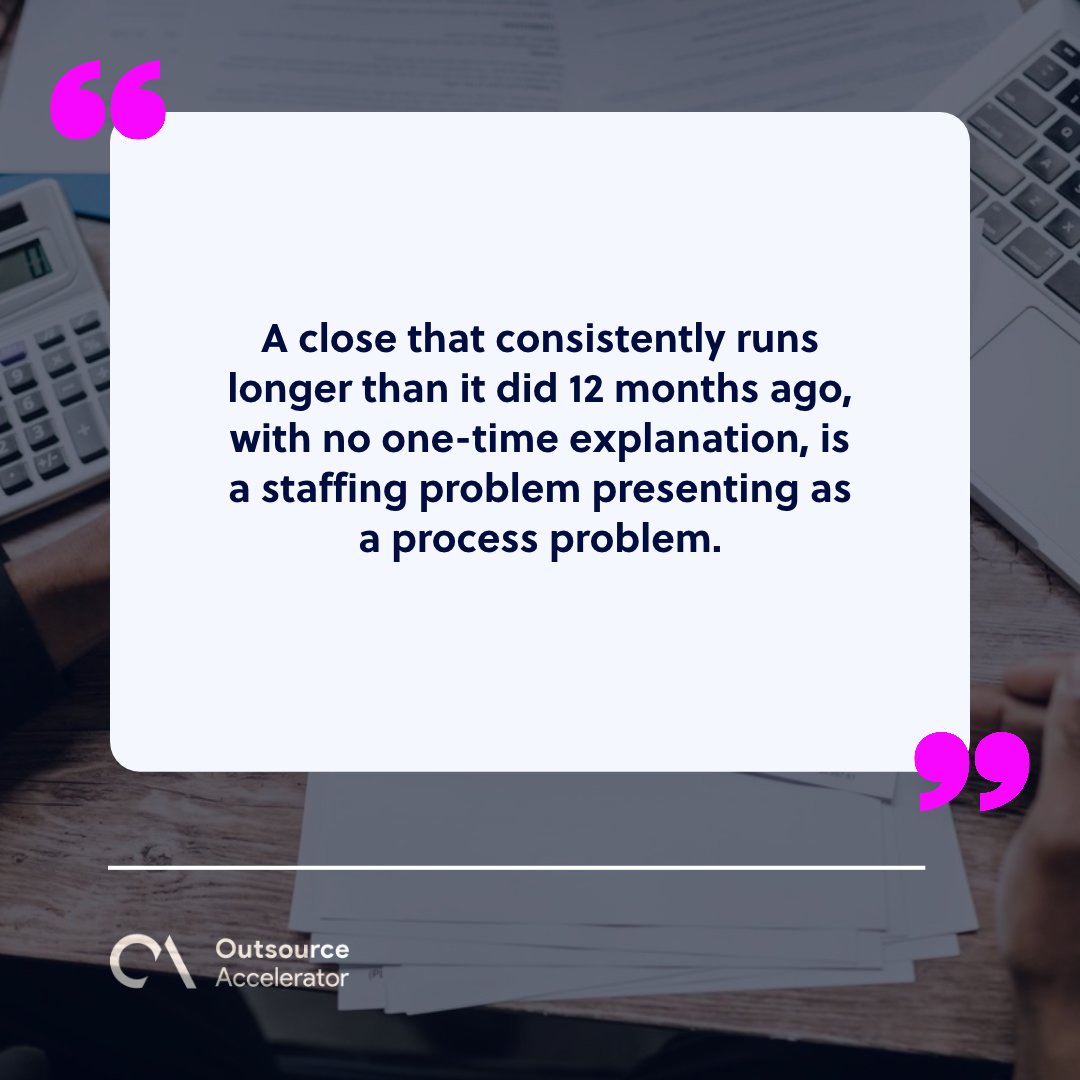
A close cycle that extends by a few days once is an anomaly. A close that consistently runs longer than it did 12 months ago, with no one-time explanation, is a staffing problem presenting as a process problem.
The team isn’t slower. It’s carrying more: more accounts, more entities, more reporting requirements, and the same number of people to handle them. When the cycle lengthens without a change in scope, the team has quietly absorbed more than it was sized for.
Pro Tip: Track average close time month over month, not just against target. A close that meets the stated deadline while taking 20% longer than it did six months ago is a leading indicator, not a success story.
2. Senior staff are doing work that junior roles should handle
When a controller is reconciling accounts or a CPA is manually entering invoices, the team doesn’t have a workflow problem. It has a staffing ratio problem.
Senior staff absorb lower-value tasks when there’s no one else to do them. That’s expensive in salary terms and means the analytical work that justifies their role gets pushed back or done under time pressure.
3. Error rates are rising without an obvious cause
A spike in miscategorizations, a period-end correction that shows up in the next close, an AR item posted to the wrong account: small errors like these often trace back to volume, not to a specific mistake or a training gap.
When a team is at capacity, the margin for checking work narrows. Quality checks get shortened. The error rate surfaces in the numbers before it shows up in performance reviews.
Scaling outsourced finance functions works best when targeted at high-volume transactional work. That takes the inputting burden off the in-house team, so they can focus on reviewing and catching errors rather than creating them.
4. You can’t take on more revenue without hiring first
If adding a new client, a new entity, or a new reporting requirement would require a headcount increase before the accounting team could absorb it, the function has become a ceiling on growth, not an enabler of it.
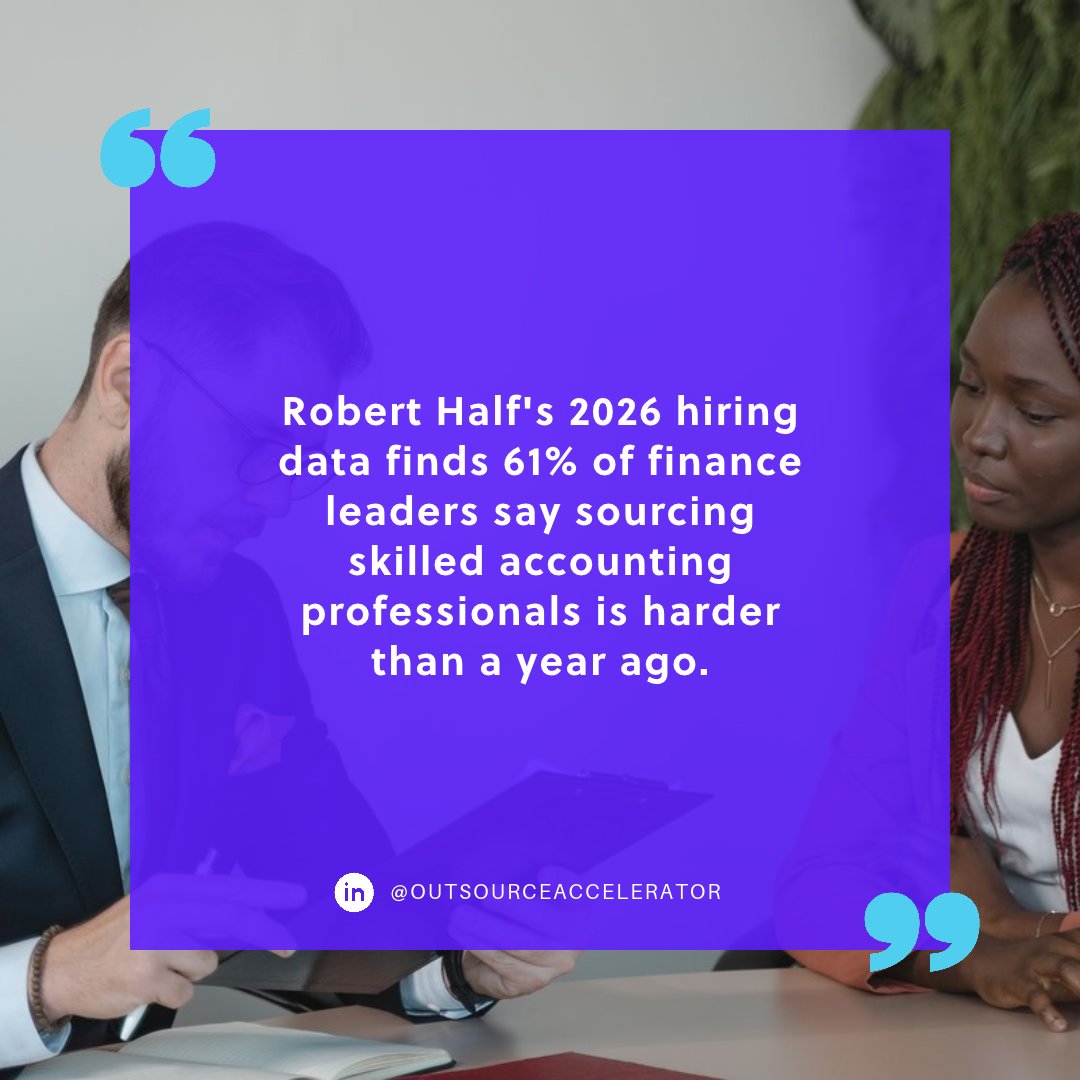
Robert Half’s 2026 hiring data finds 61% of finance leaders say sourcing skilled accounting professionals is harder than a year ago. When a qualified hire is months away and the team is already at the limit, the business loses the ability to move at the pace revenue opportunities require.
5. Overtime has become a standing expectation
Overtime at close or during tax season is a known feature of accounting work. Overtime as a consistent baseline, with no plan to hire into the gap and no defined end, is a different problem.
When extended hours stop being seasonal and become the default state, the team is absorbing volume beyond what it was sized for.
Burnout and turnover follow, and when a tenured team member leaves, the institutional knowledge they carry leaves with them. At that point, the gap is harder to fill than it would have been months earlier.
Pro Tip: Ask your accounting lead how much of the team’s current workload is recurring volume versus strategic or judgment-intensive work. If the answer is more than 60% recurring, there’s likely a function that could transfer to a nearshore team without losing continuity.
How does Connext provide nearshore accounting support?
Connext builds dedicated nearshore accounting teams in Latin America, with staff working in US time zones to support real-time collaboration with the in-house team. The model is designed for businesses that need accounting bandwidth without the domestic recruitment timeline or the transition costs of a full offshore arrangement.
Connext’s nearshore accounting support includes:
- Accounts payable and receivable: dedicated staff handling invoice processing, payment runs, collections, and AR aging reports, freeing the in-house team from high-volume transactional work
- Bookkeeping and reconciliations: full-cycle bookkeeping and bank reconciliations covering the volume work that tends to absorb senior staff time during and between close cycles
- Financial analysis support: analyst-level roles that handle variance analysis, management reporting, and data preparation under the direction of the in-house finance lead
- Controller-level functions: senior accounting staff for multi-entity businesses needing oversight across entities without the cost or lead time of a full-time domestic hire
- Industry coverage: accounting teams supporting professional services, healthcare, fintech, real estate, and distribution businesses, with workflows built around client systems and reporting requirements
Businesses that have identified one or more of these capacity signals can connect with Connext to discuss which functions are ready for nearshore support and what a typical onboarding timeline looks like.






 Independent






