
A comprehensive introduction to remote patient monitoring


What is remote patient monitoring?
Remote patient monitoring is a telehealth service that uses mobile devices to collect patient health data at home and send it to healthcare providers.
Remote patient monitoring lets clinicians track parts of a patient’s health from afar. So it saves time for both providers and patients. Here is what it makes possible:
- Patients manage chronic conditions from the comfort of home.
- Providers catch problems early with steady data.
- Clinics free up onsite resources for urgent cases.
This ability to monitor health remotely has grown fast as a telehealth option. As a result, more healthcare providers now rely on it every day.
What is remote patient monitoring (RPM)?
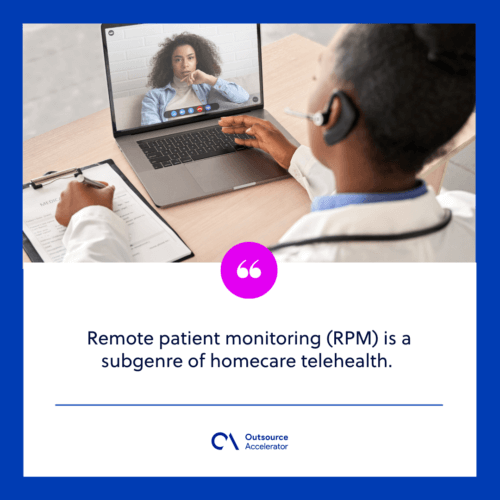
Remote patient monitoring (RPM) is a subgenre of homecare telehealth. So RPM representatives use mobile medical devices and technology to do the job.
Many offshoring firms like Staffwiz help providers add remote patient monitoring specialists. For example, efficient monitoring assistants collect and send patient-generated health data (PGHD) to providers. As a result, care teams stay informed without extra onsite visits. This is one reason healthcare outsourcing keeps growing.
RPM representatives often capture physiological data, such as:
- Vital signs
- Weight
- Blood pressure
- Heart rate
This data moves to a physician’s office through telehealth software. For example, it can run on a computer, smartphone, or tablet. So the methods differ based on the device or the condition being monitored.
Most RPM apps give patients and providers an interface to track and analyze data. In addition, they often share treatment suggestions. So a visit may follow once a clinician reviews the data or spots an issue.
Since many services are customizable now, Staffwiz offers a tailored solution for each client’s needs. As a result, teams get support that fits their exact workflow. Some clinics also pair RPM with a medical billing virtual assistant to keep paperwork moving.
RPM’s latest statistics and prediction
Here are some key statistics and forecasts tied to remote patient monitoring:
- As RPM gains ground, Insider Intelligence has estimated that about 70.6 million patients, or 26.2% of the US population, would use remote patient monitoring tools.
- Grand View Research forecasts the global RPM market will grow at a compound annual growth rate (CAGR) of 18.5%.
- Fortune Business Insights projects the global market for RPM devices will rise at a CAGR of 18.9% between 2021 and 2028.
With forecasts like these, it is no wonder providers keep turning to remote patient monitoring. As a result, it should lift the industry’s ROI. In addition, it cuts the costly expense of monitoring patient data onsite.
Significant benefits of remote patient monitoring
Staffwiz believes the work-from-home model has worked well for many businesses. For example, it helps them cut costs and lift efficiency. So it is no surprise that many practitioners now adopt remote patient monitoring too.
Let us look at some of the main benefits.
Increased patient engagement
RPM representatives give patients daily updates about their conditions. In addition, they educate patients and offer steady support. So patients feel more involved in their own care.
As noted earlier, RPM tools give patients an interface to track their records. As a result, these tools help people manage their current medical situations. So provider and patient relationships grow stronger through shared data.
Improved quality care
Patient data and consultations can now be accessed remotely. As a result, hospital resources go further for emergencies and severe cases. So onsite teams focus where they are needed most. Stronger patient care management often follows.
Adequate access to healthcare
RPM lets patients run basic health screenings on their own. So clinicians can treat more patients onsite. For example, people use the latest RPM tools to check key signs at home.
Better patient assurance and outcomes
Constant monitoring catches problems early. So patients feel confident that issues will be flagged in time. As a result, outcomes tend to improve.
Hire a remote patient monitoring representative from Staffwiz
With remote patient monitoring, providers can help more patients and improve results. In addition, they lower care costs and find new ways to earn.
Still, the right tools and trends are not enough on their own. For example, you also need a reliable support team. So you need an efficient outsourcing provider to strengthen your RPM process. A trusted healthcare BPO partner can fill that gap.
Staffwiz plays a big part in telehealth care. So it can help you recruit the best remote patient monitoring representative for your business. In fact, many clinics now add trained healthcare virtual assistants this way.
So all you need to do is book a call with Staffwiz today.
Frequently asked questions about remote patient monitoring
What conditions is remote patient monitoring best for?
RPM works well for chronic conditions that need steady tracking. For example, it suits diabetes, heart disease, and high blood pressure. So it helps patients manage daily health without frequent visits.
Is remote patient monitoring safe and private?
Yes, when providers use secure, compliant systems. For example, good RPM software encrypts patient data in transit. So teams must still follow local privacy rules at every step.
How is RPM different from general telehealth?
Telehealth covers all remote care, including video visits. RPM, however, focuses on collecting and sending health data from devices. So RPM is one specific part of the wider telehealth field.
Do patients need special equipment for RPM?
Usually, yes, but the setup is simple. For example, patients use connected devices like a blood pressure cuff or scale. So the data then flows to the provider through an app.
Why do healthcare providers outsource RPM staff?
Outsourcing gives quick access to trained specialists. In addition, it lowers hiring and overhead costs. So providers can scale their monitoring program without straining onsite teams.






 Independent






